

258 11 Mechanical Properties
latter are of importance. Simply speaking, dislocations are caused by additional
partial lattice planes in an otherwise perfect crystal. (More precisely, one has to
distinguish between edge and screw dislocations; however, this is a topic for a
specialized book.) During plastic deformation, dislocations may either glide or
climb dislocation gliding always occurs after an increase of the stress beyond the
yield stress, whereas dislocation climbing observed during creep deformation, is
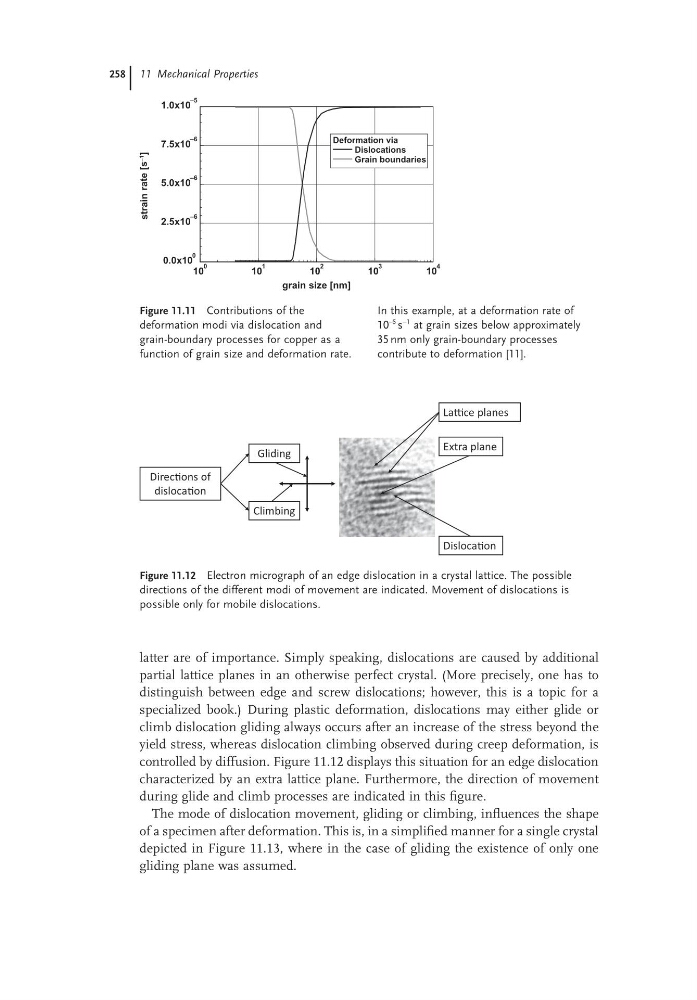
controlled by diffusion. Figure 11.12 displays this situation for an edge dislocation
characterized by an extra lattice plane. Furthermore, the direction of movement
during glide and climb processes are indicated in this figure.
The mode of dislocation movement, gliding or climbing, influences the shape
of a specimen after deformation. This is, in a simplified manner for a single crystal
depicted in Figure 11.13, where in the case of gliding the existence of only one
gliding plane was assumed.
Figure 11.11 Contributions of the
deformation modi via dislocation and
grain-boundary processes for copper as a
function of grain size and deformation rate.
In this example, at a deformation rate of
10
−5 s
−1 at grain sizes below approximately
35 nm only grain-boundary processes
contribute to deformation [11].
10
0
10
1
10
2
10
3
10
4
grain size [nm]
0.0x10
0
2.5x10
–6
5.0x10
–6
7.5x10
–6
1.0x10
–5
strain
rate
[s
–1
]
Deformation via
Dislocations
Grain boundaries
Figure 11.12 Electron micrograph of an edge dislocation in a crystal lattice. The possible
directions of the different modi of movement are indicated. Movement of dislocations is
possible only for mobile dislocations.
Laƫce planes
Extra plane
DislocaƟon
Gliding
Climbing
DirecƟons of
dislocaƟon
latter are of importance. Simply speaking, dislocations are caused by additional
partial lattice planes in an otherwise perfect crystal. (More precisely, one has to
distinguish between edge and screw dislocations; however, this is a topic for a
specialized book.) During plastic deformation, dislocations may either glide or
climb dislocation gliding always occurs after an increase of the stress beyond the
yield stress, whereas dislocation climbing observed during creep deformation, is
controlled by diffusion. Figure 11.12 displays this situation for an edge dislocation
characterized by an extra lattice plane. Furthermore, the direction of movement
during glide and climb processes are indicated in this figure.
The mode of dislocation movement, gliding or climbing, influences the shape
of a specimen after deformation. This is, in a simplified manner for a single crystal
depicted in Figure 11.13, where in the case of gliding the existence of only one
gliding plane was assumed.
Figure 11.11 Contributions of the
deformation modi via dislocation and
grain-boundary processes for copper as a
function of grain size and deformation rate.
In this example, at a deformation rate of
10
−5 s
−1 at grain sizes below approximately
35 nm only grain-boundary processes
contribute to deformation [11].
10
0
10
1
10
2
10
3
10
4
grain size [nm]
0.0x10
0
2.5x10
–6
5.0x10
–6
7.5x10
–6
1.0x10
–5
strain
rate
[s
–1
]
Deformation via
Dislocations
Grain boundaries
Figure 11.12 Electron micrograph of an edge dislocation in a crystal lattice. The possible
directions of the different modi of movement are indicated. Movement of dislocations is
possible only for mobile dislocations.
Laƫce planes
Extra plane
DislocaƟon
Gliding
Climbing
DirecƟons of
dislocaƟon