

10.4 Electrical Conductivity of Nanocomposites 241
The current–voltage plot displayed in Figure 10.15 shows for the DNA molecule
with a length of 5 nm distinct steps. Certainly, these steps are, due to noise,
blurred. Therefore, for better visibility, the possible scattering ranges of the data
are marked by shaded areas. It is obvious that the 10-nm DNA molecules no longer
exhibit these characteristic steps, at least as distinct as for the shorter one.
10.4
Electrical Conductivity of Nanocomposites
Besides potential use as new electronic elements, the most important application
of one- and two-dimensional electric conductors are as fillers in polymers to
produce electrically conductive nanocomposites. The great specialty of these nanocomposites is their optical transparency. In other words: these nanocomposites
have the potential to replace ITO (indium-tin-oxide) coatings, which are nowadays
the means to obtain transparent electrical conductive coating applied in screens
for TV sets, computer displays, etc. Potentially, these nanocomposites have the
advantage of being elastic bendable and printable, even on soft screens. In contrast, ITO layers are produced by sputtering processes, a quite expensive production route, and are brittle. Therefore, ITO layers are restricted to stiff substrates
only. A comparison of the spectral optical transmission of nanotube–polymer
composites or graphene with ITO is given in Chapter 5.
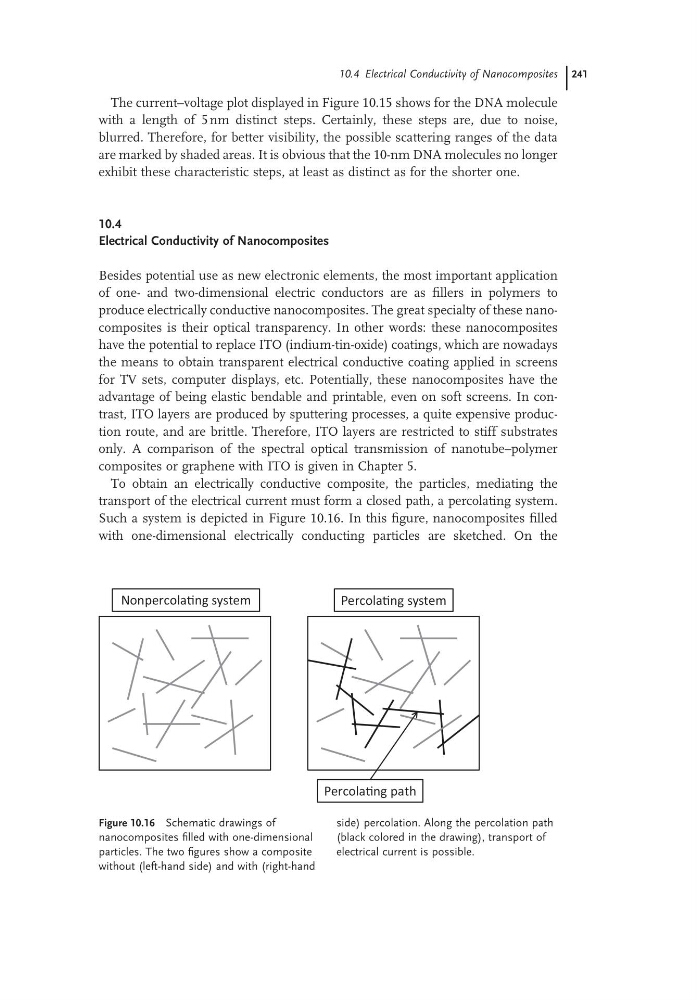
To obtain an electrically conductive composite, the particles, mediating the
transport of the electrical current must form a closed path, a percolating system.
Such a system is depicted in Figure 10.16. In this figure, nanocomposites filled
with one-dimensional electrically conducting particles are sketched. On the
Figure 10.16 Schematic drawings of
nanocomposites filled with one-dimensional
particles. The two figures show a composite
without (left-hand side) and with (right-hand
side) percolation. Along the percolation path
(black colored in the drawing), transport of
electrical current is possible.
PercolaƟng path
NonpercolaƟng system
PercolaƟng system
The current–voltage plot displayed in Figure 10.15 shows for the DNA molecule
with a length of 5 nm distinct steps. Certainly, these steps are, due to noise,
blurred. Therefore, for better visibility, the possible scattering ranges of the data
are marked by shaded areas. It is obvious that the 10-nm DNA molecules no longer
exhibit these characteristic steps, at least as distinct as for the shorter one.
10.4
Electrical Conductivity of Nanocomposites
Besides potential use as new electronic elements, the most important application
of one- and two-dimensional electric conductors are as fillers in polymers to
produce electrically conductive nanocomposites. The great specialty of these nanocomposites is their optical transparency. In other words: these nanocomposites
have the potential to replace ITO (indium-tin-oxide) coatings, which are nowadays
the means to obtain transparent electrical conductive coating applied in screens
for TV sets, computer displays, etc. Potentially, these nanocomposites have the
advantage of being elastic bendable and printable, even on soft screens. In contrast, ITO layers are produced by sputtering processes, a quite expensive production route, and are brittle. Therefore, ITO layers are restricted to stiff substrates
only. A comparison of the spectral optical transmission of nanotube–polymer
composites or graphene with ITO is given in Chapter 5.
To obtain an electrically conductive composite, the particles, mediating the
transport of the electrical current must form a closed path, a percolating system.
Such a system is depicted in Figure 10.16. In this figure, nanocomposites filled
with one-dimensional electrically conducting particles are sketched. On the
Figure 10.16 Schematic drawings of
nanocomposites filled with one-dimensional
particles. The two figures show a composite
without (left-hand side) and with (right-hand
side) percolation. Along the percolation path
(black colored in the drawing), transport of
electrical current is possible.
PercolaƟng path
NonpercolaƟng system
PercolaƟng system