

10.1 Fundamentals of Electric Conductivity; Diffusive versus Ballistic Conductivity 233
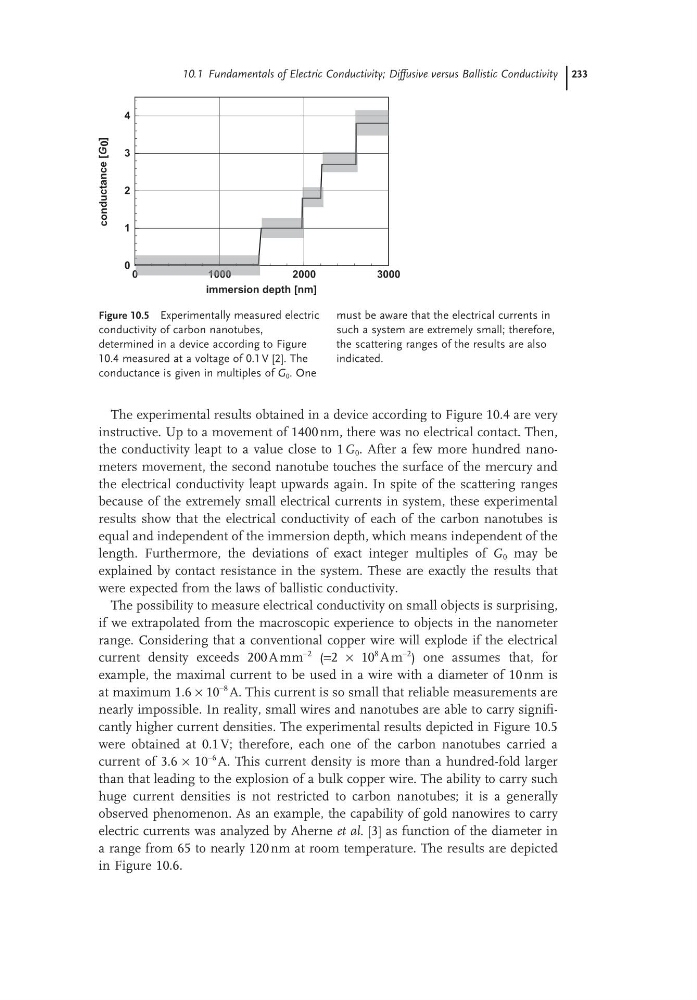
The experimental results obtained in a device according to Figure 10.4 are very
instructive. Up to a movement of 1400 nm, there was no electrical contact. Then,
the conductivity leapt to a value close to 1 G 0 . After a few more hundred nanometers movement, the second nanotube touches the surface of the mercury and
the electrical conductivity leapt upwards again. In spite of the scattering ranges
because of the extremely small electrical currents in system, these experimental
results show that the electrical conductivity of each of the carbon nanotubes is
equal and independent of the immersion depth, which means independent of the
length. Furthermore, the deviations of exact integer multiples of G 0 may be
explained by contact resistance in the system. These are exactly the results that
were expected from the laws of ballistic conductivity.
The possibility to measure electrical conductivity on small objects is surprising,
if we extrapolated from the macroscopic experience to objects in the nanometer
range. Considering that a conventional copper wire will explode if the electrical
current density exceeds 200 A mm
−2 (=2 × 10
8 A m
−2 ) one assumes that, for
example, the maximal current to be used in a wire with a diameter of 10 nm is
at maximum 1.6 × 10
−8 A. This current is so small that reliable measurements are
nearly impossible. In reality, small wires and nanotubes are able to carry significantly higher current densities. The experimental results depicted in Figure 10.5
were obtained at 0.1 V; therefore, each one of the carbon nanotubes carried a
current of 3.6 × 10
−6 A. This current density is more than a hundred-fold larger
than that leading to the explosion of a bulk copper wire. The ability to carry such
huge current densities is not restricted to carbon nanotubes; it is a generally
observed phenomenon. As an example, the capability of gold nanowires to carry
electric currents was analyzed by Aherne et al. [3] as function of the diameter in
a range from 65 to nearly 120 nm at room temperature. The results are depicted
in Figure 10.6.
Figure 10.5 Experimentally measured electric
conductivity of carbon nanotubes,
determined in a device according to Figure
10.4 measured at a voltage of 0.1 V [2]. The
conductance is given in multiples of G 0 . One
must be aware that the electrical currents in
such a system are extremely small; therefore,
the scattering ranges of the results are also
indicated.
0
1000
2000
3000
immersion depth [nm]
0
1
2
3
4
G
[
e
c
n
a
t
c
u
d
n
o
c 0
]
0
1000
The experimental results obtained in a device according to Figure 10.4 are very
instructive. Up to a movement of 1400 nm, there was no electrical contact. Then,
the conductivity leapt to a value close to 1 G 0 . After a few more hundred nanometers movement, the second nanotube touches the surface of the mercury and
the electrical conductivity leapt upwards again. In spite of the scattering ranges
because of the extremely small electrical currents in system, these experimental
results show that the electrical conductivity of each of the carbon nanotubes is
equal and independent of the immersion depth, which means independent of the
length. Furthermore, the deviations of exact integer multiples of G 0 may be
explained by contact resistance in the system. These are exactly the results that
were expected from the laws of ballistic conductivity.
The possibility to measure electrical conductivity on small objects is surprising,
if we extrapolated from the macroscopic experience to objects in the nanometer
range. Considering that a conventional copper wire will explode if the electrical
current density exceeds 200 A mm
−2 (=2 × 10
8 A m
−2 ) one assumes that, for
example, the maximal current to be used in a wire with a diameter of 10 nm is
at maximum 1.6 × 10
−8 A. This current is so small that reliable measurements are
nearly impossible. In reality, small wires and nanotubes are able to carry significantly higher current densities. The experimental results depicted in Figure 10.5
were obtained at 0.1 V; therefore, each one of the carbon nanotubes carried a
current of 3.6 × 10
−6 A. This current density is more than a hundred-fold larger
than that leading to the explosion of a bulk copper wire. The ability to carry such
huge current densities is not restricted to carbon nanotubes; it is a generally
observed phenomenon. As an example, the capability of gold nanowires to carry
electric currents was analyzed by Aherne et al. [3] as function of the diameter in
a range from 65 to nearly 120 nm at room temperature. The results are depicted
in Figure 10.6.
Figure 10.5 Experimentally measured electric
conductivity of carbon nanotubes,
determined in a device according to Figure
10.4 measured at a voltage of 0.1 V [2]. The
conductance is given in multiples of G 0 . One
must be aware that the electrical currents in
such a system are extremely small; therefore,
the scattering ranges of the results are also
indicated.
0
1000
2000
3000
immersion depth [nm]
0
1
2
3
4
G
[
e
c
n
a
t
c
u
d
n
o
c 0
]
0
1000