

9.9 Photochromic and Electrochromic Materials 219
9.9
Photochromic and Electrochromic Materials
9.9.1
General Considerations
Photochromic materials change their color under the influence of light, electrochromic materials do so under the influence of an electrical field. The changes in
color are reversible. Generally, photochromic materials are white or colorless in
the dark; and in sunlight or ultraviolet radiation they change color. The intensity
of coloration is a function of light intensity. After removing the light source, the
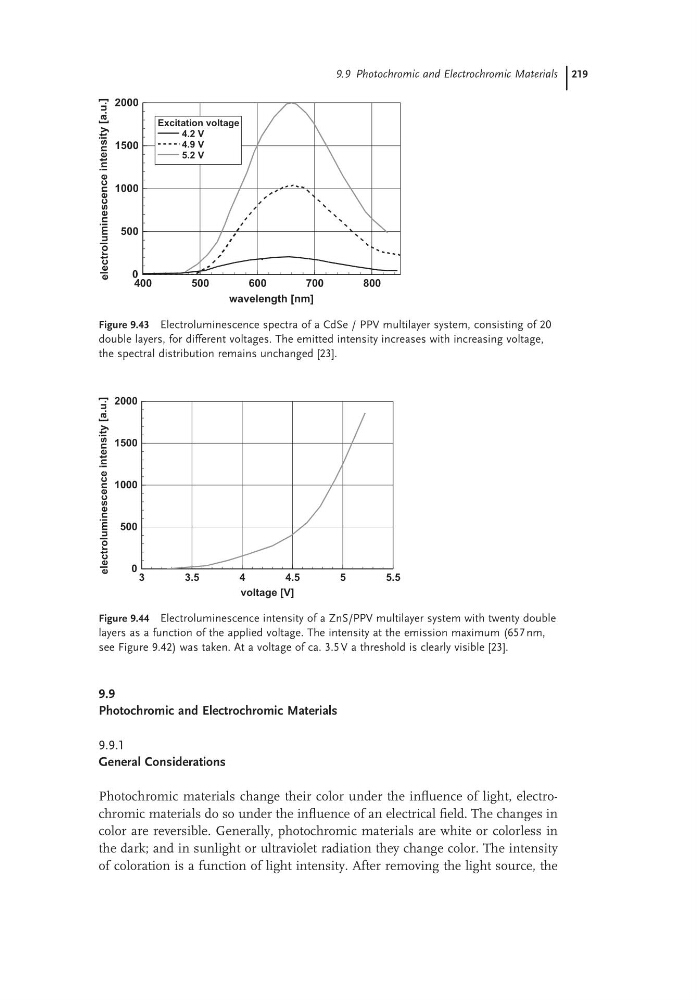
Figure 9.43 Electroluminescence spectra of a CdSe / PPV multilayer system, consisting of 20
double layers, for different voltages. The emitted intensity increases with increasing voltage,
the spectral distribution remains unchanged [23].
400
500
600
700
800
wavelength [nm]
0
500
1000
1500
2000
electroluminescence
intensity
[a.u.]
Excitation voltage
4.2 V
4.9 V
5.2 V
Figure 9.44 Electroluminescence intensity of a ZnS/PPV multilayer system with twenty double
layers as a function of the applied voltage. The intensity at the emission maximum (657 nm,
see Figure 9.42) was taken. At a voltage of ca. 3.5 V a threshold is clearly visible [23].
3
3.5
4
4.5
5
5.5
voltage [V]
0
500
1000
1500
2000
electroluminescence
intensity
[a.u.]
9.9
Photochromic and Electrochromic Materials
9.9.1
General Considerations
Photochromic materials change their color under the influence of light, electrochromic materials do so under the influence of an electrical field. The changes in
color are reversible. Generally, photochromic materials are white or colorless in
the dark; and in sunlight or ultraviolet radiation they change color. The intensity
of coloration is a function of light intensity. After removing the light source, the
Figure 9.43 Electroluminescence spectra of a CdSe / PPV multilayer system, consisting of 20
double layers, for different voltages. The emitted intensity increases with increasing voltage,
the spectral distribution remains unchanged [23].
400
500
600
700
800
wavelength [nm]
0
500
1000
1500
2000
electroluminescence
intensity
[a.u.]
Excitation voltage
4.2 V
4.9 V
5.2 V
Figure 9.44 Electroluminescence intensity of a ZnS/PPV multilayer system with twenty double
layers as a function of the applied voltage. The intensity at the emission maximum (657 nm,
see Figure 9.42) was taken. At a voltage of ca. 3.5 V a threshold is clearly visible [23].
3
3.5
4
4.5
5
5.5
voltage [V]
0
500
1000
1500
2000
electroluminescence
intensity
[a.u.]