

218 9 Optical Properties
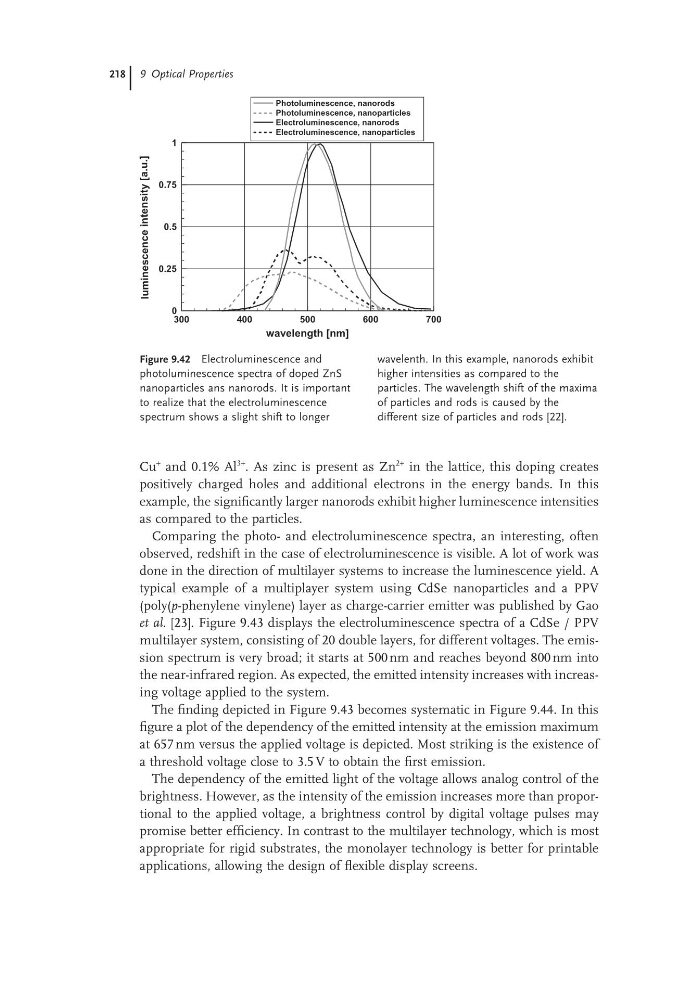
Figure 9.42 Electroluminescence and
photoluminescence spectra of doped ZnS
nanoparticles ans nanorods. It is important
to realize that the electroluminescence
spectrum shows a slight shift to longer
wavelenth. In this example, nanorods exhibit
higher intensities as compared to the
particles. The wavelength shift of the maxima
of particles and rods is caused by the
different size of particles and rods [22].
300
400
500
600
700
wavelength [nm]
0
0.25
0.5
0.75
1
luminescence
intensity
[a.u.]
Photoluminescence, nanorods
Photoluminescence, nanoparticles
Electroluminescence, nanorods
Electroluminescence, nanoparticles
Cu
+ and 0.1% Al
3+
. As zinc is present as Zn
2+ in the lattice, this doping creates
positively charged holes and additional electrons in the energy bands. In this
example, the significantly larger nanorods exhibit higher luminescence intensities
as compared to the particles.
Comparing the photo- and electroluminescence spectra, an interesting, often
observed, redshift in the case of electroluminescence is visible. A lot of work was
done in the direction of multilayer systems to increase the luminescence yield. A
typical example of a multiplayer system using CdSe nanoparticles and a PPV
(poly(p-phenylene vinylene) layer as charge-carrier emitter was published by Gao
et al. [23]. Figure 9.43 displays the electroluminescence spectra of a CdSe / PPV
multilayer system, consisting of 20 double layers, for different voltages. The emission spectrum is very broad; it starts at 500 nm and reaches beyond 800 nm into
the near-infrared region. As expected, the emitted intensity increases with increasing voltage applied to the system.
The finding depicted in Figure 9.43 becomes systematic in Figure 9.44. In this
figure a plot of the dependency of the emitted intensity at the emission maximum
at 657 nm versus the applied voltage is depicted. Most striking is the existence of
a threshold voltage close to 3.5 V to obtain the first emission.
The dependency of the emitted light of the voltage allows analog control of the
brightness. However, as the intensity of the emission increases more than proportional to the applied voltage, a brightness control by digital voltage pulses may
promise better efficiency. In contrast to the multilayer technology, which is most
appropriate for rigid substrates, the monolayer technology is better for printable
applications, allowing the design of flexible display screens.
Figure 9.42 Electroluminescence and
photoluminescence spectra of doped ZnS
nanoparticles ans nanorods. It is important
to realize that the electroluminescence
spectrum shows a slight shift to longer
wavelenth. In this example, nanorods exhibit
higher intensities as compared to the
particles. The wavelength shift of the maxima
of particles and rods is caused by the
different size of particles and rods [22].
300
400
500
600
700
wavelength [nm]
0
0.25
0.5
0.75
1
luminescence
intensity
[a.u.]
Photoluminescence, nanorods
Photoluminescence, nanoparticles
Electroluminescence, nanorods
Electroluminescence, nanoparticles
Cu
+ and 0.1% Al
3+
. As zinc is present as Zn
2+ in the lattice, this doping creates
positively charged holes and additional electrons in the energy bands. In this
example, the significantly larger nanorods exhibit higher luminescence intensities
as compared to the particles.
Comparing the photo- and electroluminescence spectra, an interesting, often
observed, redshift in the case of electroluminescence is visible. A lot of work was
done in the direction of multilayer systems to increase the luminescence yield. A
typical example of a multiplayer system using CdSe nanoparticles and a PPV
(poly(p-phenylene vinylene) layer as charge-carrier emitter was published by Gao
et al. [23]. Figure 9.43 displays the electroluminescence spectra of a CdSe / PPV
multilayer system, consisting of 20 double layers, for different voltages. The emission spectrum is very broad; it starts at 500 nm and reaches beyond 800 nm into
the near-infrared region. As expected, the emitted intensity increases with increasing voltage applied to the system.
The finding depicted in Figure 9.43 becomes systematic in Figure 9.44. In this
figure a plot of the dependency of the emitted intensity at the emission maximum
at 657 nm versus the applied voltage is depicted. Most striking is the existence of
a threshold voltage close to 3.5 V to obtain the first emission.
The dependency of the emitted light of the voltage allows analog control of the
brightness. However, as the intensity of the emission increases more than proportional to the applied voltage, a brightness control by digital voltage pulses may
promise better efficiency. In contrast to the multilayer technology, which is most
appropriate for rigid substrates, the monolayer technology is better for printable
applications, allowing the design of flexible display screens.