

9.5 Metallic Nanoparticles – Plasmon Resonance 197
9.5
Metallic Nanoparticles – Plasmon Resonance
Metallic nanoparticles are surrounded by a cloud of free electrons stemming from
the incompletely filled conduction band. This electron cloud moves in quantized
discrete waves around the particle. The quantized oscillations of the electron cloud,
relative to the lattice of the positively charged atomic cores of the metal, are called
“plasmons”. The plasmons control the optical appearance of the metals. As most
of the metals have plasmon frequencies in the ultraviolet, they have a “metallic
luster” in the visible range. A few metals, like copper and gold and a few alloys,
have plasmon frequencies in the visible range. This is the reason for their typical
color. Highly doped semiconductors show plasmon frequencies in the infrared;
therefore, they often appear black.
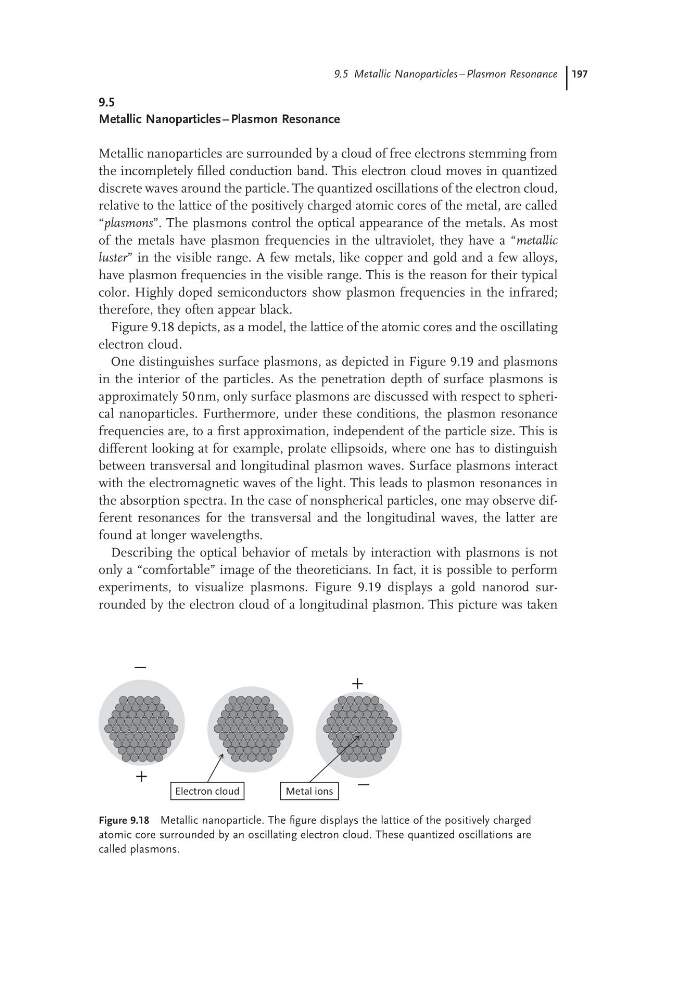
Figure 9.18 depicts, as a model, the lattice of the atomic cores and the oscillating
electron cloud.
One distinguishes surface plasmons, as depicted in Figure 9.19 and plasmons
in the interior of the particles. As the penetration depth of surface plasmons is
approximately 50 nm, only surface plasmons are discussed with respect to spherical nanoparticles. Furthermore, under these conditions, the plasmon resonance
frequencies are, to a first approximation, independent of the particle size. This is
different looking at for example, prolate ellipsoids, where one has to distinguish
between transversal and longitudinal plasmon waves. Surface plasmons interact
with the electromagnetic waves of the light. This leads to plasmon resonances in
the absorption spectra. In the case of nonspherical particles, one may observe different resonances for the transversal and the longitudinal waves, the latter are
found at longer wavelengths.
Describing the optical behavior of metals by interaction with plasmons is not
only a “comfortable” image of the theoreticians. In fact, it is possible to perform
experiments, to visualize plasmons. Figure 9.19 displays a gold nanorod surrounded by the electron cloud of a longitudinal plasmon. This picture was taken
Figure 9.18 Metallic nanoparticle. The figure displays the lattice of the positively charged
atomic core surrounded by an oscillating electron cloud. These quantized oscillations are
called plasmons.
_
_
+
+
Electron cloud
Metal ions
9.5
Metallic Nanoparticles – Plasmon Resonance
Metallic nanoparticles are surrounded by a cloud of free electrons stemming from
the incompletely filled conduction band. This electron cloud moves in quantized
discrete waves around the particle. The quantized oscillations of the electron cloud,
relative to the lattice of the positively charged atomic cores of the metal, are called
“plasmons”. The plasmons control the optical appearance of the metals. As most
of the metals have plasmon frequencies in the ultraviolet, they have a “metallic
luster” in the visible range. A few metals, like copper and gold and a few alloys,
have plasmon frequencies in the visible range. This is the reason for their typical
color. Highly doped semiconductors show plasmon frequencies in the infrared;
therefore, they often appear black.
Figure 9.18 depicts, as a model, the lattice of the atomic cores and the oscillating
electron cloud.
One distinguishes surface plasmons, as depicted in Figure 9.19 and plasmons
in the interior of the particles. As the penetration depth of surface plasmons is
approximately 50 nm, only surface plasmons are discussed with respect to spherical nanoparticles. Furthermore, under these conditions, the plasmon resonance
frequencies are, to a first approximation, independent of the particle size. This is
different looking at for example, prolate ellipsoids, where one has to distinguish
between transversal and longitudinal plasmon waves. Surface plasmons interact
with the electromagnetic waves of the light. This leads to plasmon resonances in
the absorption spectra. In the case of nonspherical particles, one may observe different resonances for the transversal and the longitudinal waves, the latter are
found at longer wavelengths.
Describing the optical behavior of metals by interaction with plasmons is not
only a “comfortable” image of the theoreticians. In fact, it is possible to perform
experiments, to visualize plasmons. Figure 9.19 displays a gold nanorod surrounded by the electron cloud of a longitudinal plasmon. This picture was taken
Figure 9.18 Metallic nanoparticle. The figure displays the lattice of the positively charged
atomic core surrounded by an oscillating electron cloud. These quantized oscillations are
called plasmons.
_
_
+
+
Electron cloud
Metal ions