

9.4 Semiconducting Particles in the Quantum-Confinement Range 189
size. This results in a blueshift of the absorption and emission spectrum with
decreasing particle size. The energy difference ΔE between two quantum levels
n and n + 1 describes the energy of an emitted photon.
∆E
h
ml
n
n
n
h
ml
mcl
n
=
+
(
) −
=
+
(
)
=
+
2
2
2
2
2
2
2
8
1
2 1
8
8
2 1
leading to λ (
)h h
. (9.9)
Equation (9.9) clearly shows the blueshift with decreasing size l of the box,
which is equivalent to the particle diameter d, or, the wavelength of the emitted
photon increases quadratically with the particle diameter d. One has to bear in
mind that blueshift is not only observed in the quantum-confinement case (see
also Eq. (9.5)).
9.4
Semiconducting Particles in the Quantum-Confinement Range
Sufficiently small semiconducting nanoparticles show the properties of quantumconfinement systems. The width of the energy gap and, therefore, the wavelength
of the emitted photons depends on the particle size. This allows particle size to be
used as a design element for absorbers and emitters of light. This has an important
advantage: Varying particle size of a nanoparticle allows optical properties to be
varied without changing the chemistry of the surface. This possibility is of special
importance for functionalizing the particles for applications, for example, in the
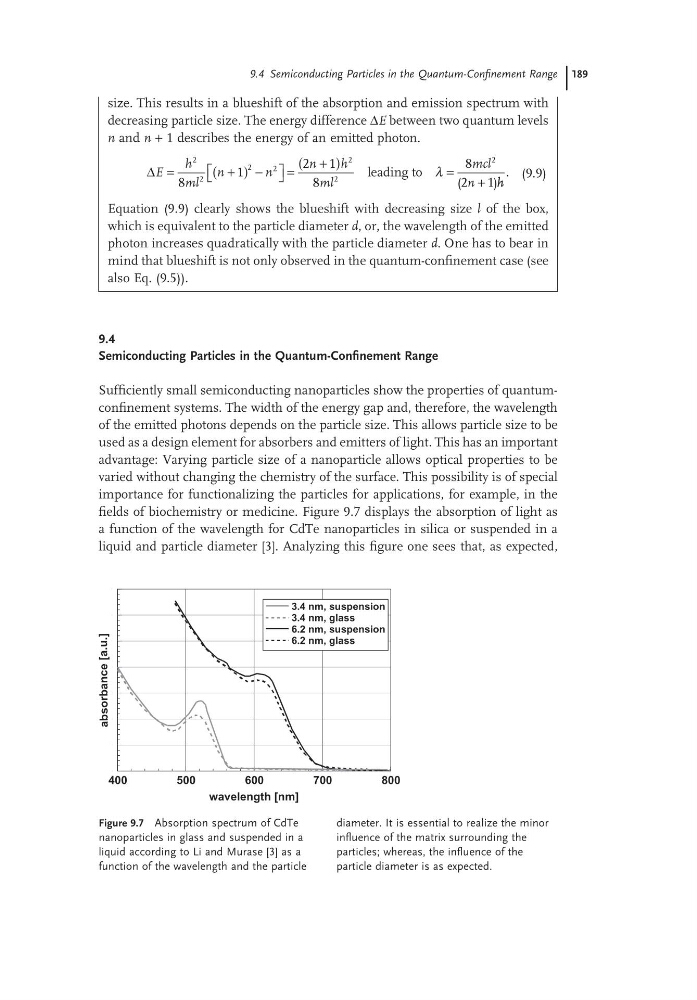
fields of biochemistry or medicine. Figure 9.7 displays the absorption of light as
a function of the wavelength for CdTe nanoparticles in silica or suspended in a
liquid and particle diameter [3]. Analyzing this figure one sees that, as expected,
Figure 9.7 Absorption spectrum of CdTe
nanoparticles in glass and suspended in a
liquid according to Li and Murase [3] as a
function of the wavelength and the particle
diameter. It is essential to realize the minor
influence of the matrix surrounding the
particles; whereas, the influence of the
particle diameter is as expected.
400
500
600
700
800
wavelength [nm]
0
2
4
6
8
10
12
14
absorbance
[a.u.]
3.4 nm, suspension
3.4 nm, glass
6.2 nm, suspension
6.2 nm, glass
size. This results in a blueshift of the absorption and emission spectrum with
decreasing particle size. The energy difference ΔE between two quantum levels
n and n + 1 describes the energy of an emitted photon.
∆E
h
ml
n
n
n
h
ml
mcl
n
=
+
(
) −
=
+
(
)
=
+
2
2
2
2
2
2
2
8
1
2 1
8
8
2 1
leading to λ (
)h h
. (9.9)
Equation (9.9) clearly shows the blueshift with decreasing size l of the box,
which is equivalent to the particle diameter d, or, the wavelength of the emitted
photon increases quadratically with the particle diameter d. One has to bear in
mind that blueshift is not only observed in the quantum-confinement case (see
also Eq. (9.5)).
9.4
Semiconducting Particles in the Quantum-Confinement Range
Sufficiently small semiconducting nanoparticles show the properties of quantumconfinement systems. The width of the energy gap and, therefore, the wavelength
of the emitted photons depends on the particle size. This allows particle size to be
used as a design element for absorbers and emitters of light. This has an important
advantage: Varying particle size of a nanoparticle allows optical properties to be
varied without changing the chemistry of the surface. This possibility is of special
importance for functionalizing the particles for applications, for example, in the
fields of biochemistry or medicine. Figure 9.7 displays the absorption of light as
a function of the wavelength for CdTe nanoparticles in silica or suspended in a
liquid and particle diameter [3]. Analyzing this figure one sees that, as expected,
Figure 9.7 Absorption spectrum of CdTe
nanoparticles in glass and suspended in a
liquid according to Li and Murase [3] as a
function of the wavelength and the particle
diameter. It is essential to realize the minor
influence of the matrix surrounding the
particles; whereas, the influence of the
particle diameter is as expected.
400
500
600
700
800
wavelength [nm]
0
2
4
6
8
10
12
14
absorbance
[a.u.]
3.4 nm, suspension
3.4 nm, glass
6.2 nm, suspension
6.2 nm, glass