

172 8 Magnetic Nanomaterials, Superparamagnetism
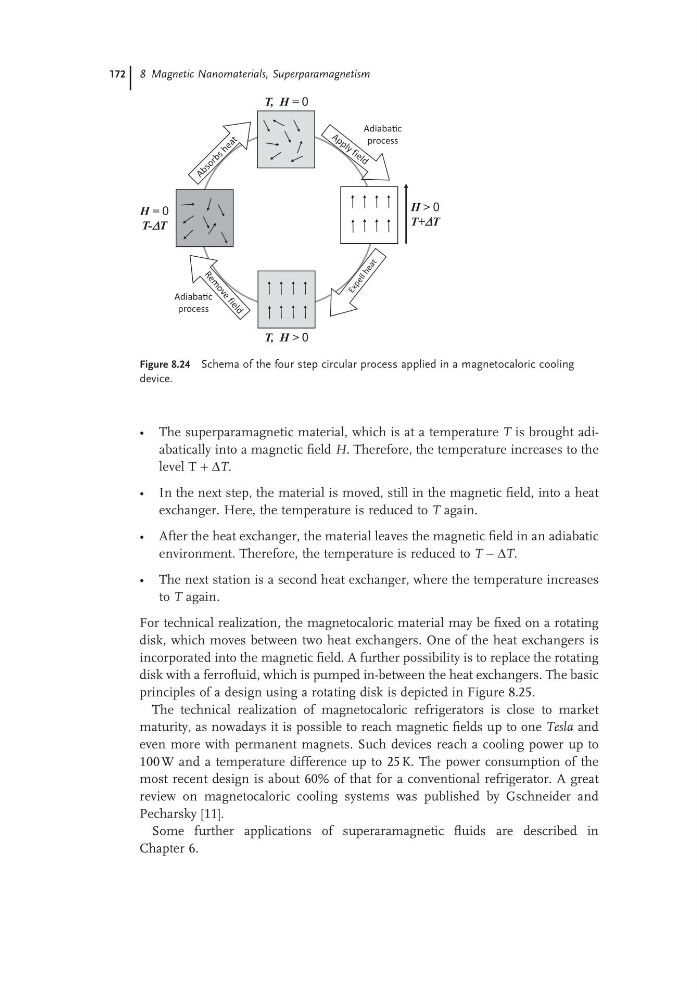
• The superparamagnetic material, which is at a temperature T is brought adiabatically into a magnetic field H. Therefore, the temperature increases to the
level T + ΔT.
• In the next step, the material is moved, still in the magnetic field, into a heat
exchanger. Here, the temperature is reduced to T again.
• After the heat exchanger, the material leaves the magnetic field in an adiabatic
environment. Therefore, the temperature is reduced to T − ΔT.
• The next station is a second heat exchanger, where the temperature increases
to T again.
For technical realization, the magnetocaloric material may be fixed on a rotating
disk, which moves between two heat exchangers. One of the heat exchangers is
incorporated into the magnetic field. A further possibility is to replace the rotating
disk with a ferrofluid, which is pumped inbetween the heat exchangers. The basic
principles of a design using a rotating disk is depicted in Figure 8.25.
The technical realization of magnetocaloric refrigerators is close to market
maturity, as nowadays it is possible to reach magnetic fields up to one Tesla and
even more with permanent magnets. Such devices reach a cooling power up to
100 W and a temperature difference up to 25 K. The power consumption of the
most recent design is about 60% of that for a conventional refrigerator. A great
review on magnetocaloric cooling systems was published by Gschneider and
Pecharsky [11].
Some further applications of superaramagnetic fluids are described in
Chapter 6.
Figure 8.24 Schema of the four step circular process applied in a magnetocaloric cooling
device.
AdiabaƟc
process
AdiabaƟc
process
H = 0
T-∆T
H > 0
T+∆T
T, H > 0
T, H = 0
• The superparamagnetic material, which is at a temperature T is brought adiabatically into a magnetic field H. Therefore, the temperature increases to the
level T + ΔT.
• In the next step, the material is moved, still in the magnetic field, into a heat
exchanger. Here, the temperature is reduced to T again.
• After the heat exchanger, the material leaves the magnetic field in an adiabatic
environment. Therefore, the temperature is reduced to T − ΔT.
• The next station is a second heat exchanger, where the temperature increases
to T again.
For technical realization, the magnetocaloric material may be fixed on a rotating
disk, which moves between two heat exchangers. One of the heat exchangers is
incorporated into the magnetic field. A further possibility is to replace the rotating
disk with a ferrofluid, which is pumped inbetween the heat exchangers. The basic
principles of a design using a rotating disk is depicted in Figure 8.25.
The technical realization of magnetocaloric refrigerators is close to market
maturity, as nowadays it is possible to reach magnetic fields up to one Tesla and
even more with permanent magnets. Such devices reach a cooling power up to
100 W and a temperature difference up to 25 K. The power consumption of the
most recent design is about 60% of that for a conventional refrigerator. A great
review on magnetocaloric cooling systems was published by Gschneider and
Pecharsky [11].
Some further applications of superaramagnetic fluids are described in
Chapter 6.
Figure 8.24 Schema of the four step circular process applied in a magnetocaloric cooling
device.
AdiabaƟc
process
AdiabaƟc
process
H = 0
T-∆T
H > 0
T+∆T
T, H > 0
T, H = 0