

164 8 Magnetic Nanomaterials, Superparamagnetism
if a material is superparamagnetic. This method was found to be the Mößbauer
effect of
57 Fe.
The Mößbauer effect applies the resonant absorption of γquanta in the iron
nucleus. Using this effect, one measures the influence of the chemical bonding
and external magnetic fields on the energy levels of a nucleus. In its elementary
form a Mößbauer experiment uses the decay of
57
Co that leads to
57 Fe in an exited
state, which emits, besides others, a γphoton with energy of 14.4 keV. The natural
line width of this emission is 10
−8 eV. The emitter and the absorber are fixed in a
solid; therefore, the photons do not lose energy by recoil phenomena, as would be
observed, for example, in a gas. (In a gas, the energy of the emitted quanta would
be altered by ca. 10
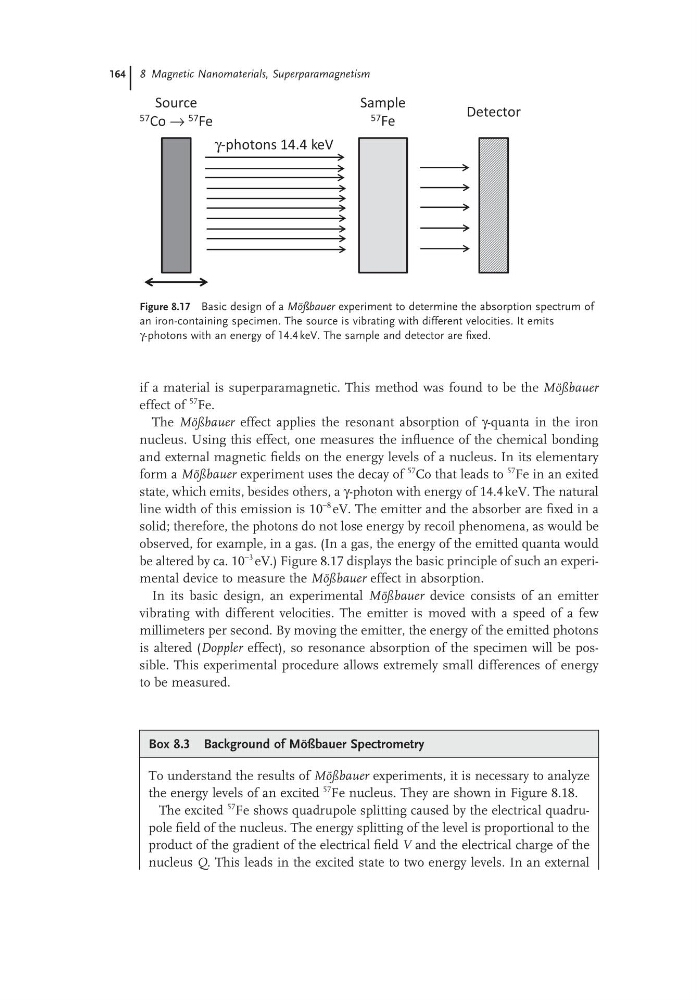
−3 eV.) Figure 8.17 displays the basic principle of such an experimental device to measure the Mößbauer effect in absorption.
In its basic design, an experimental Mößbauer device consists of an emitter
vibrating with different velocities. The emitter is moved with a speed of a few
millimeters per second. By moving the emitter, the energy of the emitted photons
is altered (Doppler effect), so resonance absorption of the specimen will be possible. This experimental procedure allows extremely small differences of energy
to be measured.
Figure 8.17 Basic design of a Mößbauer experiment to determine the absorption spectrum of
an iron-containing specimen. The source is vibrating with different velocities. It emits
γ-photons with an energy of 14.4 keV. The sample and detector are fixed.
Source
57 Co → 57 Fe
Sample
57 Fe
Detector
γ-photons 14.4 keV
Box 8.3 Background of Mößbauer Spectrometry
To understand the results of Mößbauer experiments, it is necessary to analyze
the energy levels of an excited
57 Fe nucleus. They are shown in Figure 8.18.
The excited
57
Fe shows quadrupole splitting caused by the electrical quadrupole field of the nucleus. The energy splitting of the level is proportional to the
product of the gradient of the electrical field V and the electrical charge of the
nucleus Q. This leads in the excited state to two energy levels. In an external
if a material is superparamagnetic. This method was found to be the Mößbauer
effect of
57 Fe.
The Mößbauer effect applies the resonant absorption of γquanta in the iron
nucleus. Using this effect, one measures the influence of the chemical bonding
and external magnetic fields on the energy levels of a nucleus. In its elementary
form a Mößbauer experiment uses the decay of
57
Co that leads to
57 Fe in an exited
state, which emits, besides others, a γphoton with energy of 14.4 keV. The natural
line width of this emission is 10
−8 eV. The emitter and the absorber are fixed in a
solid; therefore, the photons do not lose energy by recoil phenomena, as would be
observed, for example, in a gas. (In a gas, the energy of the emitted quanta would
be altered by ca. 10
−3 eV.) Figure 8.17 displays the basic principle of such an experimental device to measure the Mößbauer effect in absorption.
In its basic design, an experimental Mößbauer device consists of an emitter
vibrating with different velocities. The emitter is moved with a speed of a few
millimeters per second. By moving the emitter, the energy of the emitted photons
is altered (Doppler effect), so resonance absorption of the specimen will be possible. This experimental procedure allows extremely small differences of energy
to be measured.
Figure 8.17 Basic design of a Mößbauer experiment to determine the absorption spectrum of
an iron-containing specimen. The source is vibrating with different velocities. It emits
γ-photons with an energy of 14.4 keV. The sample and detector are fixed.
Source
57 Co → 57 Fe
Sample
57 Fe
Detector
γ-photons 14.4 keV
Box 8.3 Background of Mößbauer Spectrometry
To understand the results of Mößbauer experiments, it is necessary to analyze
the energy levels of an excited
57 Fe nucleus. They are shown in Figure 8.18.
The excited
57
Fe shows quadrupole splitting caused by the electrical quadrupole field of the nucleus. The energy splitting of the level is proportional to the
product of the gradient of the electrical field V and the electrical charge of the
nucleus Q. This leads in the excited state to two energy levels. In an external