

8.4 Superparamagnetic Particles in the Mößbauer Spectrum 163
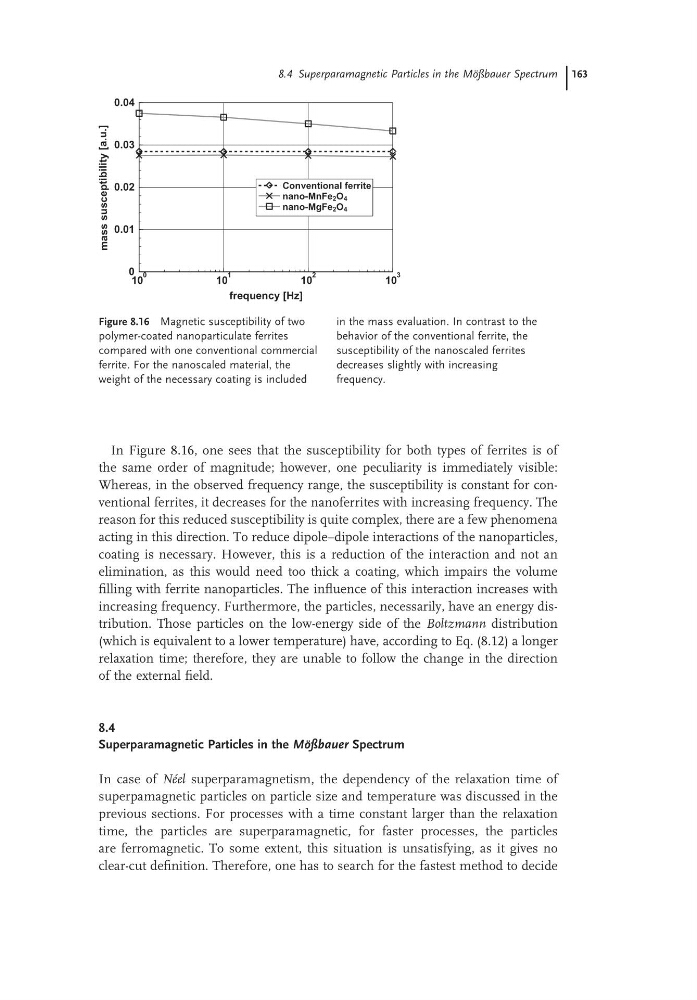
In Figure 8.16, one sees that the susceptibility for both types of ferrites is of
the same order of magnitude; however, one peculiarity is immediately visible:
Whereas, in the observed frequency range, the susceptibility is constant for conventional ferrites, it decreases for the nanoferrites with increasing frequency. The
reason for this reduced susceptibility is quite complex, there are a few phenomena
acting in this direction. To reduce dipole–dipole interactions of the nanoparticles,
coating is necessary. However, this is a reduction of the interaction and not an
elimination, as this would need too thick a coating, which impairs the volume
filling with ferrite nanoparticles. The influence of this interaction increases with
increasing frequency. Furthermore, the particles, necessarily, have an energy distribution. Those particles on the lowenergy side of the Boltzmann distribution
(which is equivalent to a lower temperature) have, according to Eq. (8.12) a longer
relaxation time; therefore, they are unable to follow the change in the direction
of the external field.
8.4
Superparamagnetic Particles in the Mößbauer Spectrum
In case of Néel superparamagnetism, the dependency of the relaxation time of
superpamagnetic particles on particle size and temperature was discussed in the
previous sections. For processes with a time constant larger than the relaxation
time, the particles are superparamagnetic, for faster processes, the particles
are ferromagnetic. To some extent, this situation is unsatisfying, as it gives no
clearcut definition. Therefore, one has to search for the fastest method to decide
Figure 8.16 Magnetic susceptibility of two
polymer-coated nanoparticulate ferrites
compared with one conventional commercial
ferrite. For the nanoscaled material, the
weight of the necessary coating is included
in the mass evaluation. In contrast to the
behavior of the conventional ferrite, the
susceptibility of the nanoscaled ferrites
decreases slightly with increasing
frequency.
10
0
10
1
10
2
10
3
frequency [Hz]
0
0.01
0.02
0.03
0.04
mass
susceptibility
[a.u.]
Conventional ferrite
nano-MnFe2O4
nano-MgFe2O4
In Figure 8.16, one sees that the susceptibility for both types of ferrites is of
the same order of magnitude; however, one peculiarity is immediately visible:
Whereas, in the observed frequency range, the susceptibility is constant for conventional ferrites, it decreases for the nanoferrites with increasing frequency. The
reason for this reduced susceptibility is quite complex, there are a few phenomena
acting in this direction. To reduce dipole–dipole interactions of the nanoparticles,
coating is necessary. However, this is a reduction of the interaction and not an
elimination, as this would need too thick a coating, which impairs the volume
filling with ferrite nanoparticles. The influence of this interaction increases with
increasing frequency. Furthermore, the particles, necessarily, have an energy distribution. Those particles on the lowenergy side of the Boltzmann distribution
(which is equivalent to a lower temperature) have, according to Eq. (8.12) a longer
relaxation time; therefore, they are unable to follow the change in the direction
of the external field.
8.4
Superparamagnetic Particles in the Mößbauer Spectrum
In case of Néel superparamagnetism, the dependency of the relaxation time of
superpamagnetic particles on particle size and temperature was discussed in the
previous sections. For processes with a time constant larger than the relaxation
time, the particles are superparamagnetic, for faster processes, the particles
are ferromagnetic. To some extent, this situation is unsatisfying, as it gives no
clearcut definition. Therefore, one has to search for the fastest method to decide
Figure 8.16 Magnetic susceptibility of two
polymer-coated nanoparticulate ferrites
compared with one conventional commercial
ferrite. For the nanoscaled material, the
weight of the necessary coating is included
in the mass evaluation. In contrast to the
behavior of the conventional ferrite, the
susceptibility of the nanoscaled ferrites
decreases slightly with increasing
frequency.
10
0
10
1
10
2
10
3
frequency [Hz]
0
0.01
0.02
0.03
0.04
mass
susceptibility
[a.u.]
Conventional ferrite
nano-MnFe2O4
nano-MgFe2O4