

8.2 Fundamentals of Superparamagnetism 161
sizes, into account, one may say that the thickness of the nonmagnetic surface
layer is in the range of a little less than 1 nm. It is interesting to realize that the
thickness of this surface layer is exactly one lattice constant. Looking at larger
particles, say 100 nm, the influence of this thin surface layer is no longer
measurable.
With respect to applications, the existence of this surface layer has severe
consequences: for example, assuming a size of the magnetic particles of 5 nm,
the 1nm surface layer takes 80% of the particle volume, with the consequence
that the saturation magnetization is reduced to 20% of the bulk value. This
reduces the use of magnetic nanoparticles in applications demanding high
magnetization.
Antiferromagnetism is possible because of a two antiparallel oriented, mutually
compensating magnetic sublattices. For complete compensation of the magnetic
moments of the two sublattices, perfect ordering is necessary. How do antiferromagnetic nanoparticles behave? Also in this case, one expects reduced order in
the regions near to the surface. Reduced perfection of the magnetic sublattices
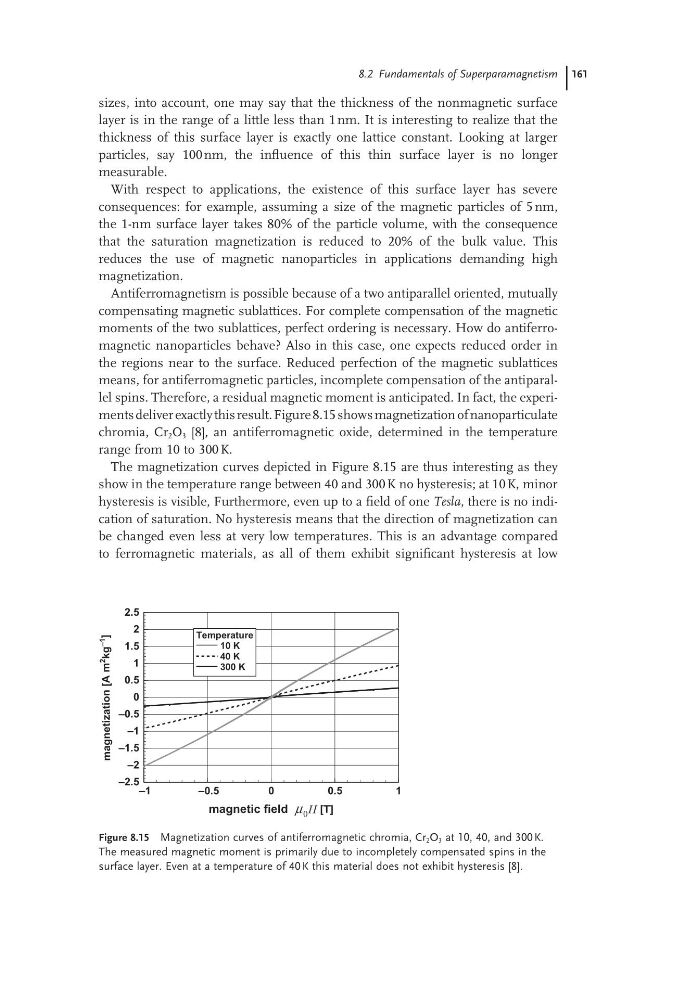
means, for antiferromagnetic particles, incomplete compensation of the antiparallel spins. Therefore, a residual magnetic moment is anticipated. In fact, the experiments deliver exactly this result. Figure 8.15 shows magnetization of nanoparticulate
chromia, Cr 2 O 3 [8], an antiferromagnetic oxide, determined in the temperature
range from 10 to 300 K.
The magnetization curves depicted in Figure 8.15 are thus interesting as they
show in the temperature range between 40 and 300 K no hysteresis; at 10 K, minor
hysteresis is visible, Furthermore, even up to a field of one Tesla, there is no indication of saturation. No hysteresis means that the direction of magnetization can
be changed even less at very low temperatures. This is an advantage compared
to ferromagnetic materials, as all of them exhibit significant hysteresis at low
Figure 8.15 Magnetization curves of antiferromagnetic chromia, Cr 2 O 3 at 10, 40, and 300 K.
The measured magnetic moment is primarily due to incompletely compensated spins in the
surface layer. Even at a temperature of 40 K this material does not exhibit hysteresis [8].
–1
–0.5
0
0.5
1
magnetic field µ 0 H [T]
–2.5
–2
–1.5
–1
–0.5
0
0.5
1
1.5
2
2.5
magnetization
[A
m
2
kg
–1
]
Temperature
10 K
40 K
300 K
sizes, into account, one may say that the thickness of the nonmagnetic surface
layer is in the range of a little less than 1 nm. It is interesting to realize that the
thickness of this surface layer is exactly one lattice constant. Looking at larger
particles, say 100 nm, the influence of this thin surface layer is no longer
measurable.
With respect to applications, the existence of this surface layer has severe
consequences: for example, assuming a size of the magnetic particles of 5 nm,
the 1nm surface layer takes 80% of the particle volume, with the consequence
that the saturation magnetization is reduced to 20% of the bulk value. This
reduces the use of magnetic nanoparticles in applications demanding high
magnetization.
Antiferromagnetism is possible because of a two antiparallel oriented, mutually
compensating magnetic sublattices. For complete compensation of the magnetic
moments of the two sublattices, perfect ordering is necessary. How do antiferromagnetic nanoparticles behave? Also in this case, one expects reduced order in
the regions near to the surface. Reduced perfection of the magnetic sublattices
means, for antiferromagnetic particles, incomplete compensation of the antiparallel spins. Therefore, a residual magnetic moment is anticipated. In fact, the experiments deliver exactly this result. Figure 8.15 shows magnetization of nanoparticulate
chromia, Cr 2 O 3 [8], an antiferromagnetic oxide, determined in the temperature
range from 10 to 300 K.
The magnetization curves depicted in Figure 8.15 are thus interesting as they
show in the temperature range between 40 and 300 K no hysteresis; at 10 K, minor
hysteresis is visible, Furthermore, even up to a field of one Tesla, there is no indication of saturation. No hysteresis means that the direction of magnetization can
be changed even less at very low temperatures. This is an advantage compared
to ferromagnetic materials, as all of them exhibit significant hysteresis at low
Figure 8.15 Magnetization curves of antiferromagnetic chromia, Cr 2 O 3 at 10, 40, and 300 K.
The measured magnetic moment is primarily due to incompletely compensated spins in the
surface layer. Even at a temperature of 40 K this material does not exhibit hysteresis [8].
–1
–0.5
0
0.5
1
magnetic field µ 0 H [T]
–2.5
–2
–1.5
–1
–0.5
0
0.5
1
1.5
2
2.5
magnetization
[A
m
2
kg
–1
]
Temperature
10 K
40 K
300 K