

1 Introduction 5
Figure 1.6 Contact situation in the case of
the Lotus effect. Due to the corrugated
surface, one has the impression of a huge
contact angle α. However, looking at the
points of contact of the individual particles,
it is obvious that there is nothing special
there, one finds the standard values.
Water drop
Substrate
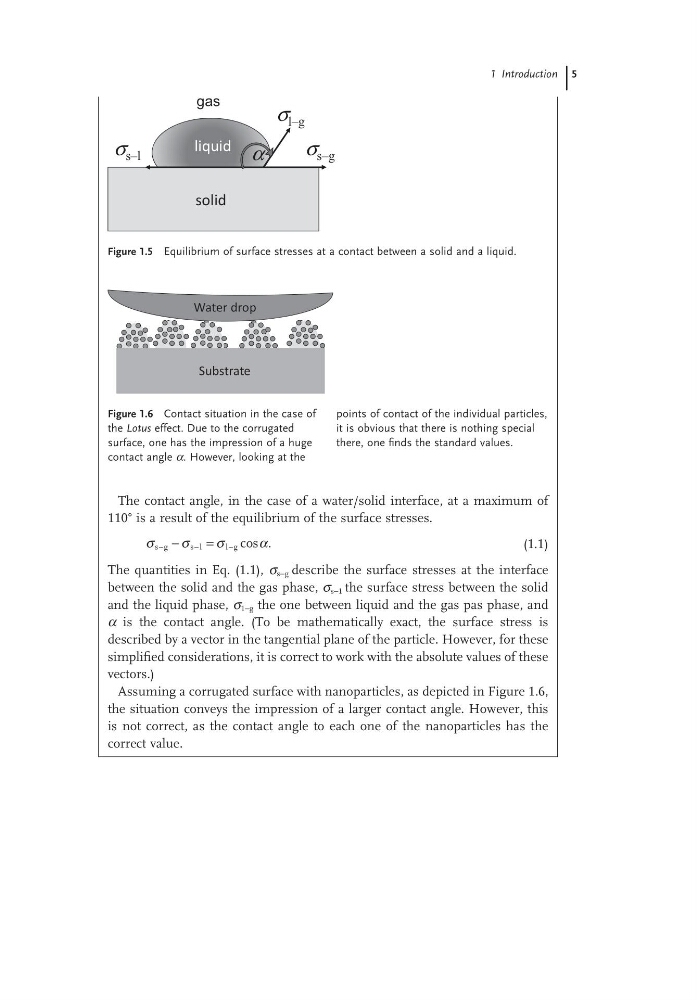
Figure 1.5 Equilibrium of surface stresses at a contact between a solid and a liquid.
α
gas
solid
liquid
σ s–l
σ s–g
σ l–g
The contact angle, in the case of a water/solid interface, at a maximum of
110° is a result of the equilibrium of the surface stresses.
σ
σ
σ
α
s g
s l
l g
−
−
−
−
=
cos .
(1.1)
The quantities in Eq. (1.1), σ s−g describe the surface stresses at the interface
between the solid and the gas phase, σ s−1 the surface stress between the solid
and the liquid phase, σ 1−g the one between liquid and the gas pas phase, and
α is the contact angle. (To be mathematically exact, the surface stress is
described by a vector in the tangential plane of the particle. However, for these
simplified considerations, it is correct to work with the absolute values of these
vectors.)
Assuming a corrugated surface with nanoparticles, as depicted in Figure 1.6,
the situation conveys the impression of a larger contact angle. However, this
is not correct, as the contact angle to each one of the nanoparticles has the
correct value.
Figure 1.6 Contact situation in the case of
the Lotus effect. Due to the corrugated
surface, one has the impression of a huge
contact angle α. However, looking at the
points of contact of the individual particles,
it is obvious that there is nothing special
there, one finds the standard values.
Water drop
Substrate
Figure 1.5 Equilibrium of surface stresses at a contact between a solid and a liquid.
α
gas
solid
liquid
σ s–l
σ s–g
σ l–g
The contact angle, in the case of a water/solid interface, at a maximum of
110° is a result of the equilibrium of the surface stresses.
σ
σ
σ
α
s g
s l
l g
−
−
−
−
=
cos .
(1.1)
The quantities in Eq. (1.1), σ s−g describe the surface stresses at the interface
between the solid and the gas phase, σ s−1 the surface stress between the solid
and the liquid phase, σ 1−g the one between liquid and the gas pas phase, and
α is the contact angle. (To be mathematically exact, the surface stress is
described by a vector in the tangential plane of the particle. However, for these
simplified considerations, it is correct to work with the absolute values of these
vectors.)
Assuming a corrugated surface with nanoparticles, as depicted in Figure 1.6,
the situation conveys the impression of a larger contact angle. However, this
is not correct, as the contact angle to each one of the nanoparticles has the
correct value.