

4 1 Introduction
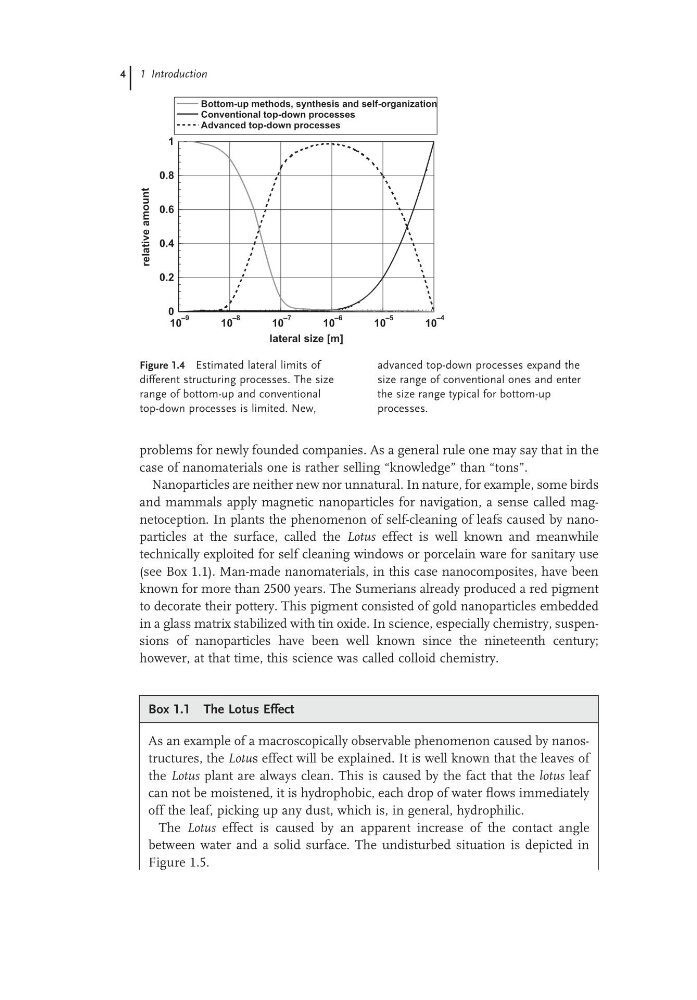
Figure 1.4 Estimated lateral limits of
different structuring processes. The size
range of bottom-up and conventional
top-down processes is limited. New,
advanced top-down processes expand the
size range of conventional ones and enter
the size range typical for bottom-up
processes.
10
–9
10
–8
10
–7
10
–6
10
–5
10
–4
lateral size [m]
0
0.2
0.4
0.6
0.8
1
relative
amount
Bottom-up methods, synthesis and self-organization
Conventional top-down processes
Advanced top-down processes
Box 1.1 The Lotus Effect
As an example of a macroscopically observable phenomenon caused by nanostructures, the Lotus effect will be explained. It is well known that the leaves of
the Lotus plant are always clean. This is caused by the fact that the lotus leaf
can not be moistened, it is hydrophobic, each drop of water flows immediately
off the leaf, picking up any dust, which is, in general, hydrophilic.
The Lotus effect is caused by an apparent increase of the contact angle
between water and a solid surface. The undisturbed situation is depicted in
Figure 1.5.
problems for newly founded companies. As a general rule one may say that in the
case of nanomaterials one is rather selling “knowledge” than “tons”.
Nanoparticles are neither new nor unnatural. In nature, for example, some birds
and mammals apply magnetic nanoparticles for navigation, a sense called magnetoception. In plants the phenomenon of self-cleaning of leafs caused by nanoparticles at the surface, called the Lotus effect is well known and meanwhile
technically exploited for self cleaning windows or porcelain ware for sanitary use
(see Box 1.1). Man-made nanomaterials, in this case nanocomposites, have been
known for more than 2500 years. The Sumerians already produced a red pigment
to decorate their pottery. This pigment consisted of gold nanoparticles embedded
in a glass matrix stabilized with tin oxide. In science, especially chemistry, suspensions of nanoparticles have been well known since the nineteenth century;
however, at that time, this science was called colloid chemistry.
Figure 1.4 Estimated lateral limits of
different structuring processes. The size
range of bottom-up and conventional
top-down processes is limited. New,
advanced top-down processes expand the
size range of conventional ones and enter
the size range typical for bottom-up
processes.
10
–9
10
–8
10
–7
10
–6
10
–5
10
–4
lateral size [m]
0
0.2
0.4
0.6
0.8
1
relative
amount
Bottom-up methods, synthesis and self-organization
Conventional top-down processes
Advanced top-down processes
Box 1.1 The Lotus Effect
As an example of a macroscopically observable phenomenon caused by nanostructures, the Lotus effect will be explained. It is well known that the leaves of
the Lotus plant are always clean. This is caused by the fact that the lotus leaf
can not be moistened, it is hydrophobic, each drop of water flows immediately
off the leaf, picking up any dust, which is, in general, hydrophilic.
The Lotus effect is caused by an apparent increase of the contact angle
between water and a solid surface. The undisturbed situation is depicted in
Figure 1.5.
problems for newly founded companies. As a general rule one may say that in the
case of nanomaterials one is rather selling “knowledge” than “tons”.
Nanoparticles are neither new nor unnatural. In nature, for example, some birds
and mammals apply magnetic nanoparticles for navigation, a sense called magnetoception. In plants the phenomenon of self-cleaning of leafs caused by nanoparticles at the surface, called the Lotus effect is well known and meanwhile
technically exploited for self cleaning windows or porcelain ware for sanitary use
(see Box 1.1). Man-made nanomaterials, in this case nanocomposites, have been
known for more than 2500 years. The Sumerians already produced a red pigment
to decorate their pottery. This pigment consisted of gold nanoparticles embedded
in a glass matrix stabilized with tin oxide. In science, especially chemistry, suspensions of nanoparticles have been well known since the nineteenth century;
however, at that time, this science was called colloid chemistry.