

142 7 Thermodynamics of Nanoparticles and Phase Transformations
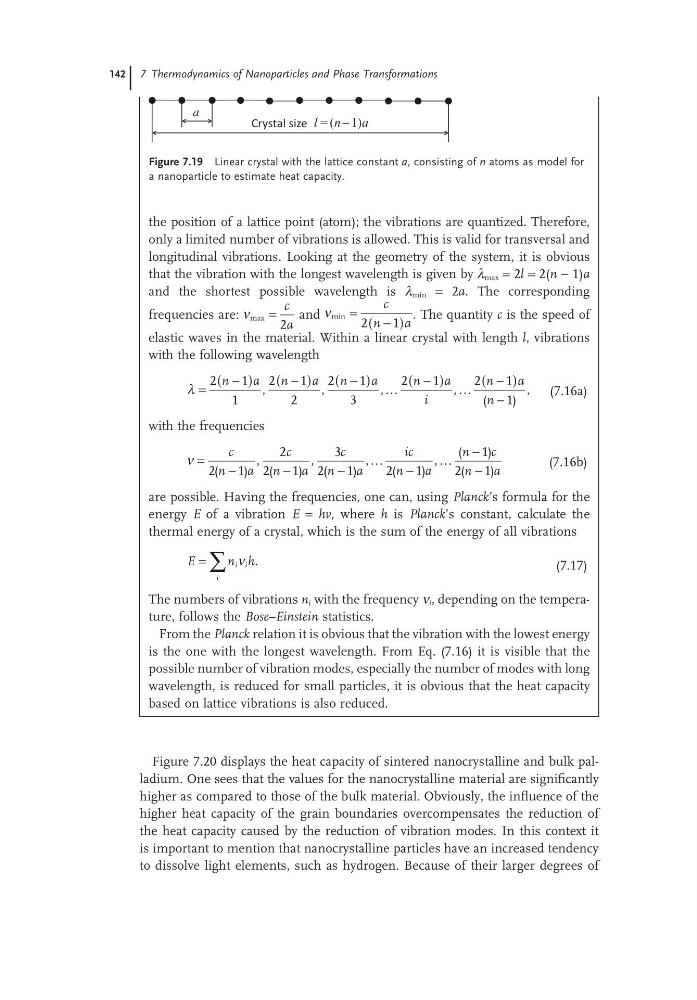
Figure 7.19 Linear crystal with the lattice constant a, consisting of n atoms as model for
a nanoparticle to estimate heat capacity.
Crystal size l = (n − 1)a
a
the position of a lattice point (atom); the vibrations are quantized. Therefore,
only a limited number of vibrations is allowed. This is valid for transversal and
longitudinal vibrations. Looking at the geometry of the system, it is obvious
that the vibration with the longest wavelength is given by λ max = 2l = 2(n − 1)a
and the shortest possible wavelength is λ min = 2a. The corresponding
frequencies are: ν max =
c
a
2
and ν min =
−
(
)
c
n
a
2
1
. The quantity c is the speed of
elastic waves in the material. Within a linear crystal with length l, vibrations
with the following wavelength
λ =
−
(
)
−
(
)
−
(
)
−
(
)
−
(
)
−
2
1
1
2
1
2
2
1
3
2
1
2
1
1
n
a
n
a
n
a
n
a
i
n
a
n
,
,
,
,
(
)
,
…
…
(7.16a)
with the frequencies
ν =
−
−
−
−
−
−
c
n
a
c
n
a
c
n
a
ic
n
a
n
c
n
a
2
1
2
2
1
3
2
1
2
1
1
2
1
(
)
, (
)
, (
)
,
(
)
,
(
)
(
)
…
…
(7.16b)
are possible. Having the frequencies, one can, using Planck’s formula for the
energy E of a vibration E = hv, where h is Planck’s constant, calculate the
thermal energy of a crystal, which is the sum of the energy of all vibrations
E
n h
i i
i
= ∑ ν .
(7.17)
The numbers of vibrations n i with the frequency ν i , depending on the temperature, follows the Bose–Einstein statistics.
From the Planck relation it is obvious that the vibration with the lowest energy
is the one with the longest wavelength. From Eq. (7.16) it is visible that the
possible number of vibration modes, especially the number of modes with long
wavelength, is reduced for small particles, it is obvious that the heat capacity
based on lattice vibrations is also reduced.
Figure 7.20 displays the heat capacity of sintered nanocrystalline and bulk palladium. One sees that the values for the nanocrystalline material are significantly
higher as compared to those of the bulk material. Obviously, the influence of the
higher heat capacity of the grain boundaries overcompensates the reduction of
the heat capacity caused by the reduction of vibration modes. In this context it
is important to mention that nanocrystalline particles have an increased tendency
to dissolve light elements, such as hydrogen. Because of their larger degrees of
Figure 7.19 Linear crystal with the lattice constant a, consisting of n atoms as model for
a nanoparticle to estimate heat capacity.
Crystal size l = (n − 1)a
a
the position of a lattice point (atom); the vibrations are quantized. Therefore,
only a limited number of vibrations is allowed. This is valid for transversal and
longitudinal vibrations. Looking at the geometry of the system, it is obvious
that the vibration with the longest wavelength is given by λ max = 2l = 2(n − 1)a
and the shortest possible wavelength is λ min = 2a. The corresponding
frequencies are: ν max =
c
a
2
and ν min =
−
(
)
c
n
a
2
1
. The quantity c is the speed of
elastic waves in the material. Within a linear crystal with length l, vibrations
with the following wavelength
λ =
−
(
)
−
(
)
−
(
)
−
(
)
−
(
)
−
2
1
1
2
1
2
2
1
3
2
1
2
1
1
n
a
n
a
n
a
n
a
i
n
a
n
,
,
,
,
(
)
,
…
…
(7.16a)
with the frequencies
ν =
−
−
−
−
−
−
c
n
a
c
n
a
c
n
a
ic
n
a
n
c
n
a
2
1
2
2
1
3
2
1
2
1
1
2
1
(
)
, (
)
, (
)
,
(
)
,
(
)
(
)
…
…
(7.16b)
are possible. Having the frequencies, one can, using Planck’s formula for the
energy E of a vibration E = hv, where h is Planck’s constant, calculate the
thermal energy of a crystal, which is the sum of the energy of all vibrations
E
n h
i i
i
= ∑ ν .
(7.17)
The numbers of vibrations n i with the frequency ν i , depending on the temperature, follows the Bose–Einstein statistics.
From the Planck relation it is obvious that the vibration with the lowest energy
is the one with the longest wavelength. From Eq. (7.16) it is visible that the
possible number of vibration modes, especially the number of modes with long
wavelength, is reduced for small particles, it is obvious that the heat capacity
based on lattice vibrations is also reduced.
Figure 7.20 displays the heat capacity of sintered nanocrystalline and bulk palladium. One sees that the values for the nanocrystalline material are significantly
higher as compared to those of the bulk material. Obviously, the influence of the
higher heat capacity of the grain boundaries overcompensates the reduction of
the heat capacity caused by the reduction of vibration modes. In this context it
is important to mention that nanocrystalline particles have an increased tendency
to dissolve light elements, such as hydrogen. Because of their larger degrees of