

140 7 Thermodynamics of Nanoparticles and Phase Transformations
Range 2, which is not accessible at all. In the range in-between the vertical
tangents, between the temperatures T lower and T upper , one finds different concentrations in the heating and cooling cycle. Such a behavior is called bistability.
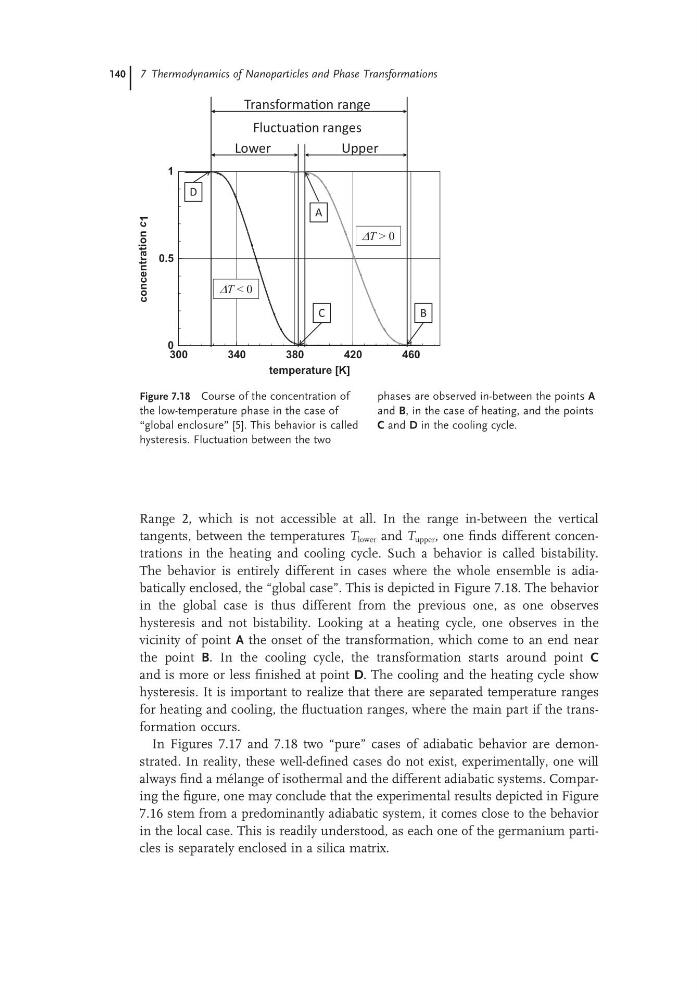
The behavior is entirely different in cases where the whole ensemble is adiabatically enclosed, the “global case”. This is depicted in Figure 7.18. The behavior
in the global case is thus different from the previous one, as one observes
hysteresis and not bistability. Looking at a heating cycle, one observes in the
vicinity of point A the onset of the transformation, which come to an end near
the point B. In the cooling cycle, the transformation starts around point C
and is more or less finished at point D. The cooling and the heating cycle show
hysteresis. It is important to realize that there are separated temperature ranges
for heating and cooling, the fluctuation ranges, where the main part if the transformation occurs.
In Figures 7.17 and 7.18 two “pure” cases of adiabatic behavior are demonstrated. In reality, these well-defined cases do not exist, experimentally, one will
always find a mélange of isothermal and the different adiabatic systems. Comparing the figure, one may conclude that the experimental results depicted in Figure
7.16 stem from a predominantly adiabatic system, it comes close to the behavior
in the local case. This is readily understood, as each one of the germanium particles is separately enclosed in a silica matrix.
Figure 7.18 Course of the concentration of
the low-temperature phase in the case of
“global enclosure” [5]. This behavior is called
hysteresis. Fluctuation between the two
phases are observed in-between the points A
and B, in the case of heating, and the points
C and D in the cooling cycle.
300
340
380
420
460
temperature [K]
0
0.5
1
concentration
c 1
∆T > 0
FluctuaƟon ranges
Lower
Upper
TransformaƟon range
∆T < 0
D
A
C
B
Range 2, which is not accessible at all. In the range in-between the vertical
tangents, between the temperatures T lower and T upper , one finds different concentrations in the heating and cooling cycle. Such a behavior is called bistability.
The behavior is entirely different in cases where the whole ensemble is adiabatically enclosed, the “global case”. This is depicted in Figure 7.18. The behavior
in the global case is thus different from the previous one, as one observes
hysteresis and not bistability. Looking at a heating cycle, one observes in the
vicinity of point A the onset of the transformation, which come to an end near
the point B. In the cooling cycle, the transformation starts around point C
and is more or less finished at point D. The cooling and the heating cycle show
hysteresis. It is important to realize that there are separated temperature ranges
for heating and cooling, the fluctuation ranges, where the main part if the transformation occurs.
In Figures 7.17 and 7.18 two “pure” cases of adiabatic behavior are demonstrated. In reality, these well-defined cases do not exist, experimentally, one will
always find a mélange of isothermal and the different adiabatic systems. Comparing the figure, one may conclude that the experimental results depicted in Figure
7.16 stem from a predominantly adiabatic system, it comes close to the behavior
in the local case. This is readily understood, as each one of the germanium particles is separately enclosed in a silica matrix.
Figure 7.18 Course of the concentration of
the low-temperature phase in the case of
“global enclosure” [5]. This behavior is called
hysteresis. Fluctuation between the two
phases are observed in-between the points A
and B, in the case of heating, and the points
C and D in the cooling cycle.
300
340
380
420
460
temperature [K]
0
0.5
1
concentration
c 1
∆T > 0
FluctuaƟon ranges
Lower
Upper
TransformaƟon range
∆T < 0
D
A
C
B