

7.3 Thermal Instabilities Connected to Phase Transformations 133
with atomic resolution needs a minute or even more time for recording.) It is
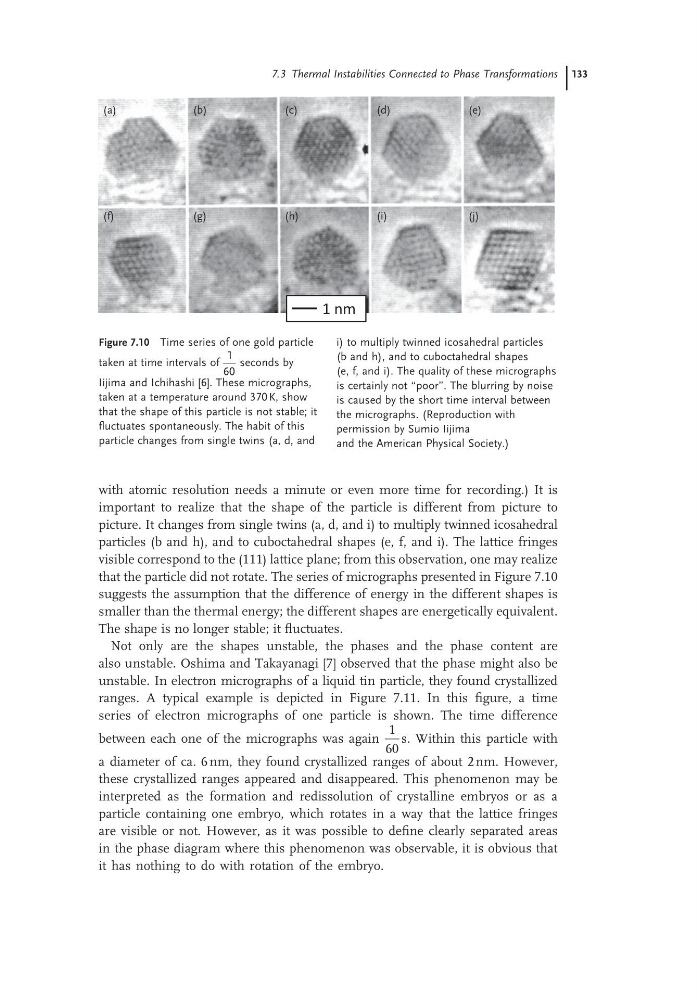
important to realize that the shape of the particle is different from picture to
picture. It changes from single twins (a, d, and i) to multiply twinned icosahedral
particles (b and h), and to cuboctahedral shapes (e, f, and i). The lattice fringes
visible correspond to the (111) lattice plane; from this observation, one may realize
that the particle did not rotate. The series of micrographs presented in Figure 7.10
suggests the assumption that the difference of energy in the different shapes is
smaller than the thermal energy; the different shapes are energetically equivalent.
The shape is no longer stable; it fluctuates.
Not only are the shapes unstable, the phases and the phase content are
also unstable. Oshima and Takayanagi [7] observed that the phase might also be
unstable. In electron micrographs of a liquid tin particle, they found crystallized
ranges. A typical example is depicted in Figure 7.11. In this figure, a time
series of electron micrographs of one particle is shown. The time difference
between each one of the micrographs was again
1
60
s. Within this particle with
a diameter of ca. 6 nm, they found crystallized ranges of about 2 nm. However,
these crystallized ranges appeared and disappeared. This phenomenon may be
interpreted as the formation and redissolution of crystalline embryos or as a
particle containing one embryo, which rotates in a way that the lattice fringes
are visible or not. However, as it was possible to define clearly separated areas
in the phase diagram where this phenomenon was observable, it is obvious that
it has nothing to do with rotation of the embryo.
Figure 7.10 Time series of one gold particle
taken at time intervals of
1
60
seconds by
Iijima and Ichihashi [6]. These micrographs,
taken at a temperature around 370 K, show
that the shape of this particle is not stable; it
fluctuates spontaneously. The habit of this
particle changes from single twins (a, d, and
i) to multiply twinned icosahedral particles
(b and h), and to cuboctahedral shapes
(e, f, and i). The quality of these micrographs
is certainly not “poor”. The blurring by noise
is caused by the short time interval between
the micrographs. (Reproduction with
permission by Sumio Iijima
and the American Physical Society.)
1 nm
(a)
(b)
(c)
(d)
(e)
(f)
(g)
(h)
(i)
(j)
with atomic resolution needs a minute or even more time for recording.) It is
important to realize that the shape of the particle is different from picture to
picture. It changes from single twins (a, d, and i) to multiply twinned icosahedral
particles (b and h), and to cuboctahedral shapes (e, f, and i). The lattice fringes
visible correspond to the (111) lattice plane; from this observation, one may realize
that the particle did not rotate. The series of micrographs presented in Figure 7.10
suggests the assumption that the difference of energy in the different shapes is
smaller than the thermal energy; the different shapes are energetically equivalent.
The shape is no longer stable; it fluctuates.
Not only are the shapes unstable, the phases and the phase content are
also unstable. Oshima and Takayanagi [7] observed that the phase might also be
unstable. In electron micrographs of a liquid tin particle, they found crystallized
ranges. A typical example is depicted in Figure 7.11. In this figure, a time
series of electron micrographs of one particle is shown. The time difference
between each one of the micrographs was again
1
60
s. Within this particle with
a diameter of ca. 6 nm, they found crystallized ranges of about 2 nm. However,
these crystallized ranges appeared and disappeared. This phenomenon may be
interpreted as the formation and redissolution of crystalline embryos or as a
particle containing one embryo, which rotates in a way that the lattice fringes
are visible or not. However, as it was possible to define clearly separated areas
in the phase diagram where this phenomenon was observable, it is obvious that
it has nothing to do with rotation of the embryo.
Figure 7.10 Time series of one gold particle
taken at time intervals of
1
60
seconds by
Iijima and Ichihashi [6]. These micrographs,
taken at a temperature around 370 K, show
that the shape of this particle is not stable; it
fluctuates spontaneously. The habit of this
particle changes from single twins (a, d, and
i) to multiply twinned icosahedral particles
(b and h), and to cuboctahedral shapes
(e, f, and i). The quality of these micrographs
is certainly not “poor”. The blurring by noise
is caused by the short time interval between
the micrographs. (Reproduction with
permission by Sumio Iijima
and the American Physical Society.)
1 nm
(a)
(b)
(c)
(d)
(e)
(f)
(g)
(h)
(i)
(j)