

126 7 Thermodynamics of Nanoparticles and Phase Transformations
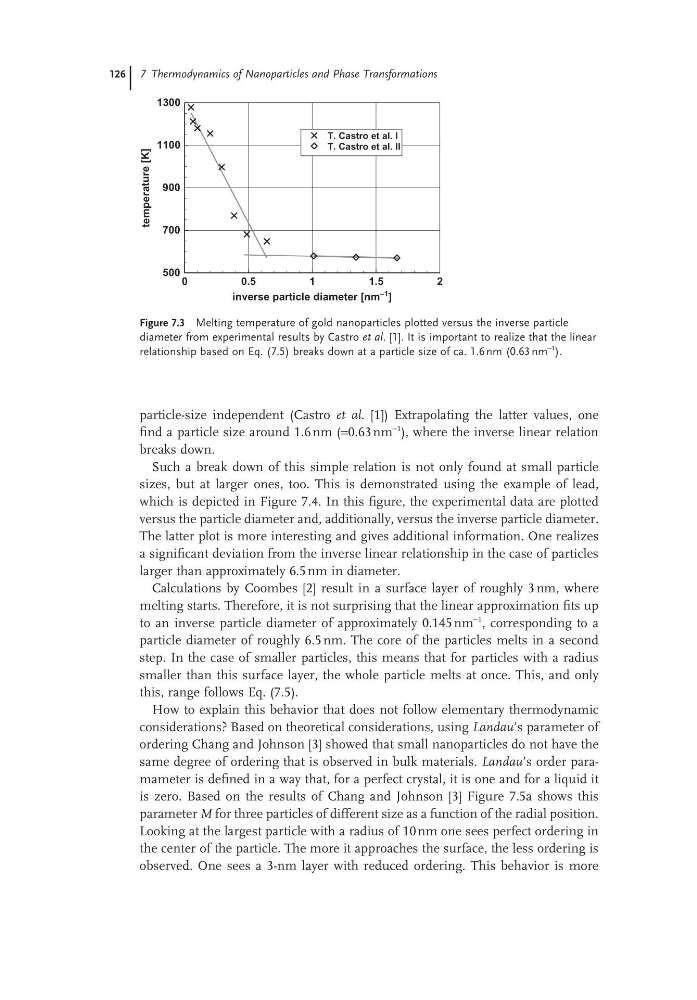
particle-size independent (Castro et al. [1]) Extrapolating the latter values, one
find a particle size around 1.6 nm (=0.63 nm
−1 ), where the inverse linear relation
breaks down.
Such a break down of this simple relation is not only found at small particle
sizes, but at larger ones, too. This is demonstrated using the example of lead,
which is depicted in Figure 7.4. In this figure, the experimental data are plotted
versus the particle diameter and, additionally, versus the inverse particle diameter.
The latter plot is more interesting and gives additional information. One realizes
a significant deviation from the inverse linear relationship in the case of particles
larger than approximately 6.5 nm in diameter.
Calculations by Coombes [2] result in a surface layer of roughly 3 nm, where
melting starts. Therefore, it is not surprising that the linear approximation fits up
to an inverse particle diameter of approximately 0.145 nm
−1
, corresponding to a
particle diameter of roughly 6.5 nm. The core of the particles melts in a second
step. In the case of smaller particles, this means that for particles with a radius
smaller than this surface layer, the whole particle melts at once. This, and only
this, range follows Eq. (7.5).
How to explain this behavior that does not follow elementary thermodynamic
considerations? Based on theoretical considerations, using Landau’s parameter of
ordering Chang and Johnson [3] showed that small nanoparticles do not have the
same degree of ordering that is observed in bulk materials. Landau’s order paramameter is defined in a way that, for a perfect crystal, it is one and for a liquid it
is zero. Based on the results of Chang and Johnson [3] Figure 7.5a shows this
parameter M for three particles of different size as a function of the radial position.
Looking at the largest particle with a radius of 10 nm one sees perfect ordering in
the center of the particle. The more it approaches the surface, the less ordering is
observed. One sees a 3-nm layer with reduced ordering. This behavior is more
Figure 7.3 Melting temperature of gold nanoparticles plotted versus the inverse particle
diameter from experimental results by Castro et al. [1]. It is important to realize that the linear
relationship based on Eq. (7.5) breaks down at a particle size of ca. 1.6 nm (0.63 nm
−1 ).
0
0.5
1
1.5
2
inverse particle diameter [nm
–1 ]
500
700
900
1100
1300
temperature
[K]
T. Castro et al. I
T. Castro et al. II
particle-size independent (Castro et al. [1]) Extrapolating the latter values, one
find a particle size around 1.6 nm (=0.63 nm
−1 ), where the inverse linear relation
breaks down.
Such a break down of this simple relation is not only found at small particle
sizes, but at larger ones, too. This is demonstrated using the example of lead,
which is depicted in Figure 7.4. In this figure, the experimental data are plotted
versus the particle diameter and, additionally, versus the inverse particle diameter.
The latter plot is more interesting and gives additional information. One realizes
a significant deviation from the inverse linear relationship in the case of particles
larger than approximately 6.5 nm in diameter.
Calculations by Coombes [2] result in a surface layer of roughly 3 nm, where
melting starts. Therefore, it is not surprising that the linear approximation fits up
to an inverse particle diameter of approximately 0.145 nm
−1
, corresponding to a
particle diameter of roughly 6.5 nm. The core of the particles melts in a second
step. In the case of smaller particles, this means that for particles with a radius
smaller than this surface layer, the whole particle melts at once. This, and only
this, range follows Eq. (7.5).
How to explain this behavior that does not follow elementary thermodynamic
considerations? Based on theoretical considerations, using Landau’s parameter of
ordering Chang and Johnson [3] showed that small nanoparticles do not have the
same degree of ordering that is observed in bulk materials. Landau’s order paramameter is defined in a way that, for a perfect crystal, it is one and for a liquid it
is zero. Based on the results of Chang and Johnson [3] Figure 7.5a shows this
parameter M for three particles of different size as a function of the radial position.
Looking at the largest particle with a radius of 10 nm one sees perfect ordering in
the center of the particle. The more it approaches the surface, the less ordering is
observed. One sees a 3-nm layer with reduced ordering. This behavior is more
Figure 7.3 Melting temperature of gold nanoparticles plotted versus the inverse particle
diameter from experimental results by Castro et al. [1]. It is important to realize that the linear
relationship based on Eq. (7.5) breaks down at a particle size of ca. 1.6 nm (0.63 nm
−1 ).
0
0.5
1
1.5
2
inverse particle diameter [nm
–1 ]
500
700
900
1100
1300
temperature
[K]
T. Castro et al. I
T. Castro et al. II