

108 5 One- and Two-Dimensional Nanoparticles
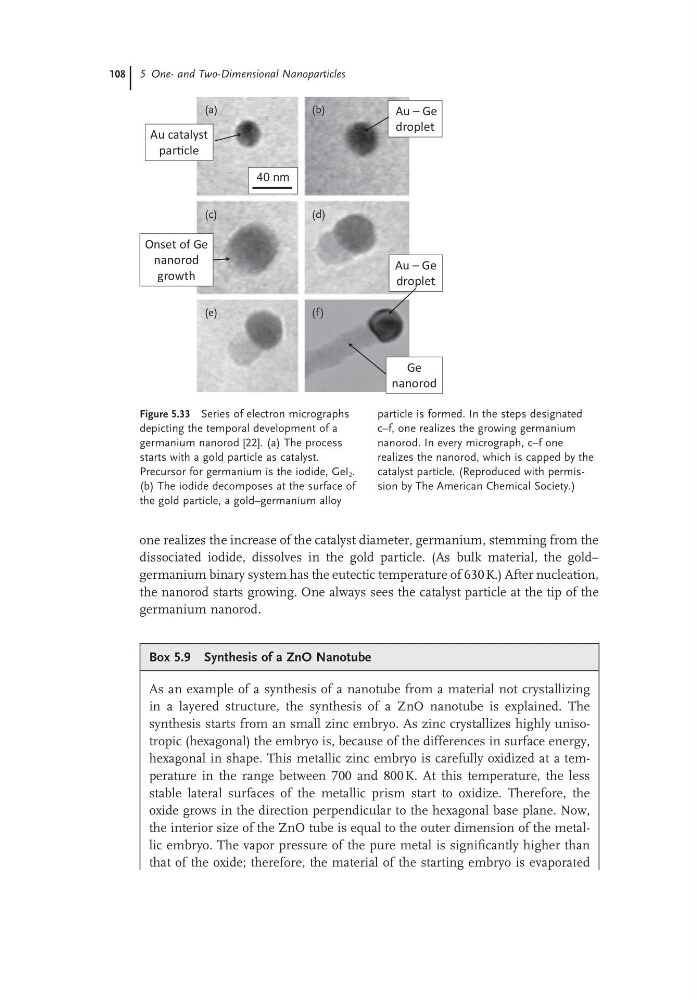
one realizes the increase of the catalyst diameter, germanium, stemming from the
dissociated iodide, dissolves in the gold particle. (As bulk material, the gold–
germanium binary system has the eutectic temperature of 630 K.) After nucleation,
the nanorod starts growing. One always sees the catalyst particle at the tip of the
germanium nanorod.
Figure 5.33 Series of electron micrographs
depicting the temporal development of a
germanium nanorod [22]. (a) The process
starts with a gold particle as catalyst.
Precursor for germanium is the iodide, GeI 2 .
(b) The iodide decomposes at the surface of
the gold particle, a gold–germanium alloy
particle is formed. In the steps designated
c–f, one realizes the growing germanium
nanorod. In every micrograph, c–f one
realizes the nanorod, which is capped by the
catalyst particle. (Reproduced with permission by The American Chemical Society.)
40 nm
Au catalyst
parƟcle
Au – Ge
droplet
Ge
nanorod
Au – Ge
droplet
Onset of Ge
nanorod
growth
(a)
(b)
(c)
(d)
(e)
(f )
Box 5.9 Synthesis of a ZnO Nanotube
As an example of a synthesis of a nanotube from a material not crystallizing
in a layered structure, the synthesis of a ZnO nanotube is explained. The
synthesis starts from an small zinc embryo. As zinc crystallizes highly unisotropic (hexagonal) the embryo is, because of the differences in surface energy,
hexagonal in shape. This metallic zinc embryo is carefully oxidized at a temperature in the range between 700 and 800 K. At this temperature, the less
stable lateral surfaces of the metallic prism start to oxidize. Therefore, the
oxide grows in the direction perpendicular to the hexagonal base plane. Now,
the interior size of the ZnO tube is equal to the outer dimension of the metallic embryo. The vapor pressure of the pure metal is significantly higher than
that of the oxide; therefore, the material of the starting embryo is evaporated
one realizes the increase of the catalyst diameter, germanium, stemming from the
dissociated iodide, dissolves in the gold particle. (As bulk material, the gold–
germanium binary system has the eutectic temperature of 630 K.) After nucleation,
the nanorod starts growing. One always sees the catalyst particle at the tip of the
germanium nanorod.
Figure 5.33 Series of electron micrographs
depicting the temporal development of a
germanium nanorod [22]. (a) The process
starts with a gold particle as catalyst.
Precursor for germanium is the iodide, GeI 2 .
(b) The iodide decomposes at the surface of
the gold particle, a gold–germanium alloy
particle is formed. In the steps designated
c–f, one realizes the growing germanium
nanorod. In every micrograph, c–f one
realizes the nanorod, which is capped by the
catalyst particle. (Reproduced with permission by The American Chemical Society.)
40 nm
Au catalyst
parƟcle
Au – Ge
droplet
Ge
nanorod
Au – Ge
droplet
Onset of Ge
nanorod
growth
(a)
(b)
(c)
(d)
(e)
(f )
Box 5.9 Synthesis of a ZnO Nanotube
As an example of a synthesis of a nanotube from a material not crystallizing
in a layered structure, the synthesis of a ZnO nanotube is explained. The
synthesis starts from an small zinc embryo. As zinc crystallizes highly unisotropic (hexagonal) the embryo is, because of the differences in surface energy,
hexagonal in shape. This metallic zinc embryo is carefully oxidized at a temperature in the range between 700 and 800 K. At this temperature, the less
stable lateral surfaces of the metallic prism start to oxidize. Therefore, the
oxide grows in the direction perpendicular to the hexagonal base plane. Now,
the interior size of the ZnO tube is equal to the outer dimension of the metallic embryo. The vapor pressure of the pure metal is significantly higher than
that of the oxide; therefore, the material of the starting embryo is evaporated