

106 5 One- and Two-Dimensional Nanoparticles
particles should be liquid. To avoid too high temperatures, the application of
eutectic systems is recommended.
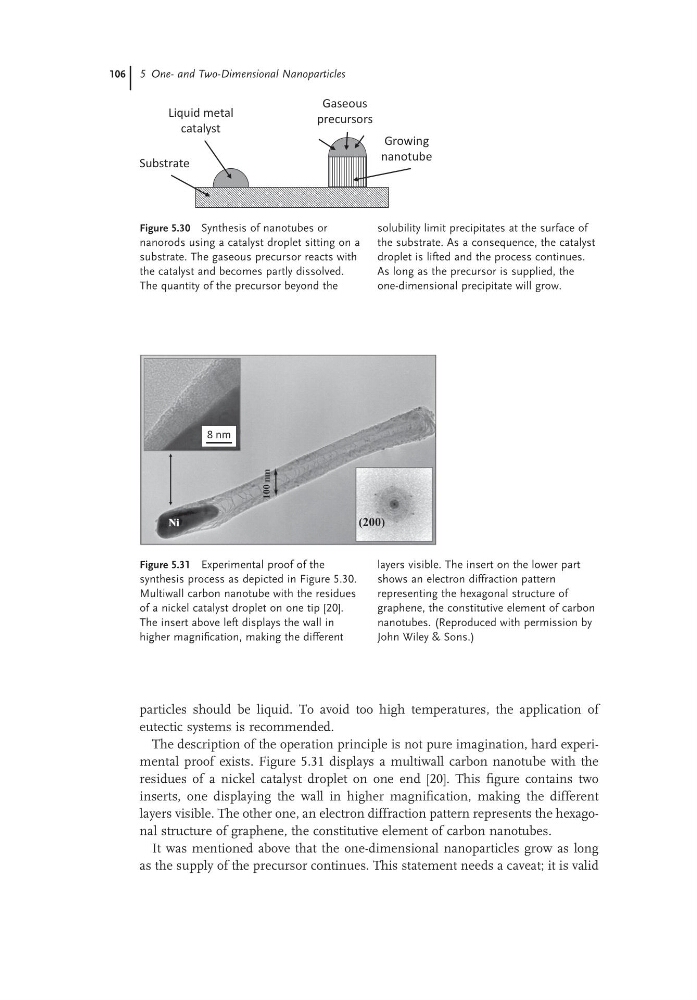
The description of the operation principle is not pure imagination, hard experimental proof exists. Figure 5.31 displays a multiwall carbon nanotube with the
residues of a nickel catalyst droplet on one end [20]. This figure contains two
inserts, one displaying the wall in higher magnification, making the different
layers visible. The other one, an electron diffraction pattern represents the hexagonal structure of graphene, the constitutive element of carbon nanotubes.
It was mentioned above that the one-dimensional nanoparticles grow as long
as the supply of the precursor continues. This statement needs a caveat; it is valid
Figure 5.30 Synthesis of nanotubes or
nanorods using a catalyst droplet sitting on a
substrate. The gaseous precursor reacts with
the catalyst and becomes partly dissolved.
The quantity of the precursor beyond the
solubility limit precipitates at the surface of
the substrate. As a consequence, the catalyst
droplet is lifted and the process continues.
As long as the precursor is supplied, the
one-dimensional precipitate will grow.
Substrate
Liquid metal
catalyst
Gaseous
precursors
Growing
nanotube
Figure 5.31 Experimental proof of the
synthesis process as depicted in Figure 5.30.
Multiwall carbon nanotube with the residues
of a nickel catalyst droplet on one tip [20].
The insert above left displays the wall in
higher magnification, making the different
layers visible. The insert on the lower part
shows an electron diffraction pattern
representing the hexagonal structure of
graphene, the constitutive element of carbon
nanotubes. (Reproduced with permission by
John Wiley & Sons.)
8 nm
Ni
(200)
100
particles should be liquid. To avoid too high temperatures, the application of
eutectic systems is recommended.
The description of the operation principle is not pure imagination, hard experimental proof exists. Figure 5.31 displays a multiwall carbon nanotube with the
residues of a nickel catalyst droplet on one end [20]. This figure contains two
inserts, one displaying the wall in higher magnification, making the different
layers visible. The other one, an electron diffraction pattern represents the hexagonal structure of graphene, the constitutive element of carbon nanotubes.
It was mentioned above that the one-dimensional nanoparticles grow as long
as the supply of the precursor continues. This statement needs a caveat; it is valid
Figure 5.30 Synthesis of nanotubes or
nanorods using a catalyst droplet sitting on a
substrate. The gaseous precursor reacts with
the catalyst and becomes partly dissolved.
The quantity of the precursor beyond the
solubility limit precipitates at the surface of
the substrate. As a consequence, the catalyst
droplet is lifted and the process continues.
As long as the precursor is supplied, the
one-dimensional precipitate will grow.
Substrate
Liquid metal
catalyst
Gaseous
precursors
Growing
nanotube
Figure 5.31 Experimental proof of the
synthesis process as depicted in Figure 5.30.
Multiwall carbon nanotube with the residues
of a nickel catalyst droplet on one tip [20].
The insert above left displays the wall in
higher magnification, making the different
layers visible. The insert on the lower part
shows an electron diffraction pattern
representing the hexagonal structure of
graphene, the constitutive element of carbon
nanotubes. (Reproduced with permission by
John Wiley & Sons.)
8 nm
Ni
(200)
100