

5.3 Nanostructures Related to Compounds with Layered Structures 89
Analyzing Table 5.1, one realizes that a 10-nm nanorod vibrates in a frequency
range that is far from those that are in technical use. Vibrations of nanorods have
been used to determine the mass of single molecules, sitting on the surface, by
measuring the frequency shift. Such a device is able to act as a kind of balance for
single molecules or atoms [6, 7].
5.3
Nanostructures Related to Compounds with Layered Structures
5.3.1
Carbon- and Boron-Nitride-Based Nanoparticles
Certainly, the most important group of objects are based on carbon. Except for the
binding in the lattice influencing the physical properties, which does not have any
influence on the geometry of the particles, nearly everything discussed in connection with carbon is valid for boron nitride, too. To understand carbon nanotubes,
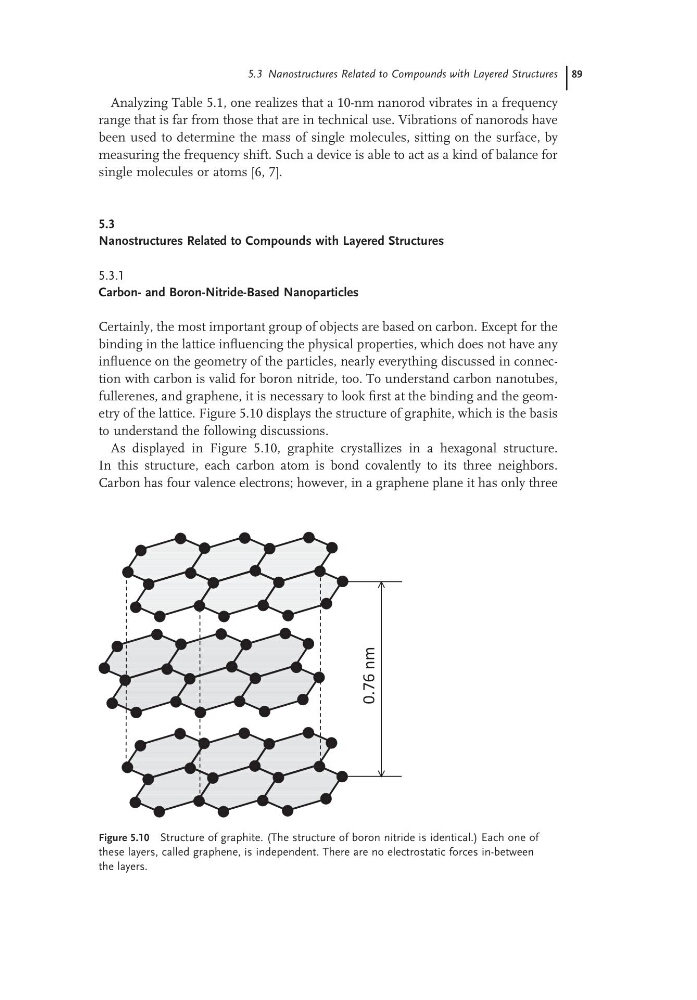
fullerenes, and graphene, it is necessary to look first at the binding and the geometry of the lattice. Figure 5.10 displays the structure of graphite, which is the basis
to understand the following discussions.
As displayed in Figure 5.10, graphite crystallizes in a hexagonal structure.
In this structure, each carbon atom is bond covalently to its three neighbors.
Carbon has four valence electrons; however, in a graphene plane it has only three
Figure 5.10 Structure of graphite. (The structure of boron nitride is identical.) Each one of
these layers, called graphene, is independent. There are no electrostatic forces in-between
the layers.
0.76 nm
Analyzing Table 5.1, one realizes that a 10-nm nanorod vibrates in a frequency
range that is far from those that are in technical use. Vibrations of nanorods have
been used to determine the mass of single molecules, sitting on the surface, by
measuring the frequency shift. Such a device is able to act as a kind of balance for
single molecules or atoms [6, 7].
5.3
Nanostructures Related to Compounds with Layered Structures
5.3.1
Carbon- and Boron-Nitride-Based Nanoparticles
Certainly, the most important group of objects are based on carbon. Except for the
binding in the lattice influencing the physical properties, which does not have any
influence on the geometry of the particles, nearly everything discussed in connection with carbon is valid for boron nitride, too. To understand carbon nanotubes,
fullerenes, and graphene, it is necessary to look first at the binding and the geometry of the lattice. Figure 5.10 displays the structure of graphite, which is the basis
to understand the following discussions.
As displayed in Figure 5.10, graphite crystallizes in a hexagonal structure.
In this structure, each carbon atom is bond covalently to its three neighbors.
Carbon has four valence electrons; however, in a graphene plane it has only three
Figure 5.10 Structure of graphite. (The structure of boron nitride is identical.) Each one of
these layers, called graphene, is independent. There are no electrostatic forces in-between
the layers.
0.76 nm