

88 5 One- and Two-Dimensional Nanoparticles
5.2
Vibrations of Nanorods and Nanotubes – Scaling Law for Vibrations
It is well known and part of everyone’s daily experience that the frequency of
vibrations increases with increasing length of a rod. This context is experienced
for example, in the case of music instruments. Now, one may ask, what are the
consequences if the dimensions go into the range of a few nanometers. This is
the question about vibration frequencies of nanorods and nanotubes. It is well
known that the resonance frequency of a rod, fixed on one end is, under the
assumption of constant aspect ratio (the ratio length over diameter) of a cylindrical
rod is indirectly proportional to the length of the rod.
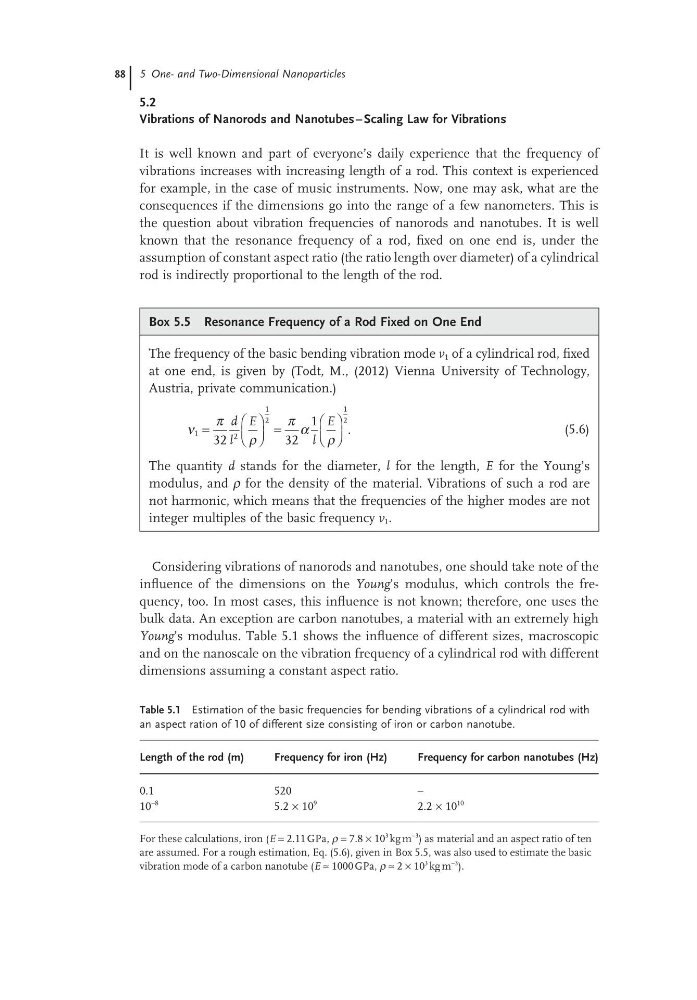
Table 5.1 Estimation of the basic frequencies for bending vibrations of a cylindrical rod with
an aspect ration of 10 of different size consisting of iron or carbon nanotube.
Length of the rod (m)
Frequency for iron (Hz)
Frequency for carbon nanotubes (Hz)
0.1
520
–
10
−8
5.2 × 10
9
2.2 × 10
10
For these calculations, iron (E = 2.11 GPa, ρ = 7.8 × 10
3 kg m
−3 ) as material and an aspect ratio of ten
are assumed. For a rough estimation, Eq. (5.6), given in Box 5.5, was also used to estimate the basic
vibration mode of a carbon nanotube (E ≈ 1000 GPa, ρ ≈ 2 × 10
3 kg m
−3 ).
Box 5.5 Resonance Frequency of a Rod Fixed on One End
The frequency of the basic bending vibration mode v 1 of a cylindrical rod, fixed
at one end, is given by (Todt, M., (2012) Vienna University of Technology,
Austria, private communication.)
ν
π
ρ
π α ρ
1
2
1
2
1
2
32
32
1
=
=
d
l
E
l
E .
(5.6)
The quantity d stands for the diameter, l for the length, E for the Young’s
modulus, and ρ for the density of the material. Vibrations of such a rod are
not harmonic, which means that the frequencies of the higher modes are not
integer multiples of the basic frequency v 1 .
Considering vibrations of nanorods and nanotubes, one should take note of the
influence of the dimensions on the Young’s modulus, which controls the frequency, too. In most cases, this influence is not known; therefore, one uses the
bulk data. An exception are carbon nanotubes, a material with an extremely high
Young’s modulus. Table 5.1 shows the influence of different sizes, macroscopic
and on the nanoscale on the vibration frequency of a cylindrical rod with different
dimensions assuming a constant aspect ratio.
5.2
Vibrations of Nanorods and Nanotubes – Scaling Law for Vibrations
It is well known and part of everyone’s daily experience that the frequency of
vibrations increases with increasing length of a rod. This context is experienced
for example, in the case of music instruments. Now, one may ask, what are the
consequences if the dimensions go into the range of a few nanometers. This is
the question about vibration frequencies of nanorods and nanotubes. It is well
known that the resonance frequency of a rod, fixed on one end is, under the
assumption of constant aspect ratio (the ratio length over diameter) of a cylindrical
rod is indirectly proportional to the length of the rod.
Table 5.1 Estimation of the basic frequencies for bending vibrations of a cylindrical rod with
an aspect ration of 10 of different size consisting of iron or carbon nanotube.
Length of the rod (m)
Frequency for iron (Hz)
Frequency for carbon nanotubes (Hz)
0.1
520
–
10
−8
5.2 × 10
9
2.2 × 10
10
For these calculations, iron (E = 2.11 GPa, ρ = 7.8 × 10
3 kg m
−3 ) as material and an aspect ratio of ten
are assumed. For a rough estimation, Eq. (5.6), given in Box 5.5, was also used to estimate the basic
vibration mode of a carbon nanotube (E ≈ 1000 GPa, ρ ≈ 2 × 10
3 kg m
−3 ).
Box 5.5 Resonance Frequency of a Rod Fixed on One End
The frequency of the basic bending vibration mode v 1 of a cylindrical rod, fixed
at one end, is given by (Todt, M., (2012) Vienna University of Technology,
Austria, private communication.)
ν
π
ρ
π α ρ
1
2
1
2
1
2
32
32
1
=
=
d
l
E
l
E .
(5.6)
The quantity d stands for the diameter, l for the length, E for the Young’s
modulus, and ρ for the density of the material. Vibrations of such a rod are
not harmonic, which means that the frequencies of the higher modes are not
integer multiples of the basic frequency v 1 .
Considering vibrations of nanorods and nanotubes, one should take note of the
influence of the dimensions on the Young’s modulus, which controls the frequency, too. In most cases, this influence is not known; therefore, one uses the
bulk data. An exception are carbon nanotubes, a material with an extremely high
Young’s modulus. Table 5.1 shows the influence of different sizes, macroscopic
and on the nanoscale on the vibration frequency of a cylindrical rod with different
dimensions assuming a constant aspect ratio.