

of
polymerization
determined
previously,
the
end-functionalization rate is assessed by comparing the peak
integral of the PTMC at 4.2 ppm (4H) or 2.05 ppm (2H) with
the grafted methacrylate with the peak integral at 6.06 ppm
(1H) and 5.51 ppm (1H) corresponding to the acrylate bonds
CH 2 -. Purity of the macromers is also evaluated by
1 H-NMR
with the presence of the remained non-grafted methacrylate
molecules with chemical shifts at 6.09 ppm (1H) and 5.51 ppm
(1H). Degree of functionalization on PDLLA macromers is
assessed via the integral peak at 5.15 ppm of the -CH(1H) groups (see Note 5). End-functionalization of these
types of macromers is 90–95% (see Notes 6 and 7).
3.3 Photocrosslinking Assays Using
the Synthesized
Macromer Resins
Prior to any building by SL, the crosslinking ability should be
assessed initially on a film. Crosslinking characterization consists
in the measure of the gel content.
1. Dissolve macromers in dichloromethane (30 wt%) in order to
decrease the viscosity (see Note 8). Add Lucirin TPO-L (5 wt%
relative to the macromers) (see Note 9).
2. Use a mold to create films with a thickness of 500 μm, and
irradiate the resin for 10 min at a wavelength of 452 nm into a
crosslinking cabinet under argon flow to avoid radical polymerization quenching.
3. Gel content determination is performed by a weighing method
(at least in triplicate). Vacuum-dry film and weigh it to give m 0 .
Rinse film in dichloromethane, and refresh solvent twice.
Vacuum-dry film until a constant weight is reached (m 1 ). Efficient crosslinking procedure should lead to gel content above
90%. The gel content is defined as:
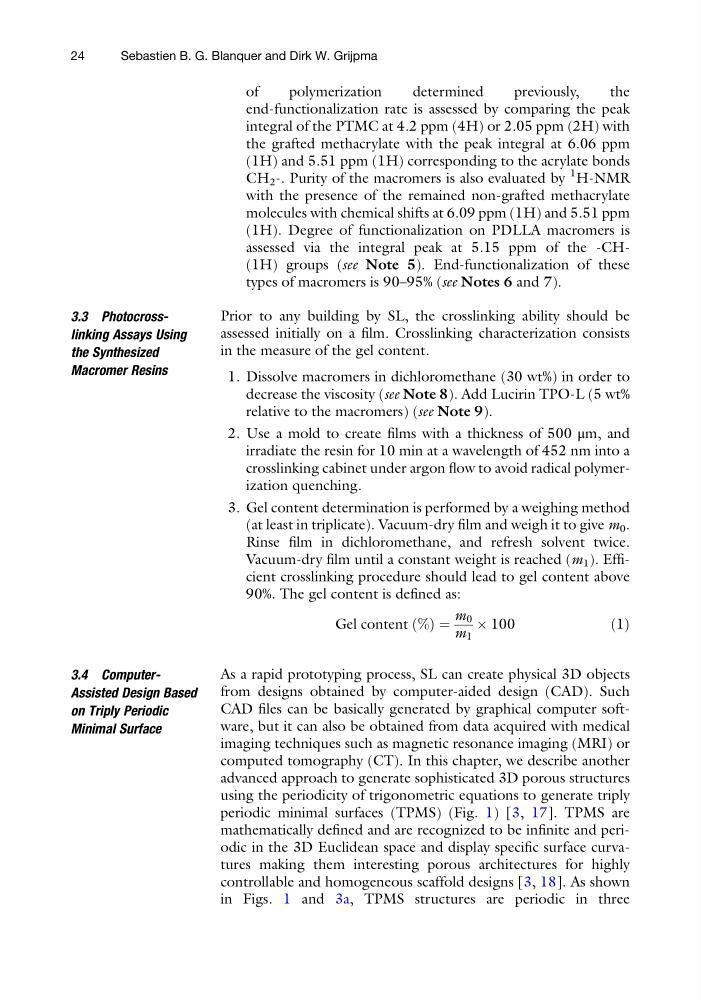
Gel content %
ð Þ ¼
m 0
m 1
 100
ð1Þ
3.4 ComputerAssisted Design Based
on Triply Periodic
Minimal Surface
As a rapid prototyping process, SL can create physical 3D objects
from designs obtained by computer-aided design (CAD). Such
CAD files can be basically generated by graphical computer software, but it can also be obtained from data acquired with medical
imaging techniques such as magnetic resonance imaging (MRI) or
computed tomography (CT). In this chapter, we describe another
advanced approach to generate sophisticated 3D porous structures
using the periodicity of trigonometric equations to generate triply
periodic minimal surfaces (TPMS) (Fig. 1) [3, 17]. TPMS are
mathematically defined and are recognized to be infinite and periodic in the 3D Euclidean space and display specific surface curvatures making them interesting porous architectures for highly
controllable and homogeneous scaffold designs [3, 18]. As shown
in Figs. 1 and 3a, TPMS structures are periodic in three
24
Sebastien B. G. Blanquer and Dirk W. Grijpma
polymerization
determined
previously,
the
end-functionalization rate is assessed by comparing the peak
integral of the PTMC at 4.2 ppm (4H) or 2.05 ppm (2H) with
the grafted methacrylate with the peak integral at 6.06 ppm
(1H) and 5.51 ppm (1H) corresponding to the acrylate bonds
CH 2 -. Purity of the macromers is also evaluated by
1 H-NMR
with the presence of the remained non-grafted methacrylate
molecules with chemical shifts at 6.09 ppm (1H) and 5.51 ppm
(1H). Degree of functionalization on PDLLA macromers is
assessed via the integral peak at 5.15 ppm of the -CH(1H) groups (see Note 5). End-functionalization of these
types of macromers is 90–95% (see Notes 6 and 7).
3.3 Photocrosslinking Assays Using
the Synthesized
Macromer Resins
Prior to any building by SL, the crosslinking ability should be
assessed initially on a film. Crosslinking characterization consists
in the measure of the gel content.
1. Dissolve macromers in dichloromethane (30 wt%) in order to
decrease the viscosity (see Note 8). Add Lucirin TPO-L (5 wt%
relative to the macromers) (see Note 9).
2. Use a mold to create films with a thickness of 500 μm, and
irradiate the resin for 10 min at a wavelength of 452 nm into a
crosslinking cabinet under argon flow to avoid radical polymerization quenching.
3. Gel content determination is performed by a weighing method
(at least in triplicate). Vacuum-dry film and weigh it to give m 0 .
Rinse film in dichloromethane, and refresh solvent twice.
Vacuum-dry film until a constant weight is reached (m 1 ). Efficient crosslinking procedure should lead to gel content above
90%. The gel content is defined as:
Gel content %
ð Þ ¼
m 0
m 1
 100
ð1Þ
3.4 ComputerAssisted Design Based
on Triply Periodic
Minimal Surface
As a rapid prototyping process, SL can create physical 3D objects
from designs obtained by computer-aided design (CAD). Such
CAD files can be basically generated by graphical computer software, but it can also be obtained from data acquired with medical
imaging techniques such as magnetic resonance imaging (MRI) or
computed tomography (CT). In this chapter, we describe another
advanced approach to generate sophisticated 3D porous structures
using the periodicity of trigonometric equations to generate triply
periodic minimal surfaces (TPMS) (Fig. 1) [3, 17]. TPMS are
mathematically defined and are recognized to be infinite and periodic in the 3D Euclidean space and display specific surface curvatures making them interesting porous architectures for highly
controllable and homogeneous scaffold designs [3, 18]. As shown
in Figs. 1 and 3a, TPMS structures are periodic in three
24
Sebastien B. G. Blanquer and Dirk W. Grijpma