

aqueous solution. Parallel linear patterns of fibers in the sub-micron
dimensions were printed on glass coverslips (Fig. 3) and PDMS
films. The patterned fibers can be used as a topographical and
chemical guidance for cell attachment and growth [9, 10]. Gelatin
fibers patterned on PDMS film were used to culture EA.hy926
cells. The dynamic interactions between cells and the fibers are
shown in the live cell images (Fig. 4). Immunostaining was performed to show the cell morphology along a microfiber.
2 Materials
Prepare all solutions using deionized water and analytical grade
reagents. Prepare and store all reagents at room temperatures
below 25
C. When disposing waste, strictly follow the waste
disposal regulations.
2.1 Example Polymer
Solutions
1. PS-DMF: dissolve 0.25 g of PS (Mw ¼ 280 kDa) in 1 g of
DMF to obtain a concentration of 25 wt%. Place a magnetic
stirrer into the solution and tighten the lid. Leave the solution
to stir until homogeneous.
2. PEO-water: dissolve 0.1 g of PEO (Mw ¼ 400 kDa) in 1 g of
water to obtain a concentration of 10 wt%. Place a magnetic
stirrer into the solution and tighten the lid. Leave the solution
to stir until homogeneous.
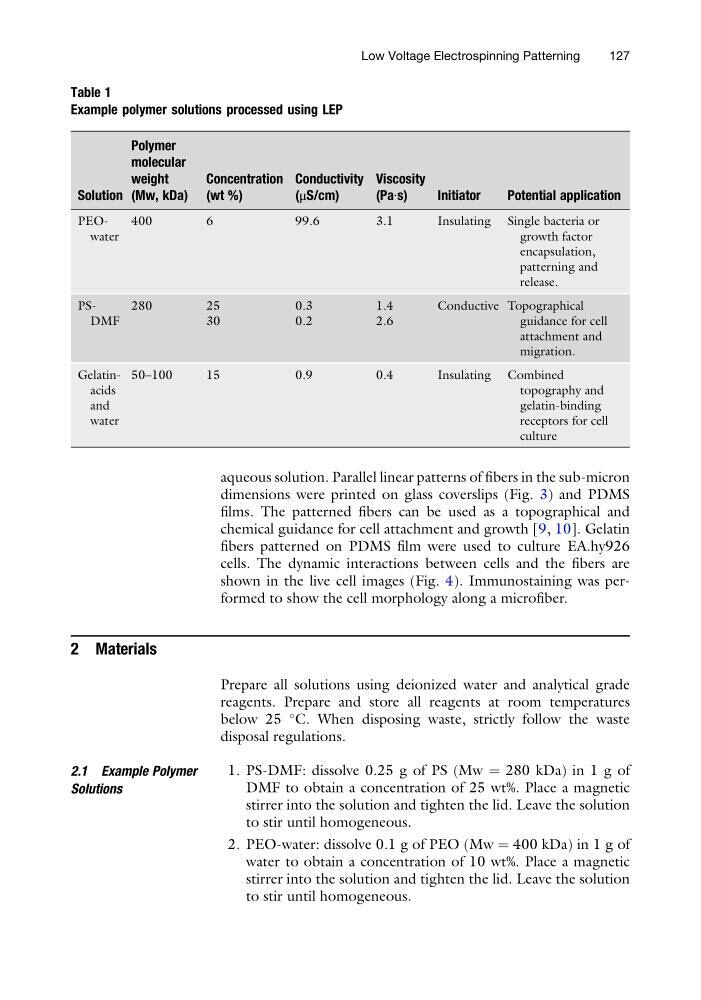
Table 1
Example polymer solutions processed using LEP
Solution
Polymer
molecular
weight
(Mw, kDa)
Concentration
(wt %)
Conductivity
(μS/cm)
Viscosity
(Pa∙s)
Initiator
Potential application
PEOwater
400
6
99.6
3.1
Insulating Single bacteria or
growth factor
encapsulation,
patterning and
release.
PSDMF
280
25
30
0.3
0.2
1.4
2.6
Conductive Topographical
guidance for cell
attachment and
migration.
Gelatinacids
and
water
50–100
15
0.9
0.4
Insulating Combined
topography and
gelatin-binding
receptors for cell
culture
Low Voltage Electrospinning Patterning
127
dimensions were printed on glass coverslips (Fig. 3) and PDMS
films. The patterned fibers can be used as a topographical and
chemical guidance for cell attachment and growth [9, 10]. Gelatin
fibers patterned on PDMS film were used to culture EA.hy926
cells. The dynamic interactions between cells and the fibers are
shown in the live cell images (Fig. 4). Immunostaining was performed to show the cell morphology along a microfiber.
2 Materials
Prepare all solutions using deionized water and analytical grade
reagents. Prepare and store all reagents at room temperatures
below 25
C. When disposing waste, strictly follow the waste
disposal regulations.
2.1 Example Polymer
Solutions
1. PS-DMF: dissolve 0.25 g of PS (Mw ¼ 280 kDa) in 1 g of
DMF to obtain a concentration of 25 wt%. Place a magnetic
stirrer into the solution and tighten the lid. Leave the solution
to stir until homogeneous.
2. PEO-water: dissolve 0.1 g of PEO (Mw ¼ 400 kDa) in 1 g of
water to obtain a concentration of 10 wt%. Place a magnetic
stirrer into the solution and tighten the lid. Leave the solution
to stir until homogeneous.
Table 1
Example polymer solutions processed using LEP
Solution
Polymer
molecular
weight
(Mw, kDa)
Concentration
(wt %)
Conductivity
(μS/cm)
Viscosity
(Pa∙s)
Initiator
Potential application
PEOwater
400
6
99.6
3.1
Insulating Single bacteria or
growth factor
encapsulation,
patterning and
release.
PSDMF
280
25
30
0.3
0.2
1.4
2.6
Conductive Topographical
guidance for cell
attachment and
migration.
Gelatinacids
and
water
50–100
15
0.9
0.4
Insulating Combined
topography and
gelatin-binding
receptors for cell
culture
Low Voltage Electrospinning Patterning
127