

Filtration Membranes Containing Nanoparticles of Hydrated …
767
8 Mechanism of Fouling
According to theoretical models, the mechanism of fouling is divided into complete
blocking of pores; pore narrowing (deposition on the walls of the pores); formation
of a cake on the outer surface.
The mechanism of fouling was estimated according to the Hermia model [69],
which takes into consideration a change of the permeate flux over time:
d
2 t
dV
= k
dt
dV
n
,
(8)
where k is the proportionality factor for describing the resistance of the protein layer.
The exponent n characterizes the fouling model: n = 0 corresponds to the cake
formation, n = 1.5 is related to partial pore blockage (a substance is adsorbed on the
pore walls, the centre of pores remains free), n = 1 is attributed to the intermediate
case, n = 2 means complete blockage of pores. Reducing the number of available
pores leads to a significant resistance to filtration [69]. The exponent value can be
determined from the logarithmic dependence of the second derivative of the t − V
function on the first derivative:
log
d
2 t
dV 2 = log k + n log
dt
dV
(9)
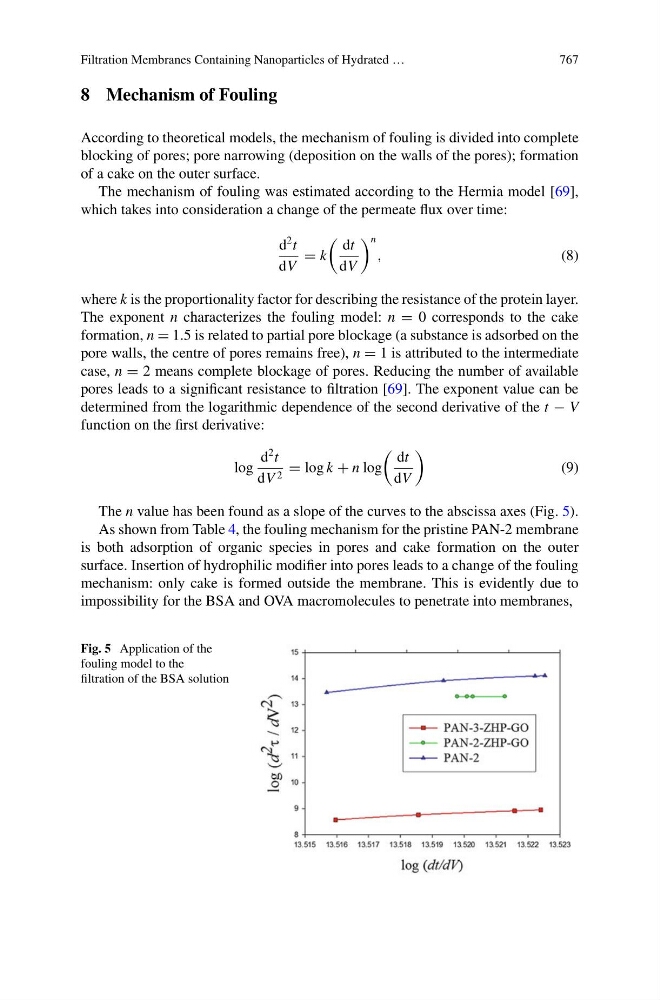
The n value has been found as a slope of the curves to the abscissa axes (Fig. 5).
As shown from Table 4, the fouling mechanism for the pristine PAN-2 membrane
is both adsorption of organic species in pores and cake formation on the outer
surface. Insertion of hydrophilic modifier into pores leads to a change of the fouling
mechanism: only cake is formed outside the membrane. This is evidently due to
impossibility for the BSA and OVA macromolecules to penetrate into membranes,
Fig. 5 Application of the
fouling model to the
filtration of the BSA solution