

766
L. Rozhdestvenska et al.
Table 4 Hydrodynamic resistance of membranes and modelling of their fouling
Parameter
PAN-2
PAN-2–HZD–GO
PAN-3
PAN-3–HZD–GO
R m , m −1
8.55 × 10 12
6.73 × 10 13
3.13 × 10 12
6.5 × 10 12
n H 2 O
–
0
–
0.5
n BSA
0.99
0
–
0.01
n OVA
0.67
0
–
1.5
where η is the dynamic viscosity of the liquid being filtered, R m is the hydrodynamic
resistance of a membrane. Comparing with pristine membranes, the hydrodynamic
resistance of the composites is higher in two (PAN-3–HZD–GO) and eight times
(PAN-3–HZD–GO), as shown in Table 4. It means blockage of membrane pores
with modifier particles.
7 Filtration of the Protein Solutions
Despite GO swelling, which accelerates the diffusion of the alkaline metal cations,
the modifier improves the membrane selectivity toward OVA and BSA (see Table 2).
It means smaller pore size between the modifier particles comparing with protein
macromolecules. For instance, the size of the elliptic BSA macromolecule is 14 ×
4 × 4 nm. Regarding OVA, its size is about 3 nm [68]. It means, the size of pores
between the modifier particles is ≈3 nm. Larger pore size has been found for HZD
embedded to microfiltration membrane (14–18 nm) [31, 32].
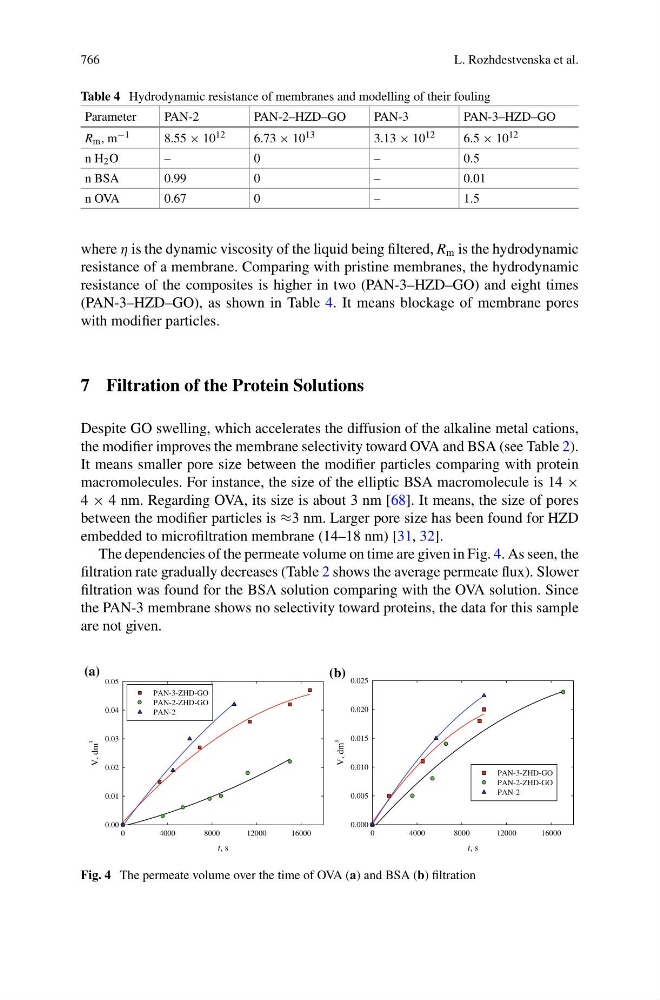
The dependencies of the permeate volume on time are given in Fig. 4. As seen, the
filtration rate gradually decreases (Table 2 shows the average permeate flux). Slower
filtration was found for the BSA solution comparing with the OVA solution. Since
the PAN-3 membrane shows no selectivity toward proteins, the data for this sample
are not given.
t, s
0
4000
8000
12000
16000
V, dm
3
0.00
0.01
0.02
0.03
0.04
0.05
PAN-3-ZHD-GO
PAN-2-ZHD-GO
PAN-2
(a)
t, s
0
4000
8000
12000
16000
V, dm
3
0.000
0.005
0.010
0.015
0.020
0.025
PAN-3-ZHD-GO
PAN-2-ZHD-GO
PAN-2
(b)
Fig. 4 The permeate volume over the time of OVA (a) and BSA (b) filtration