

764
L. Rozhdestvenska et al.
through the PAN-2 membrane: lower values of diffusion coefficients have been found
for the sample containing HZD–GO composite than for the PAN-2–HZD membrane.
According to the data of Table 1, the active layer of this polymer is characterized
by the smallest pore size: in this case, GO affects ion mobility. On the contrary, the
PAN-3–HZD–GO and PAN-4–HZD–GO samples show higher values of diffusion
coefficient comparing with the membranes modified with HZD. It means higher
swelling of GO in larger pores despite the inorganic ion exchanger. Indeed, the effect
of GO on the nobility of higher hydrated Na
+ ions is more sufficient than that of Li
+
ions.
Further, the membranes, for which GO slows down diffusion or changes it to the
greatest degree (namely, the materials based on PAN-2 and PAN-4), were investigated
in more detail.
6 Filtration of the Solution Containing Inorganic Ions
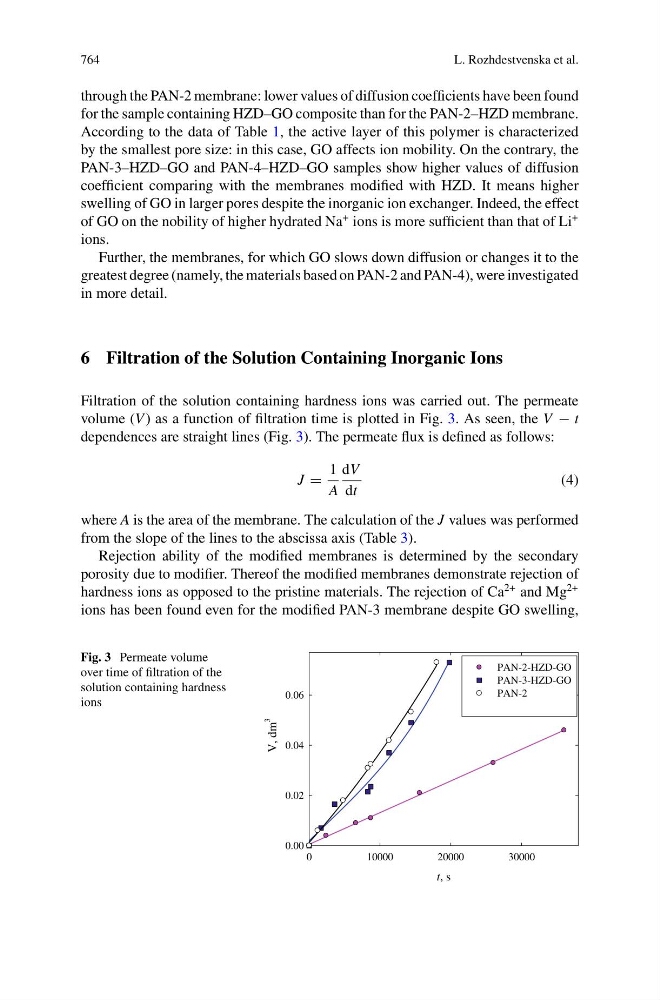
Filtration of the solution containing hardness ions was carried out. The permeate
volume (V ) as a function of filtration time is plotted in Fig. 3. As seen, the V − t
dependences are straight lines (Fig. 3). The permeate flux is defined as follows:
J =
1
A
dV
dt
(4)
where A is the area of the membrane. The calculation of the J values was performed
from the slope of the lines to the abscissa axis (Table 3).
Rejection ability of the modified membranes is determined by the secondary
porosity due to modifier. Thereof the modified membranes demonstrate rejection of
hardness ions as opposed to the pristine materials. The rejection of Ca
2+ and Mg
2+
ions has been found even for the modified PAN-3 membrane despite GO swelling,
Fig. 3 Permeate volume
over time of filtration of the
solution containing hardness
ions
t, s
0
10000
20000
30000
V, dm
3
0.00
0.02
0.04
0.06
PAN-2-HZD-GO
PAN-3-HZD-GO
PAN-2