

752
M. Ved’ et al.
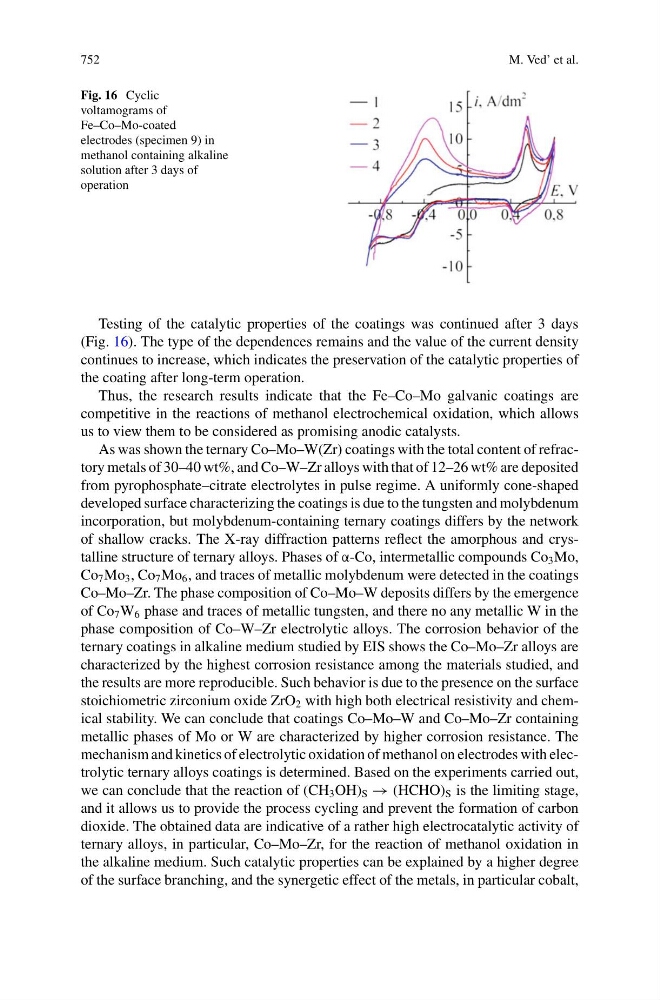
Fig. 16 Cyclic
voltamograms of
Fe–Co–Mo-coated
electrodes (specimen 9) in
methanol containing alkaline
solution after 3 days of
operation
Testing of the catalytic properties of the coatings was continued after 3 days
(Fig. 16). The type of the dependences remains and the value of the current density
continues to increase, which indicates the preservation of the catalytic properties of
the coating after long-term operation.
Thus, the research results indicate that the Fe–Co–Mo galvanic coatings are
competitive in the reactions of methanol electrochemical oxidation, which allows
us to view them to be considered as promising anodic catalysts.
As was shown the ternary Co–Mo–W(Zr) coatings with the total content of refractory metals of 30–40 wt%, and Co–W–Zr alloys with that of 12–26 wt% are deposited
from pyrophosphate–citrate electrolytes in pulse regime. A uniformly cone-shaped
developed surface characterizing the coatings is due to the tungsten and molybdenum
incorporation, but molybdenum-containing ternary coatings differs by the network
of shallow cracks. The X-ray diffraction patterns reflect the amorphous and crystalline structure of ternary alloys. Phases of α-Co, intermetallic compounds Co 3 Mo,
Co 7 Mo 3 , Co 7 Mo 6 , and traces of metallic molybdenum were detected in the coatings
Co–Mo–Zr. The phase composition of Co–Mo–W deposits differs by the emergence
of Co 7 W 6 phase and traces of metallic tungsten, and there no any metallic W in the
phase composition of Co–W–Zr electrolytic alloys. The corrosion behavior of the
ternary coatings in alkaline medium studied by EIS shows the Co–Mo–Zr alloys are
characterized by the highest corrosion resistance among the materials studied, and
the results are more reproducible. Such behavior is due to the presence on the surface
stoichiometric zirconium oxide ZrO 2 with high both electrical resistivity and chemical stability. We can conclude that coatings Co–Mo–W and Co–Mo–Zr containing
metallic phases of Mo or W are characterized by higher corrosion resistance. The
mechanism and kinetics of electrolytic oxidation of methanol on electrodes with electrolytic ternary alloys coatings is determined. Based on the experiments carried out,
we can conclude that the reaction of (CH 3 OH) S → (HCHO) S is the limiting stage,
and it allows us to provide the process cycling and prevent the formation of carbon
dioxide. The obtained data are indicative of a rather high electrocatalytic activity of
ternary alloys, in particular, Co–Mo–Zr, for the reaction of methanol oxidation in
the alkaline medium. Such catalytic properties can be explained by a higher degree
of the surface branching, and the synergetic effect of the metals, in particular cobalt,