

TiO 2 –ZnO Nanocomposites for Photodegradation of Dyes …
729
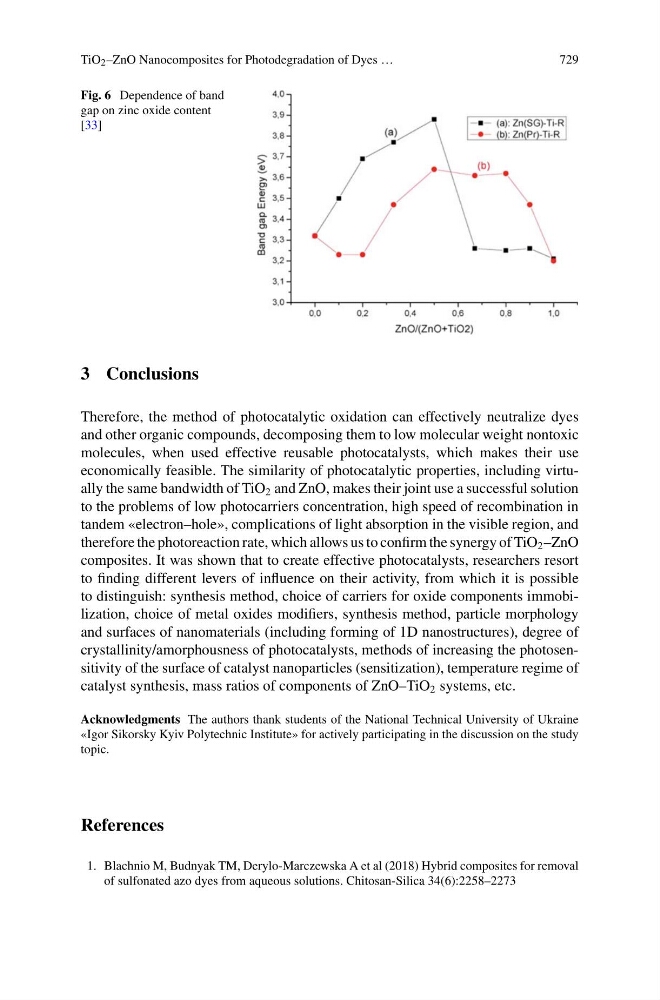
Fig. 6 Dependence of band
gap on zinc oxide content
[33]
3 Conclusions
Therefore, the method of photocatalytic oxidation can effectively neutralize dyes
and other organic compounds, decomposing them to low molecular weight nontoxic
molecules, when used effective reusable photocatalysts, which makes their use
economically feasible. The similarity of photocatalytic properties, including virtually the same bandwidth of TiO 2 and ZnO, makes their joint use a successful solution
to the problems of low photocarriers concentration, high speed of recombination in
tandem «electron–hole», complications of light absorption in the visible region, and
therefore the photoreaction rate, which allows us to confirm the synergy of TiO 2 –ZnO
composites. It was shown that to create effective photocatalysts, researchers resort
to finding different levers of influence on their activity, from which it is possible
to distinguish: synthesis method, choice of carriers for oxide components immobilization, choice of metal oxides modifiers, synthesis method, particle morphology
and surfaces of nanomaterials (including forming of 1D nanostructures), degree of
crystallinity/amorphousness of photocatalysts, methods of increasing the photosensitivity of the surface of catalyst nanoparticles (sensitization), temperature regime of
catalyst synthesis, mass ratios of components of ZnO–TiO 2 systems, etc.
Acknowledgments The authors thank students of the National Technical University of Ukraine
«Igor Sikorsky Kyiv Polytechnic Institute» for actively participating in the discussion on the study
topic.
References
1. Blachnio M, Budnyak TM, Derylo-Marczewska A et al (2018) Hybrid composites for removal
of sulfonated azo dyes from aqueous solutions. Chitosan-Silica 34(6):2258–2273