

728
O. Yanushevska et al.
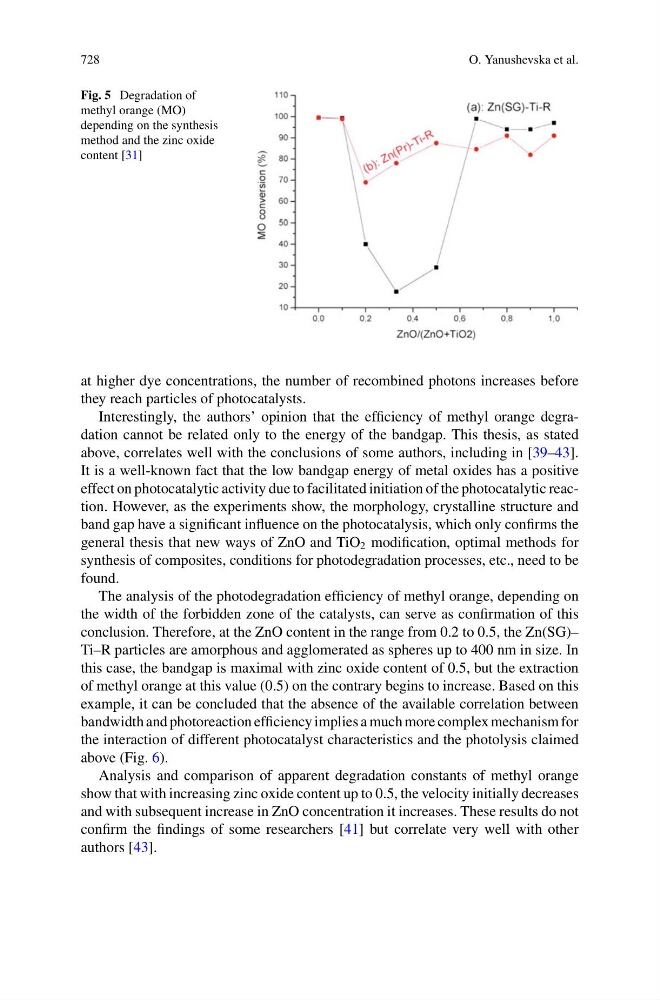
Fig. 5 Degradation of
methyl orange (MO)
depending on the synthesis
method and the zinc oxide
content [31]
at higher dye concentrations, the number of recombined photons increases before
they reach particles of photocatalysts.
Interestingly, the authors’ opinion that the efficiency of methyl orange degradation cannot be related only to the energy of the bandgap. This thesis, as stated
above, correlates well with the conclusions of some authors, including in [39–43].
It is a well-known fact that the low bandgap energy of metal oxides has a positive
effect on photocatalytic activity due to facilitated initiation of the photocatalytic reaction. However, as the experiments show, the morphology, crystalline structure and
band gap have a significant influence on the photocatalysis, which only confirms the
general thesis that new ways of ZnO and TiO 2 modification, optimal methods for
synthesis of composites, conditions for photodegradation processes, etc., need to be
found.
The analysis of the photodegradation efficiency of methyl orange, depending on
the width of the forbidden zone of the catalysts, can serve as confirmation of this
conclusion. Therefore, at the ZnO content in the range from 0.2 to 0.5, the Zn(SG)–
Ti–R particles are amorphous and agglomerated as spheres up to 400 nm in size. In
this case, the bandgap is maximal with zinc oxide content of 0.5, but the extraction
of methyl orange at this value (0.5) on the contrary begins to increase. Based on this
example, it can be concluded that the absence of the available correlation between
bandwidth and photoreaction efficiency implies a much more complex mechanism for
the interaction of different photocatalyst characteristics and the photolysis claimed
above (Fig. 6).
Analysis and comparison of apparent degradation constants of methyl orange
show that with increasing zinc oxide content up to 0.5, the velocity initially decreases
and with subsequent increase in ZnO concentration it increases. These results do not
confirm the findings of some researchers [41] but correlate very well with other
authors [43].