

720
O. Yanushevska et al.
catalysts usage, and simultaneous purification of the pollutant mixtures, complete
destruction of contaminants, low cost, and the ease of operation.
The photocatalytic degradation method is based on the generation of effective
oxidizing hydroxyl radicals by metal oxides (semiconductors) under the action of UV
radiation. Semiconductor materials (TiO 2 , ZnO, Fe 2 O 3 , WO 3 , CdS, ZnS, Cu 2 O, CuO,
SnO 2, and V 2 O 5 ) are irradiated with UV waveband, which transmits additional energy
to the electrons to overcome the bandgap for their transition into the conduction band.
The generated hydroxyl and oxide radicals react with the pollutants, which leads to
their complete degradation.
Given the large bandgap (3.2 eV) and the high rate of recombination of «electron–
hole» processes that limit TiO 2 catalytic activity, studies to improve the efficiency of
titanium (IV) oxide photocatalysts by its doping with metal oxides are conducted [6].
Among the metal oxides zinc oxide (ZnO), which has a similar bandgap (3.37 eV) and
greater catalytic activity in corrosive environments, is distinguished. The TiO 2 –ZnO
nanocomposite exhibits better photocatalytic properties than both oxides separately
by extending the «life» time of the photo-excited pairs—«hole–electron.»
Therefore, the use of binary nanocomposites increases the sorption and photocatalytic activity of nanomaterials, which opens the prospects for optimization of water
treatment processes.
1.2 Structural Modifications of Titanium (IV) and Zinc (II)
Oxides
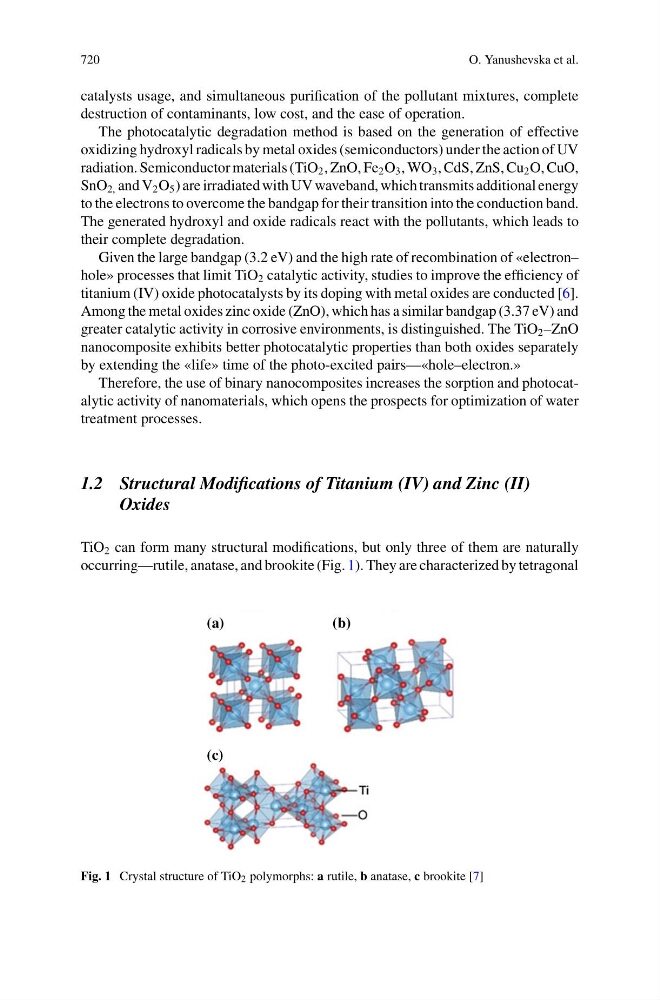
TiO 2 can form many structural modifications, but only three of them are naturally
occurring—rutile, anatase, and brookite (Fig. 1). They are characterized by tetragonal
(a)
(c)
(b)
Fig. 1 Crystal structure of TiO 2 polymorphs: a rutile, b anatase, c brookite [7]