

The Influence of Carbon, Carbon, and Boron on the Formation …
707
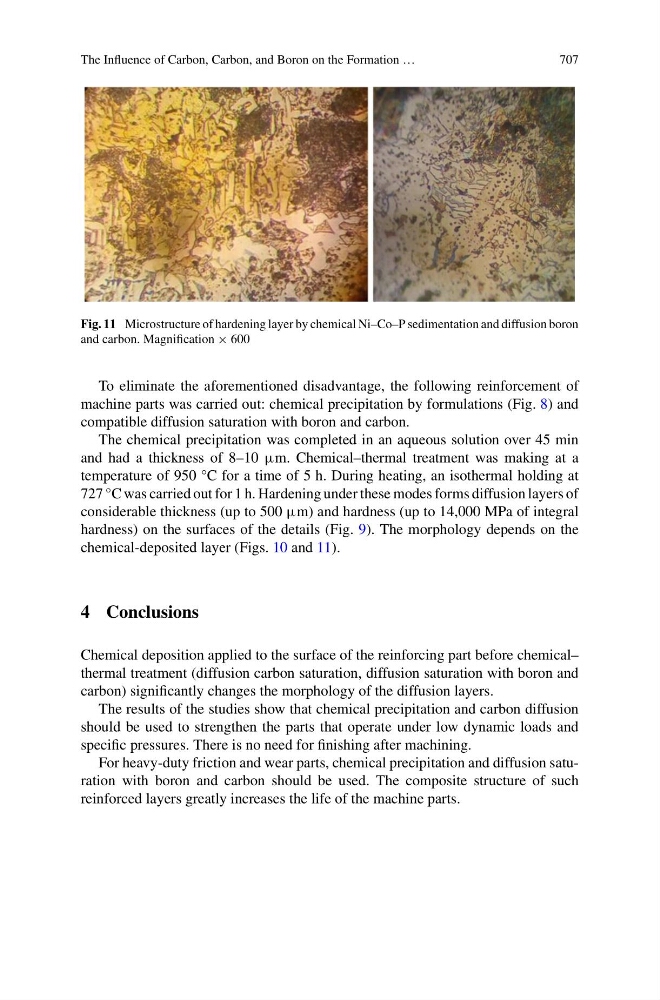
Fig. 11 Microstructure of hardening layer by chemical Ni–Co–P sedimentation and diffusion boron
and carbon. Magnification × 600
To eliminate the aforementioned disadvantage, the following reinforcement of
machine parts was carried out: chemical precipitation by formulations (Fig. 8) and
compatible diffusion saturation with boron and carbon.
The chemical precipitation was completed in an aqueous solution over 45 min
and had a thickness of 8–10 µm. Chemical–thermal treatment was making at a
temperature of 950 °C for a time of 5 h. During heating, an isothermal holding at
727 °C was carried out for 1 h. Hardening under these modes forms diffusion layers of
considerable thickness (up to 500 µm) and hardness (up to 14,000 MPa of integral
hardness) on the surfaces of the details (Fig. 9). The morphology depends on the
chemical-deposited layer (Figs. 10 and 11).
4 Conclusions
Chemical deposition applied to the surface of the reinforcing part before chemical–
thermal treatment (diffusion carbon saturation, diffusion saturation with boron and
carbon) significantly changes the morphology of the diffusion layers.
The results of the studies show that chemical precipitation and carbon diffusion
should be used to strengthen the parts that operate under low dynamic loads and
specific pressures. There is no need for finishing after machining.
For heavy-duty friction and wear parts, chemical precipitation and diffusion saturation with boron and carbon should be used. The composite structure of such
reinforced layers greatly increases the life of the machine parts.