

666
M. C. Bouleklab et al.
sintering begins to dominate the role of the above-mentioned expansion mechanisms
at the temperature of ~800 °C.
Taking into account the made above detailed discussion of the dilatometric characteristics of the Fe–Cu composite behavior, the changes in the L/L 0 (T) α (T)
dependences those occur with the addition of a small amount of the MWCNT (Fe–
Cu-CNT(0.5) composite) at temperatures higher than 350 °C become clearer. (The
role of the CNT at temperature <~300–350 °C has been observed above.) We suppose,
as it was just observed and evaluated earlier [31], that the penetration of carbon atoms
from carbon nanotubes into the surface layer of iron grains is primarily due to the
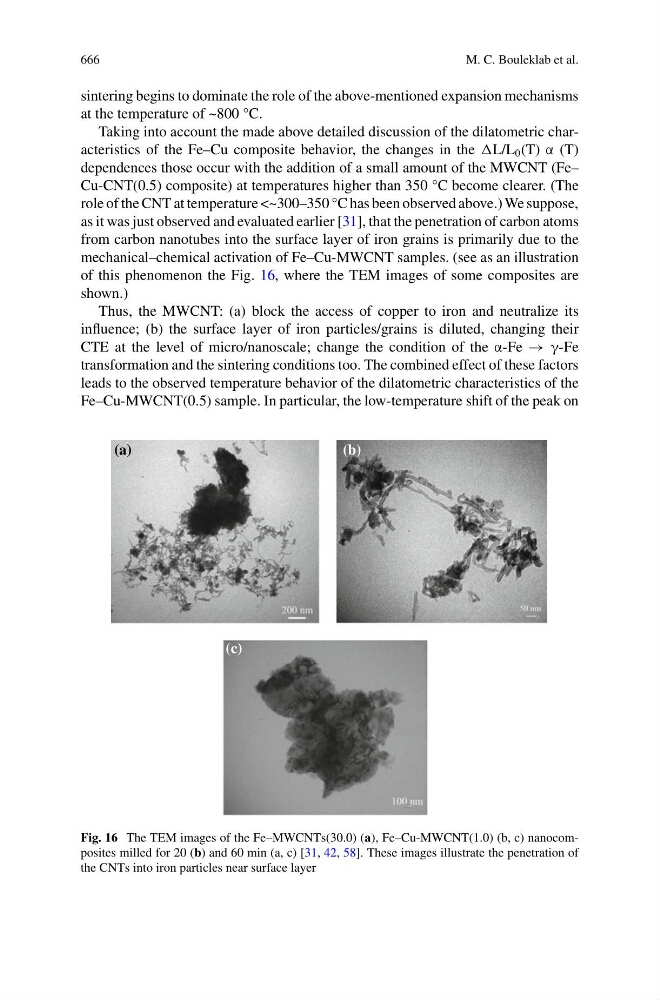
mechanical–chemical activation of Fe–Cu-MWCNT samples. (see as an illustration
of this phenomenon the Fig. 16, where the TEM images of some composites are
shown.)
Thus, the MWCNT: (a) block the access of copper to iron and neutralize its
influence; (b) the surface layer of iron particles/grains is diluted, changing their
CTE at the level of micro/nanoscale; change the condition of the α-Fe → γ-Fe
transformation and the sintering conditions too. The combined effect of these factors
leads to the observed temperature behavior of the dilatometric characteristics of the
Fe–Cu-MWCNT(0.5) sample. In particular, the low-temperature shift of the peak on
(a)
(b)
(c)
Fig. 16 The TEM images of the Fe–MWCNTs(30.0) (a), Fe–Cu-MWCNT(1.0) (b, c) nanocomposites milled for 20 (b) and 60 min (a, c) [31, 42, 58]. These images illustrate the penetration of
the CNTs into iron particles near surface layer