

42
L. S. Martseniuk and A. S. Martseniuk
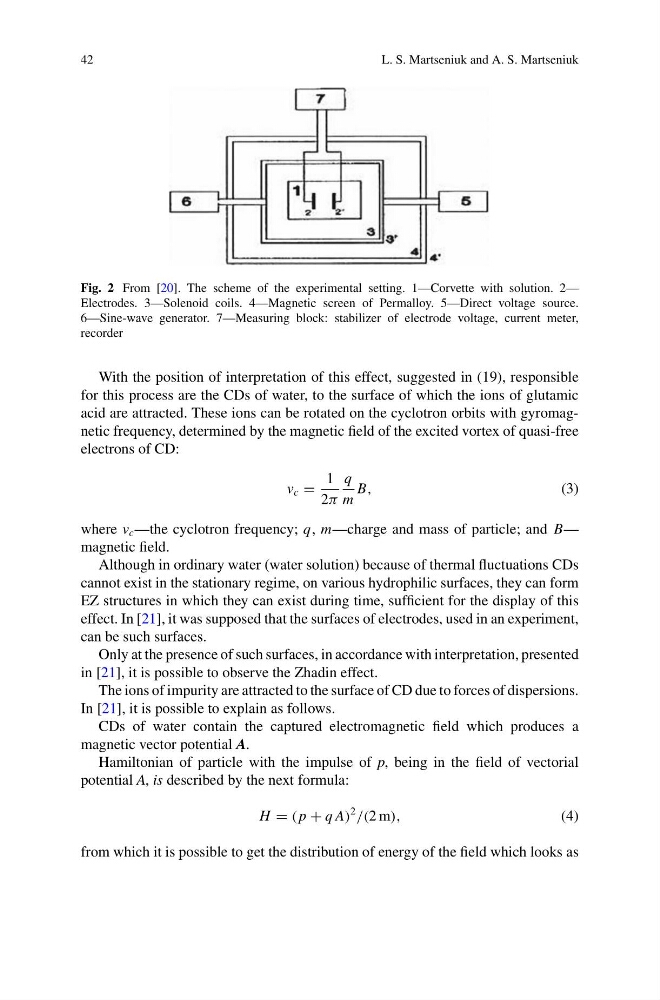
Fig. 2 From [20]. The scheme of the experimental setting. 1—Corvette with solution. 2—
Electrodes. 3—Solenoid coils. 4—Magnetic screen of Permalloy. 5—Direct voltage source.
6—Sine-wave generator. 7—Measuring block: stabilizer of electrode voltage, current meter,
recorder
With the position of interpretation of this effect, suggested in (19), responsible
for this process are the CDs of water, to the surface of which the ions of glutamic
acid are attracted. These ions can be rotated on the cyclotron orbits with gyromagnetic frequency, determined by the magnetic field of the excited vortex of quasi-free
electrons of CD:
v c =
1
2π
q
m
B,
(3)
where v c —the cyclotron frequency; q, m—charge and mass of particle; and B—
magnetic field.
Although in ordinary water (water solution) because of thermal fluctuations CDs
cannot exist in the stationary regime, on various hydrophilic surfaces, they can form
EZ structures in which they can exist during time, sufficient for the display of this
effect. In [21], it was supposed that the surfaces of electrodes, used in an experiment,
can be such surfaces.
Only at the presence of such surfaces, in accordance with interpretation, presented
in [21], it is possible to observe the Zhadin effect.
The ions of impurity are attracted to the surface of CD due to forces of dispersions.
In [21], it is possible to explain as follows.
CDs of water contain the captured electromagnetic field which produces a
magnetic vector potential A.
Hamiltonian of particle with the impulse of p, being in the field of vectorial
potential A, is described by the next formula:
H = ( p + q A)
2
/(2 m),
(4)
from which it is possible to get the distribution of energy of the field which looks as
L. S. Martseniuk and A. S. Martseniuk
Fig. 2 From [20]. The scheme of the experimental setting. 1—Corvette with solution. 2—
Electrodes. 3—Solenoid coils. 4—Magnetic screen of Permalloy. 5—Direct voltage source.
6—Sine-wave generator. 7—Measuring block: stabilizer of electrode voltage, current meter,
recorder
With the position of interpretation of this effect, suggested in (19), responsible
for this process are the CDs of water, to the surface of which the ions of glutamic
acid are attracted. These ions can be rotated on the cyclotron orbits with gyromagnetic frequency, determined by the magnetic field of the excited vortex of quasi-free
electrons of CD:
v c =
1
2π
q
m
B,
(3)
where v c —the cyclotron frequency; q, m—charge and mass of particle; and B—
magnetic field.
Although in ordinary water (water solution) because of thermal fluctuations CDs
cannot exist in the stationary regime, on various hydrophilic surfaces, they can form
EZ structures in which they can exist during time, sufficient for the display of this
effect. In [21], it was supposed that the surfaces of electrodes, used in an experiment,
can be such surfaces.
Only at the presence of such surfaces, in accordance with interpretation, presented
in [21], it is possible to observe the Zhadin effect.
The ions of impurity are attracted to the surface of CD due to forces of dispersions.
In [21], it is possible to explain as follows.
CDs of water contain the captured electromagnetic field which produces a
magnetic vector potential A.
Hamiltonian of particle with the impulse of p, being in the field of vectorial
potential A, is described by the next formula:
H = ( p + q A)
2
/(2 m),
(4)
from which it is possible to get the distribution of energy of the field which looks as