

632
A. P. Pospelov et al.
200 400 600 800 1000
0
10000
20000
30000
40000
R,
Ohm
t, sec
(a)
(b)
926.1 926.4 926.7 927.0 927.3
500
600
700
800
900
R
pct , Ohm
t, sec
1
2
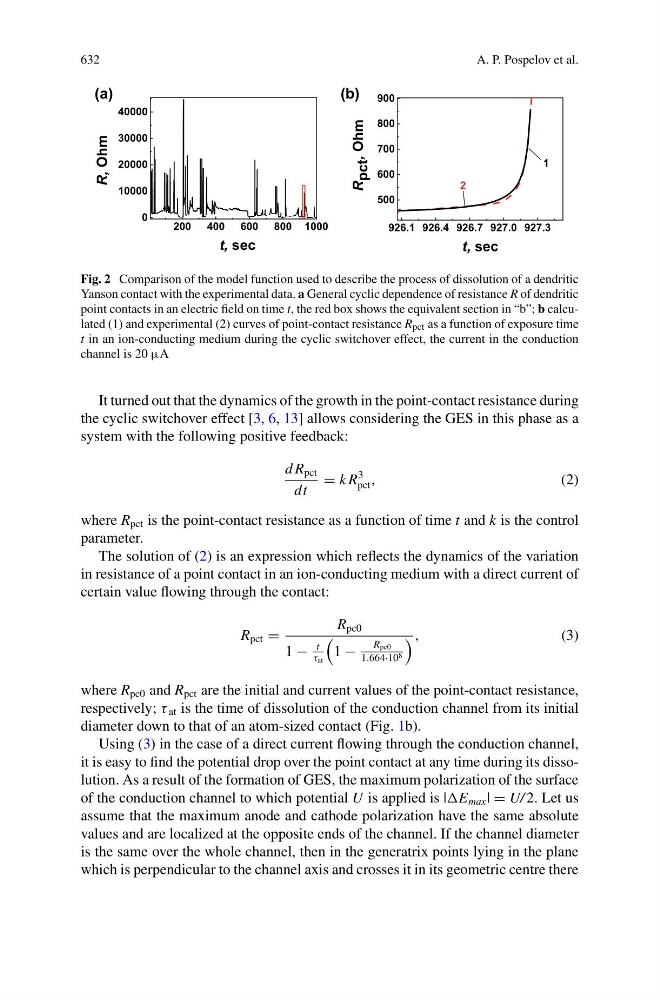
Fig. 2 Comparison of the model function used to describe the process of dissolution of a dendritic
Yanson contact with the experimental data. a General cyclic dependence of resistance R of dendritic
point contacts in an electric field on time t, the red box shows the equivalent section in “b”; b calculated (1) and experimental (2) curves of point-contact resistance R pct as a function of exposure time
t in an ion-conducting medium during the cyclic switchover effect, the current in the conduction
channel is 20 μA
It turned out that the dynamics of the growth in the point-contact resistance during
the cyclic switchover effect [3, 6, 13] allows considering the GES in this phase as a
system with the following positive feedback:
d R pct
dt
= k R
3
pct ,
(2)
where R pct is the point-contact resistance as a function of time t and k is the control
parameter.
The solution of (2) is an expression which reflects the dynamics of the variation
in resistance of a point contact in an ion-conducting medium with a direct current of
certain value flowing through the contact:
R pct =
R pc0
1 −
t
τ at
1 −
R pc0
1.664·10 8
,
(3)
where R pc0 and R pct are the initial and current values of the point-contact resistance,
respectively; τ at is the time of dissolution of the conduction channel from its initial
diameter down to that of an atom-sized contact (Fig. 1b).
Using (3) in the case of a direct current flowing through the conduction channel,
it is easy to find the potential drop over the point contact at any time during its dissolution. As a result of the formation of GES, the maximum polarization of the surface
of the conduction channel to which potential U is applied is | max | = U/ 2. Let us
assume that the maximum anode and cathode polarization have the same absolute
values and are localized at the opposite ends of the channel. If the channel diameter
is the same over the whole channel, then in the generatrix points lying in the plane
which is perpendicular to the channel axis and crosses it in its geometric centre there