

Activation Mechanism of the Cyclic Switchover Effect …
631
initial state characterized by some initial diameter to the conduction channel of an
atom-sized cross section.
Each cycle of the switchover process implies “birth” and “death” of a new point
contact in an electric field. If we neglect the drift of the system parameters during
the process, then each cycle can be seen as a parallel experiment. So, we can obtain
a large database of characteristic properties of these nanostructures with reliably
confirmed parameters for each cycle. The lifetime of a point contact as a function of its
initial resistance is one of the parameters. By comparing the data on this dependence
obtained from a model and from experiments, we will be able to arrive at a more
adequate description of the process and thus reveal some important peculiarities
in the behavior of the analyzed nanostructure. This is the task the present paper is
dealing with below.
When considering the way the gapless electrode system functions, we believe that
the intensity of the destruction of the analyzed nanostructure (decommutation phase)
is directly dependent on the density of the electrochemical current at the positively
polarized surface of the conduction channel. Let us suppose that the properties of
the surface layer of the conductor are virtually the same as those in the bulk of
the material. In this case, we neglect the impact of the energetically more saturated
surface layers on conductance, as well as the influence of compounds that may be
formed on the surface of the conductor as a result of its interaction with the electrolyte.
The anode polarization is directly correlated with the rate of the anode dissolution.
If we assume that the positive polarization in the analyzed medium is determined by
the slowdown in the electron transfer, we can obtain an expression describing the
relation between the potential drop responsible for the transfer of electrons through
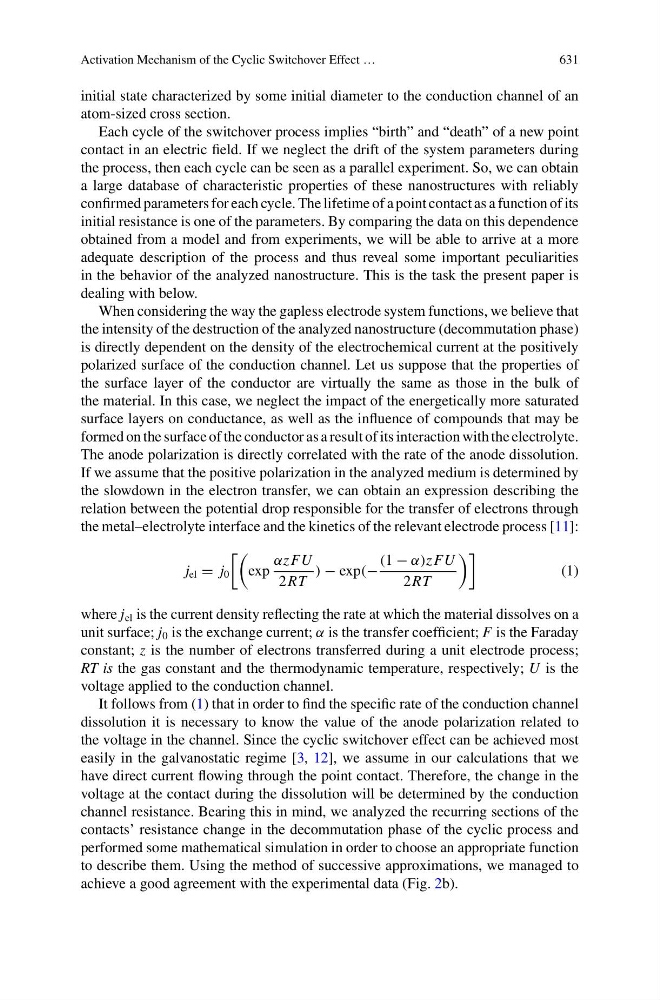
the metal–electrolyte interface and the kinetics of the relevant electrode process [11]:
j el = j 0
exp
αz FU
2RT
) − exp(−
(1 − α)z FU
2RT
(1)
where j el is the current density reflecting the rate at which the material dissolves on a
unit surface; j 0 is the exchange current; α is the transfer coefficient; F is the Faraday
constant; z is the number of electrons transferred during a unit electrode process;
RT is the gas constant and the thermodynamic temperature, respectively; U is the
voltage applied to the conduction channel.
It follows from (1) that in order to find the specific rate of the conduction channel
dissolution it is necessary to know the value of the anode polarization related to
the voltage in the channel. Since the cyclic switchover effect can be achieved most
easily in the galvanostatic regime [3, 12], we assume in our calculations that we
have direct current flowing through the point contact. Therefore, the change in the
voltage at the contact during the dissolution will be determined by the conduction
channel resistance. Bearing this in mind, we analyzed the recurring sections of the
contacts’ resistance change in the decommutation phase of the cyclic process and
performed some mathematical simulation in order to choose an appropriate function
to describe them. Using the method of successive approximations, we managed to
achieve a good agreement with the experimental data (Fig. 2b).