

610
V. Ya. Podhurska et al.
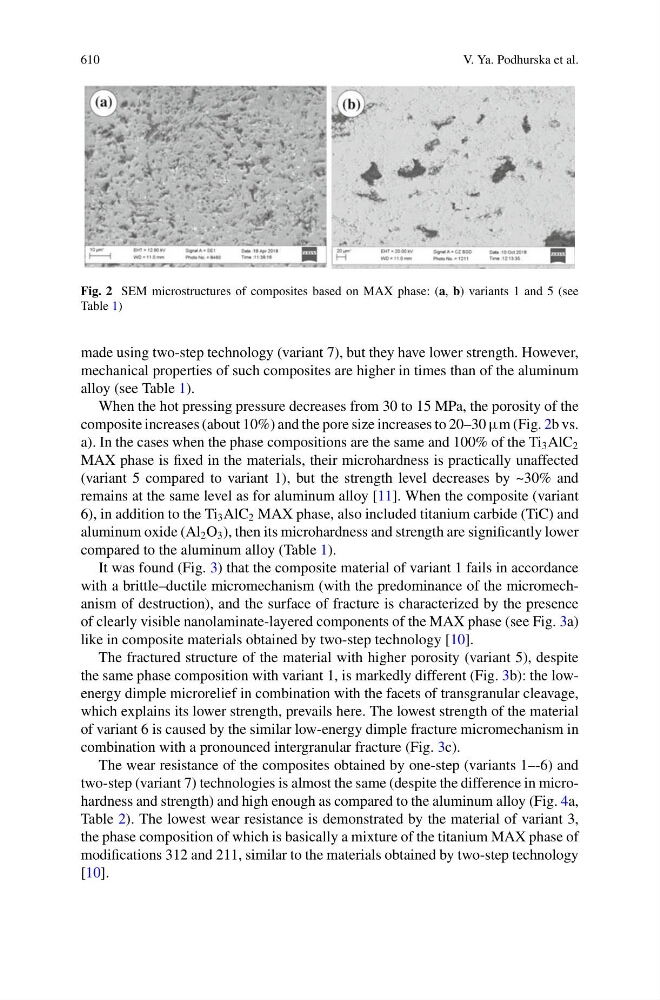
Fig. 2 SEM microstructures of composites based on MAX phase: (a, b) variants 1 and 5 (see
Table 1)
made using two-step technology (variant 7), but they have lower strength. However,
mechanical properties of such composites are higher in times than of the aluminum
alloy (see Table 1).
When the hot pressing pressure decreases from 30 to 15 MPa, the porosity of the
composite increases (about 10%) and the pore size increases to 20–30 μm (Fig. 2b vs.
a). In the cases when the phase compositions are the same and 100% of the Ti 3 AlC 2
MAX phase is fixed in the materials, their microhardness is practically unaffected
(variant 5 compared to variant 1), but the strength level decreases by ~30% and
remains at the same level as for aluminum alloy [11]. When the composite (variant
6), in addition to the Ti 3 AlC 2 MAX phase, also included titanium carbide (TiC) and
aluminum oxide (Al 2 O 3 ), then its microhardness and strength are significantly lower
compared to the aluminum alloy (Table 1).
It was found (Fig. 3) that the composite material of variant 1 fails in accordance
with a brittle–ductile micromechanism (with the predominance of the micromechanism of destruction), and the surface of fracture is characterized by the presence
of clearly visible nanolaminate-layered components of the MAX phase (see Fig. 3a)
like in composite materials obtained by two-step technology [10].
The fractured structure of the material with higher porosity (variant 5), despite
the same phase composition with variant 1, is markedly different (Fig. 3b): the lowenergy dimple microrelief in combination with the facets of transgranular cleavage,
which explains its lower strength, prevails here. The lowest strength of the material
of variant 6 is caused by the similar low-energy dimple fracture micromechanism in
combination with a pronounced intergranular fracture (Fig. 3c).
The wear resistance of the composites obtained by one-step (variants 1–-6) and
two-step (variant 7) technologies is almost the same (despite the difference in microhardness and strength) and high enough as compared to the aluminum alloy (Fig. 4a,
Table 2). The lowest wear resistance is demonstrated by the material of variant 3,
the phase composition of which is basically a mixture of the titanium MAX phase of
modifications 312 and 211, similar to the materials obtained by two-step technology
[10].