

Wear Resistance of Ti–Al–C MAX Phases …
609
Table 1 Phase compositions and mechanical properties of obtained materials
Variant
Technological parameters Phase composition, %
HV 200 , MPa
σ f , MPa
1
Hot pressing at 1350 °C,
30 MPa
100Ti 3 AlC 2
6460
425
2
–
96Ti 3 AlC 2
4TiC
5140
361
3
–
61Ti 3 AlC 2
22Ti 2 AlC
17TiC
5190
285
4
–
50Ti 3 AlC 2
7Ti 2 AlC
43TiC
6820
450
5
Hot pressing at 1350 °C,
15 MPa
100Ti 3 AlC 2
5450
285
6
–
93Ti 3 AlC 2 ,
4TiC,
3Al 2 O 3
930
88
7
Two-step technology [10] 95Ti 3 AlC 2
5TiC
5790
545
8
Aluminum alloy [10]
–
1100
300
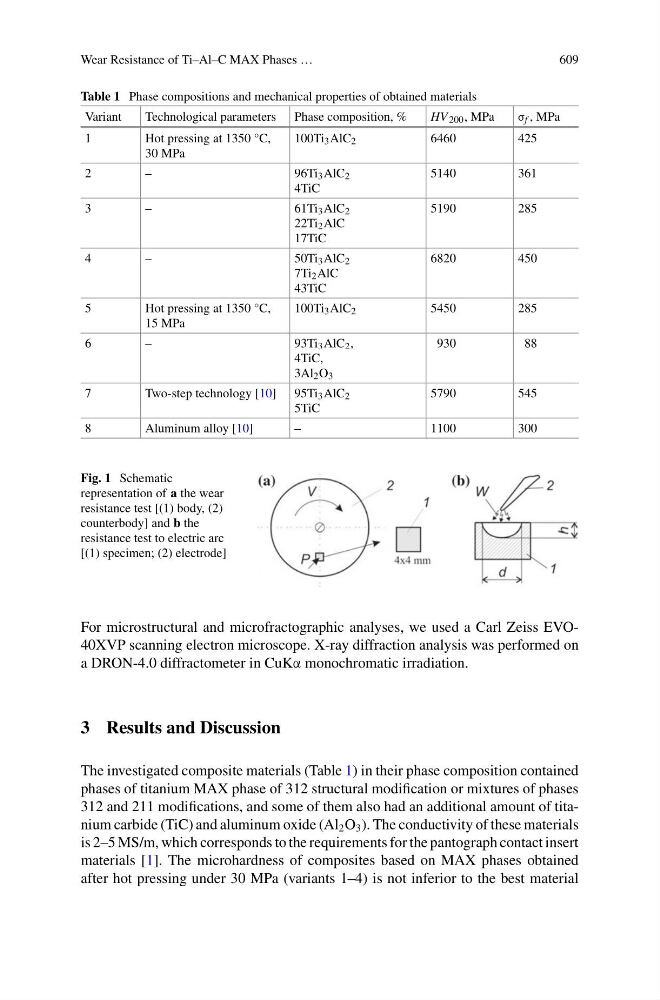
Fig. 1 Schematic
representation of a the wear
resistance test [(1) body, (2)
counterbody] and b the
resistance test to electric arc
[(1) specimen; (2) electrode]
For microstructural and microfractographic analyses, we used a Carl Zeiss EVO40XVP scanning electron microscope. X-ray diffraction analysis was performed on
a DRON-4.0 diffractometer in CuKα monochromatic irradiation.
3 Results and Discussion
The investigated composite materials (Table 1) in their phase composition contained
phases of titanium MAX phase of 312 structural modification or mixtures of phases
312 and 211 modifications, and some of them also had an additional amount of titanium carbide (TiC) and aluminum oxide (Al 2 O 3 ). The conductivity of these materials
is 2–5 MS/m, which corresponds to the requirements for the pantograph contact insert
materials [1]. The microhardness of composites based on MAX phases obtained
after hot pressing under 30 MPa (variants 1–4) is not inferior to the best material