

Influence of Different Type of Irradiation to Carbon Nanotubes
583
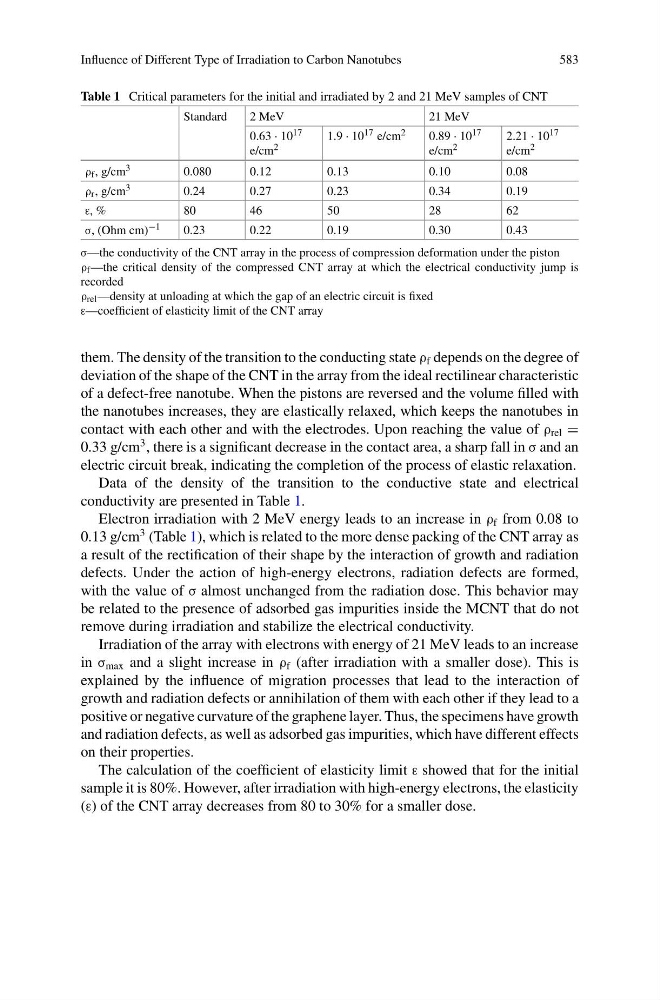
Table 1 Critical parameters for the initial and irradiated by 2 and 21 MeV samples of CNT
Standard
2 MeV
21 MeV
0.63 · 10 17
e/cm 2
1.9 · 10 17 e/cm 2
0.89 · 10 17
e/cm 2
2.21 · 10 17
e/cm 2
ρ f , g/cm 3
0.080
0.12
0.13
0.10
0.08
ρ r , g/cm 3
0.24
0.27
0.23
0.34
0.19
ε, %
80
46
50
28
62
σ, (Ohm cm) −1
0.23
0.22
0.19
0.30
0.43
σ—the conductivity of the CNT array in the process of compression deformation under the piston
ρ f —the critical density of the compressed CNT array at which the electrical conductivity jump is
recorded
ρ rel —density at unloading at which the gap of an electric circuit is fixed
ε—coefficient of elasticity limit of the CNT array
them. The density of the transition to the conducting state ρ f depends on the degree of
deviation of the shape of the CNT in the array from the ideal rectilinear characteristic
of a defect-free nanotube. When the pistons are reversed and the volume filled with
the nanotubes increases, they are elastically relaxed, which keeps the nanotubes in
contact with each other and with the electrodes. Upon reaching the value of ρ rel =
0.33 g/cm
3 , there is a significant decrease in the contact area, a sharp fall in σ and an
electric circuit break, indicating the completion of the process of elastic relaxation.
Data of the density of the transition to the conductive state and electrical
conductivity are presented in Table 1.
Electron irradiation with 2 MeV energy leads to an increase in ρ f from 0.08 to
0.13 g/cm
3 (Table 1), which is related to the more dense packing of the CNT array as
a result of the rectification of their shape by the interaction of growth and radiation
defects. Under the action of high-energy electrons, radiation defects are formed,
with the value of σ almost unchanged from the radiation dose. This behavior may
be related to the presence of adsorbed gas impurities inside the MCNT that do not
remove during irradiation and stabilize the electrical conductivity.
Irradiation of the array with electrons with energy of 21 MeV leads to an increase
in σ max and a slight increase in ρ f (after irradiation with a smaller dose). This is
explained by the influence of migration processes that lead to the interaction of
growth and radiation defects or annihilation of them with each other if they lead to a
positive or negative curvature of the graphene layer. Thus, the specimens have growth
and radiation defects, as well as adsorbed gas impurities, which have different effects
on their properties.
The calculation of the coefficient of elasticity limit ε showed that for the initial
sample it is 80%. However, after irradiation with high-energy electrons, the elasticity
(ε) of the CNT array decreases from 80 to 30% for a smaller dose.