

582
H. Yu. Mykhailova et al.
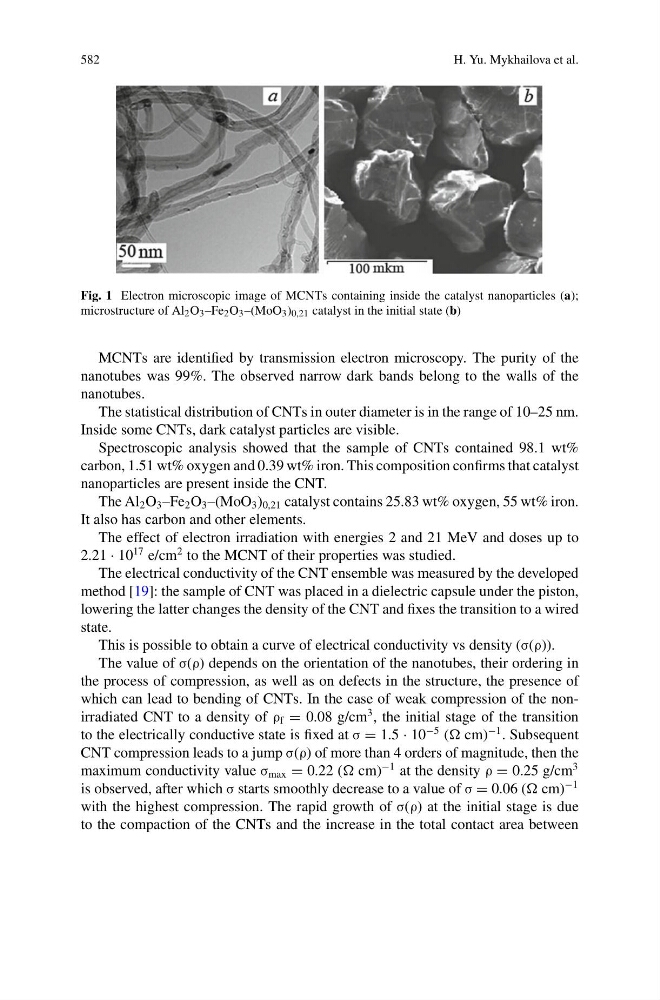
Fig. 1 Electron microscopic image of MCNTs containing inside the catalyst nanoparticles (a);
microstructure of Al 2 O 3 –Fe 2 O 3 –(MoO 3 ) 0,21 catalyst in the initial state (b)
MCNTs are identified by transmission electron microscopy. The purity of the
nanotubes was 99%. The observed narrow dark bands belong to the walls of the
nanotubes.
The statistical distribution of CNTs in outer diameter is in the range of 10–25 nm.
Inside some CNTs, dark catalyst particles are visible.
Spectroscopic analysis showed that the sample of CNTs contained 98.1 wt%
carbon, 1.51 wt% oxygen and 0.39 wt% iron. This composition confirms that catalyst
nanoparticles are present inside the CNT.
The Al 2 O 3 –Fe 2 O 3 –(MoO 3 ) 0,21 catalyst contains 25.83 wt% oxygen, 55 wt% iron.
It also has carbon and other elements.
The effect of electron irradiation with energies 2 and 21 MeV and doses up to
2.21 · 10
17 e/cm
2 to the MCNT of their properties was studied.
The electrical conductivity of the CNT ensemble was measured by the developed
method [19]: the sample of CNT was placed in a dielectric capsule under the piston,
lowering the latter changes the density of the CNT and fixes the transition to a wired
state.
This is possible to obtain a curve of electrical conductivity vs density (σ(ρ)).
The value of σ(ρ) depends on the orientation of the nanotubes, their ordering in
the process of compression, as well as on defects in the structure, the presence of
which can lead to bending of CNTs. In the case of weak compression of the nonirradiated CNT to a density of ρ f = 0.08 g/cm
3 , the initial stage of the transition
to the electrically conductive state is fixed at σ = 1.5 · 10
−5 ( cm)
−1 . Subsequent
CNT compression leads to a jump σ(ρ) of more than 4 orders of magnitude, then the
maximum conductivity value σ max = 0.22 ( cm)
−1 at the density ρ = 0.25 g/cm
3
is observed, after which σ starts smoothly decrease to a value of σ = 0.06 ( cm)
−1
with the highest compression. The rapid growth of σ(ρ) at the initial stage is due
to the compaction of the CNTs and the increase in the total contact area between
H. Yu. Mykhailova et al.
Fig. 1 Electron microscopic image of MCNTs containing inside the catalyst nanoparticles (a);
microstructure of Al 2 O 3 –Fe 2 O 3 –(MoO 3 ) 0,21 catalyst in the initial state (b)
MCNTs are identified by transmission electron microscopy. The purity of the
nanotubes was 99%. The observed narrow dark bands belong to the walls of the
nanotubes.
The statistical distribution of CNTs in outer diameter is in the range of 10–25 nm.
Inside some CNTs, dark catalyst particles are visible.
Spectroscopic analysis showed that the sample of CNTs contained 98.1 wt%
carbon, 1.51 wt% oxygen and 0.39 wt% iron. This composition confirms that catalyst
nanoparticles are present inside the CNT.
The Al 2 O 3 –Fe 2 O 3 –(MoO 3 ) 0,21 catalyst contains 25.83 wt% oxygen, 55 wt% iron.
It also has carbon and other elements.
The effect of electron irradiation with energies 2 and 21 MeV and doses up to
2.21 · 10
17 e/cm
2 to the MCNT of their properties was studied.
The electrical conductivity of the CNT ensemble was measured by the developed
method [19]: the sample of CNT was placed in a dielectric capsule under the piston,
lowering the latter changes the density of the CNT and fixes the transition to a wired
state.
This is possible to obtain a curve of electrical conductivity vs density (σ(ρ)).
The value of σ(ρ) depends on the orientation of the nanotubes, their ordering in
the process of compression, as well as on defects in the structure, the presence of
which can lead to bending of CNTs. In the case of weak compression of the nonirradiated CNT to a density of ρ f = 0.08 g/cm
3 , the initial stage of the transition
to the electrically conductive state is fixed at σ = 1.5 · 10
−5 ( cm)
−1 . Subsequent
CNT compression leads to a jump σ(ρ) of more than 4 orders of magnitude, then the
maximum conductivity value σ max = 0.22 ( cm)
−1 at the density ρ = 0.25 g/cm
3
is observed, after which σ starts smoothly decrease to a value of σ = 0.06 ( cm)
−1
with the highest compression. The rapid growth of σ(ρ) at the initial stage is due
to the compaction of the CNTs and the increase in the total contact area between