

32
O. Yu. Kravchenko and I. S. Maruschak
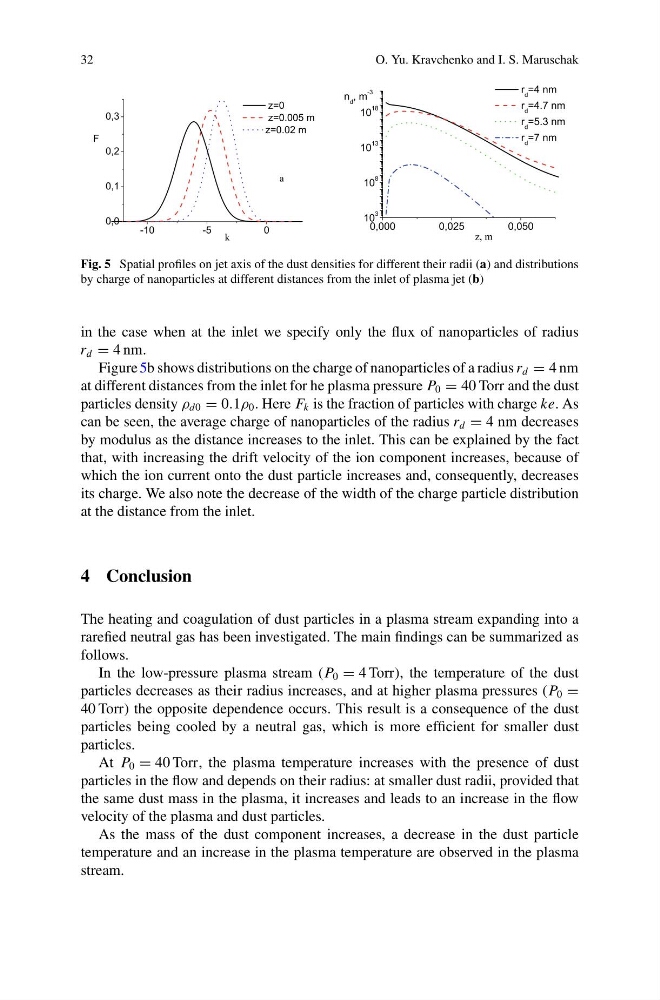
Fig. 5 Spatial profiles on jet axis of the dust densities for different their radii (a) and distributions
by charge of nanoparticles at different distances from the inlet of plasma jet (b)
in the case when at the inlet we specify only the flux of nanoparticles of radius
r d = 4 nm.
Figure 5b shows distributions on the charge of nanoparticles of a radius r d = 4 nm
at different distances from the inlet for he plasma pressure P 0 = 40 Torr and the dust
particles density ρ d0 = 0.1ρ 0 . Here F k is the fraction of particles with charge ke. As
can be seen, the average charge of nanoparticles of the radius r d = 4 nm decreases
by modulus as the distance increases to the inlet. This can be explained by the fact
that, with increasing the drift velocity of the ion component increases, because of
which the ion current onto the dust particle increases and, consequently, decreases
its charge. We also note the decrease of the width of the charge particle distribution
at the distance from the inlet.
4 Conclusion
The heating and coagulation of dust particles in a plasma stream expanding into a
rarefied neutral gas has been investigated. The main findings can be summarized as
follows.
In the low-pressure plasma stream (P 0 = 4 Torr), the temperature of the dust
particles decreases as their radius increases, and at higher plasma pressures (P 0 =
40 Torr) the opposite dependence occurs. This result is a consequence of the dust
particles being cooled by a neutral gas, which is more efficient for smaller dust
particles.
At P 0 = 40 Torr, the plasma temperature increases with the presence of dust
particles in the flow and depends on their radius: at smaller dust radii, provided that
the same dust mass in the plasma, it increases and leads to an increase in the flow
velocity of the plasma and dust particles.
As the mass of the dust component increases, a decrease in the dust particle
temperature and an increase in the plasma temperature are observed in the plasma
stream.
O. Yu. Kravchenko and I. S. Maruschak
Fig. 5 Spatial profiles on jet axis of the dust densities for different their radii (a) and distributions
by charge of nanoparticles at different distances from the inlet of plasma jet (b)
in the case when at the inlet we specify only the flux of nanoparticles of radius
r d = 4 nm.
Figure 5b shows distributions on the charge of nanoparticles of a radius r d = 4 nm
at different distances from the inlet for he plasma pressure P 0 = 40 Torr and the dust
particles density ρ d0 = 0.1ρ 0 . Here F k is the fraction of particles with charge ke. As
can be seen, the average charge of nanoparticles of the radius r d = 4 nm decreases
by modulus as the distance increases to the inlet. This can be explained by the fact
that, with increasing the drift velocity of the ion component increases, because of
which the ion current onto the dust particle increases and, consequently, decreases
its charge. We also note the decrease of the width of the charge particle distribution
at the distance from the inlet.
4 Conclusion
The heating and coagulation of dust particles in a plasma stream expanding into a
rarefied neutral gas has been investigated. The main findings can be summarized as
follows.
In the low-pressure plasma stream (P 0 = 4 Torr), the temperature of the dust
particles decreases as their radius increases, and at higher plasma pressures (P 0 =
40 Torr) the opposite dependence occurs. This result is a consequence of the dust
particles being cooled by a neutral gas, which is more efficient for smaller dust
particles.
At P 0 = 40 Torr, the plasma temperature increases with the presence of dust
particles in the flow and depends on their radius: at smaller dust radii, provided that
the same dust mass in the plasma, it increases and leads to an increase in the flow
velocity of the plasma and dust particles.
As the mass of the dust component increases, a decrease in the dust particle
temperature and an increase in the plasma temperature are observed in the plasma
stream.