

548
O. Lavrynenko et al.
Analysis of the samples formed in the wide range of pH values from 2.5 to 11.5
gives the reason to associate silver with magnetite in the range of pH values 5.6–9.5,
where it was dominant phase among the structures formed on the steel surface. At
lower and higher pH, when the iron oxyhydroxides were formed in the system, the
correlation between silver and ferrum was not found.
The results of chemical analysis and data of X-ray fluorescence spectroscopy show
the increase in the gold fraction in the chemical composition of the aurum-containing
surface structures depending on the initial concentration of HAuCl 4 . Whereas at
c(Au
3+ ) = 1 mg/dm
3 near 0.05 wt% is contained in magnetite structure, at c(Au
3+ )
= 20 mg/dm
3 gold fraction grows to 0.9 wt%.
3.2.4 Chemical Composition of the Dispersion Medium Contacted
with the Steel Surface
We perform the centrifugation of the solutions at 8 g within 10 min to sedimentation
of nanosized argentum-containing particles in the water medium. The concentration
of ferrous cations in the final solutions gradually decreased when the initial c(Ag
+ )
was enhanced. So, depending on the pH value, the ferrous concentration varied 1.3–
0.8 mg/dm
3 at c(Ag
+ ) = 0.5 mg/dm
3 , it decreased to 0.04 mg/dm
3 at c(Ag
+ ) =
3 mg/dm
3 , and it fully disappeared at (Ag
+ ) >5 mg/dm
3 . The average pH values of
final solutions varied in the range of 6.5–7.2.
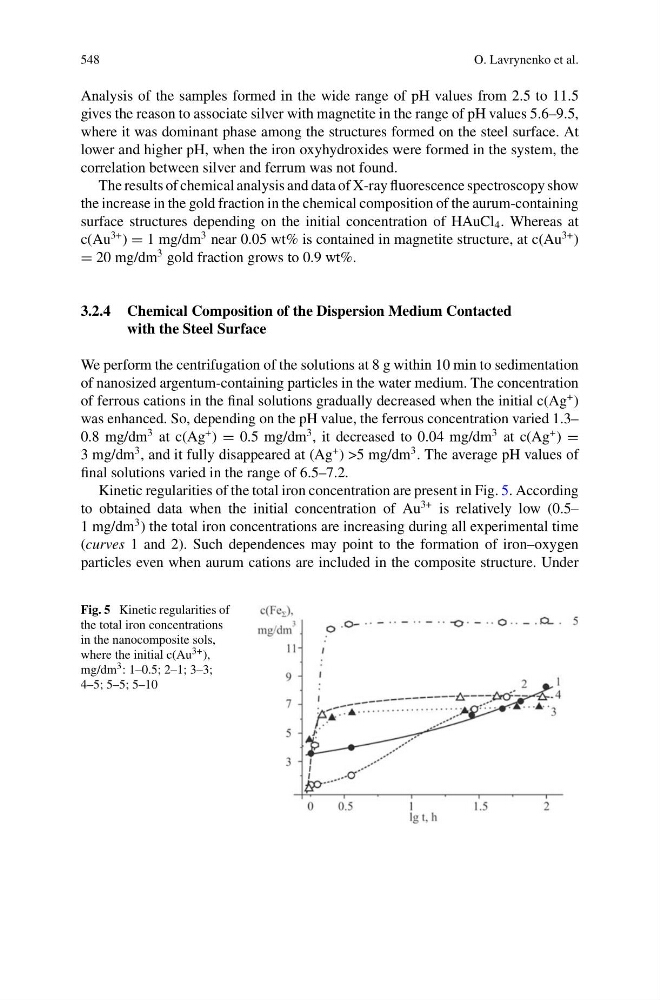
Kinetic regularities of the total iron concentration are present in Fig. 5. According
to obtained data when the initial concentration of Au
3+ is relatively low (0.5–
1 mg/dm
3 ) the total iron concentrations are increasing during all experimental time
(curves 1 and 2). Such dependences may point to the formation of iron–oxygen
particles even when aurum cations are included in the composite structure. Under
Fig. 5 Kinetic regularities of
the total iron concentrations
in the nanocomposite sols,
where the initial c(Au 3+ ),
mg/dm 3 : 1–0.5; 2–1; 3–3;
4–5; 5–5; 5–10
O. Lavrynenko et al.
Analysis of the samples formed in the wide range of pH values from 2.5 to 11.5
gives the reason to associate silver with magnetite in the range of pH values 5.6–9.5,
where it was dominant phase among the structures formed on the steel surface. At
lower and higher pH, when the iron oxyhydroxides were formed in the system, the
correlation between silver and ferrum was not found.
The results of chemical analysis and data of X-ray fluorescence spectroscopy show
the increase in the gold fraction in the chemical composition of the aurum-containing
surface structures depending on the initial concentration of HAuCl 4 . Whereas at
c(Au
3+ ) = 1 mg/dm
3 near 0.05 wt% is contained in magnetite structure, at c(Au
3+ )
= 20 mg/dm
3 gold fraction grows to 0.9 wt%.
3.2.4 Chemical Composition of the Dispersion Medium Contacted
with the Steel Surface
We perform the centrifugation of the solutions at 8 g within 10 min to sedimentation
of nanosized argentum-containing particles in the water medium. The concentration
of ferrous cations in the final solutions gradually decreased when the initial c(Ag
+ )
was enhanced. So, depending on the pH value, the ferrous concentration varied 1.3–
0.8 mg/dm
3 at c(Ag
+ ) = 0.5 mg/dm
3 , it decreased to 0.04 mg/dm
3 at c(Ag
+ ) =
3 mg/dm
3 , and it fully disappeared at (Ag
+ ) >5 mg/dm
3 . The average pH values of
final solutions varied in the range of 6.5–7.2.
Kinetic regularities of the total iron concentration are present in Fig. 5. According
to obtained data when the initial concentration of Au
3+ is relatively low (0.5–
1 mg/dm
3 ) the total iron concentrations are increasing during all experimental time
(curves 1 and 2). Such dependences may point to the formation of iron–oxygen
particles even when aurum cations are included in the composite structure. Under
Fig. 5 Kinetic regularities of
the total iron concentrations
in the nanocomposite sols,
where the initial c(Au 3+ ),
mg/dm 3 : 1–0.5; 2–1; 3–3;
4–5; 5–5; 5–10