

30
O. Yu. Kravchenko and I. S. Maruschak
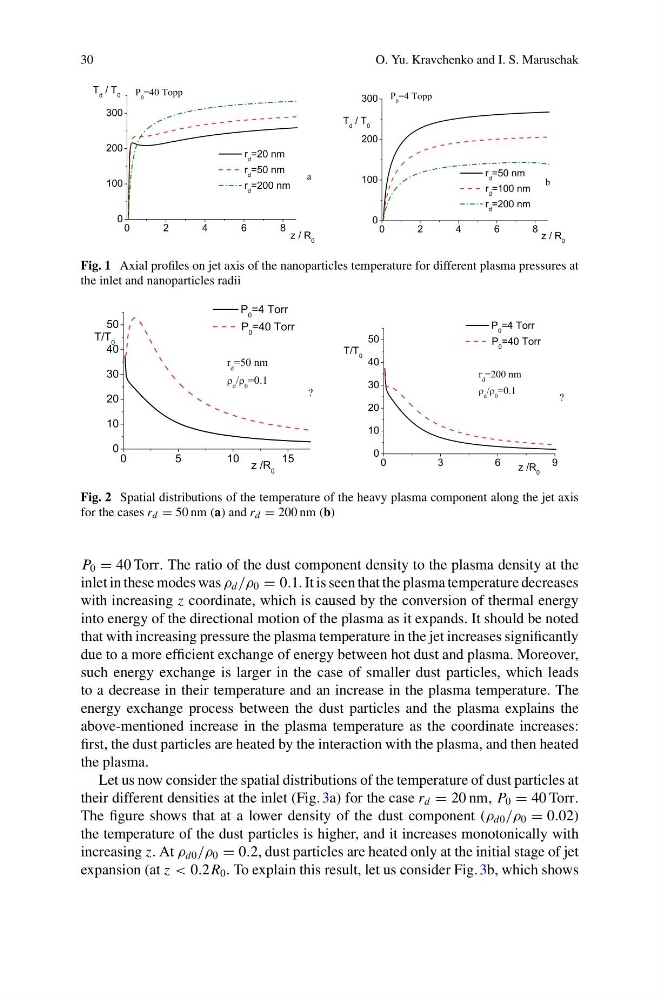
Fig. 1 Axial profiles on jet axis of the nanoparticles temperature for different plasma pressures at
the inlet and nanoparticles radii
Fig. 2 Spatial distributions of the temperature of the heavy plasma component along the jet axis
for the cases r d = 50 nm (a) and r d = 200 nm (b)
P 0 = 40 Torr. The ratio of the dust component density to the plasma density at the
inlet in these modes was ρ d /ρ 0 = 0.1. It is seen that the plasma temperature decreases
with increasing z coordinate, which is caused by the conversion of thermal energy
into energy of the directional motion of the plasma as it expands. It should be noted
that with increasing pressure the plasma temperature in the jet increases significantly
due to a more efficient exchange of energy between hot dust and plasma. Moreover,
such energy exchange is larger in the case of smaller dust particles, which leads
to a decrease in their temperature and an increase in the plasma temperature. The
energy exchange process between the dust particles and the plasma explains the
above-mentioned increase in the plasma temperature as the coordinate increases:
first, the dust particles are heated by the interaction with the plasma, and then heated
the plasma.
Let us now consider the spatial distributions of the temperature of dust particles at
their different densities at the inlet (Fig. 3a) for the case r d = 20 nm, P 0 = 40 Torr.
The figure shows that at a lower density of the dust component (ρ d0 /ρ 0 = 0.02)
the temperature of the dust particles is higher, and it increases monotonically with
increasing z. At ρ d0 /ρ 0 = 0.2, dust particles are heated only at the initial stage of jet
expansion (at z < 0.2R 0 . To explain this result, let us consider Fig. 3b, which shows
O. Yu. Kravchenko and I. S. Maruschak
Fig. 1 Axial profiles on jet axis of the nanoparticles temperature for different plasma pressures at
the inlet and nanoparticles radii
Fig. 2 Spatial distributions of the temperature of the heavy plasma component along the jet axis
for the cases r d = 50 nm (a) and r d = 200 nm (b)
P 0 = 40 Torr. The ratio of the dust component density to the plasma density at the
inlet in these modes was ρ d /ρ 0 = 0.1. It is seen that the plasma temperature decreases
with increasing z coordinate, which is caused by the conversion of thermal energy
into energy of the directional motion of the plasma as it expands. It should be noted
that with increasing pressure the plasma temperature in the jet increases significantly
due to a more efficient exchange of energy between hot dust and plasma. Moreover,
such energy exchange is larger in the case of smaller dust particles, which leads
to a decrease in their temperature and an increase in the plasma temperature. The
energy exchange process between the dust particles and the plasma explains the
above-mentioned increase in the plasma temperature as the coordinate increases:
first, the dust particles are heated by the interaction with the plasma, and then heated
the plasma.
Let us now consider the spatial distributions of the temperature of dust particles at
their different densities at the inlet (Fig. 3a) for the case r d = 20 nm, P 0 = 40 Torr.
The figure shows that at a lower density of the dust component (ρ d0 /ρ 0 = 0.02)
the temperature of the dust particles is higher, and it increases monotonically with
increasing z. At ρ d0 /ρ 0 = 0.2, dust particles are heated only at the initial stage of jet
expansion (at z < 0.2R 0 . To explain this result, let us consider Fig. 3b, which shows