

Role of Active Complexes of Selected Thiopurine Derivatives …
531
0.4
0.2
0
-0.2
-0.4
E vs. (Ag/AgCl) /V
0
-20
-40
-60
-80
I
p /µA
6TG
6TG+Triton X-100
6MP
6MP+TritonX-100
AZA
AZA+TritonX-100
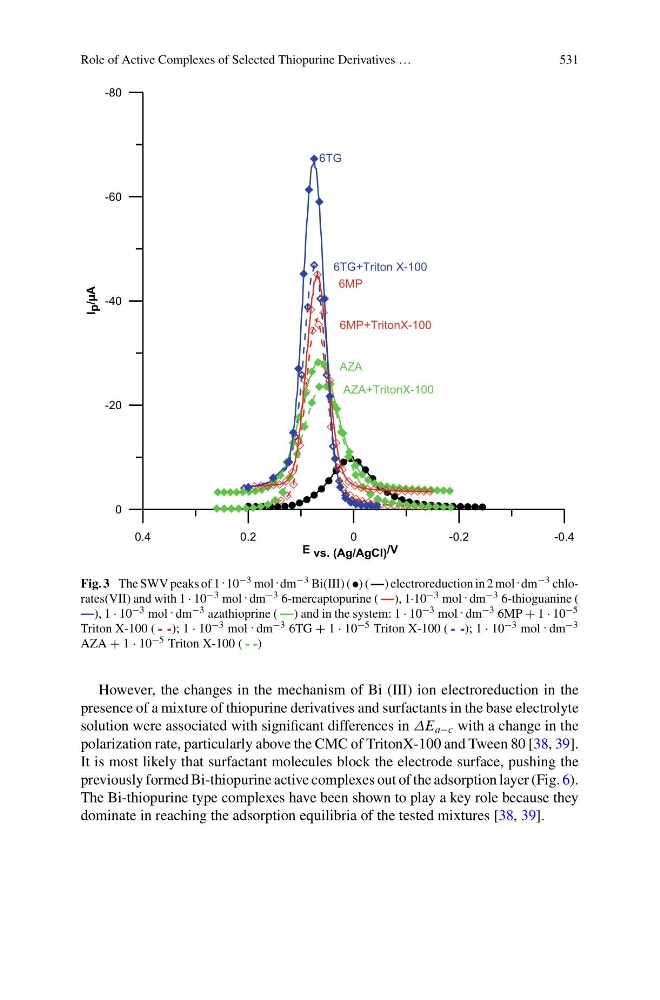
Fig. 3 The SWV peaks of 1 : 10 −3 mol : dm −3 Bi(III) ( ) ( ) electroreduction in 2 mol : dm −3 chlorates(VII) and with 1 · 10 −3 mol : dm −3 6-mercaptopurine ( ), 1·10 −3 mol : dm −3 6-thioguanine (
), 1 · 10 −3 mol : dm −3 azathioprine ( ) and in the system: 1 · 10 −3 mol : dm −3 6MP + 1 · 10 −5
Triton X-100 ( ); 1 · 10 −3 mol : dm −3 6TG + 1 · 10 −5 Triton X-100 ( ); 1 · 10 −3 mol : dm −3
AZA + 1 · 10 −5 Triton X-100 ( )
However, the changes in the mechanism of Bi (III) ion electroreduction in the
presence of a mixture of thiopurine derivatives and surfactants in the base electrolyte
solution were associated with significant differences in ΔE a−c with a change in the
polarization rate, particularly above the CMC of TritonX-100 and Tween 80 [38, 39].
It is most likely that surfactant molecules block the electrode surface, pushing the
previously formed Bi-thiopurine active complexes out of the adsorption layer (Fig. 6).
The Bi-thiopurine type complexes have been shown to play a key role because they
dominate in reaching the adsorption equilibria of the tested mixtures [38, 39].
531
0.4
0.2
0
-0.2
-0.4
E vs. (Ag/AgCl) /V
0
-20
-40
-60
-80
I
p /µA
6TG
6TG+Triton X-100
6MP
6MP+TritonX-100
AZA
AZA+TritonX-100
Fig. 3 The SWV peaks of 1 : 10 −3 mol : dm −3 Bi(III) ( ) ( ) electroreduction in 2 mol : dm −3 chlorates(VII) and with 1 · 10 −3 mol : dm −3 6-mercaptopurine ( ), 1·10 −3 mol : dm −3 6-thioguanine (
), 1 · 10 −3 mol : dm −3 azathioprine ( ) and in the system: 1 · 10 −3 mol : dm −3 6MP + 1 · 10 −5
Triton X-100 ( ); 1 · 10 −3 mol : dm −3 6TG + 1 · 10 −5 Triton X-100 ( ); 1 · 10 −3 mol : dm −3
AZA + 1 · 10 −5 Triton X-100 ( )
However, the changes in the mechanism of Bi (III) ion electroreduction in the
presence of a mixture of thiopurine derivatives and surfactants in the base electrolyte
solution were associated with significant differences in ΔE a−c with a change in the
polarization rate, particularly above the CMC of TritonX-100 and Tween 80 [38, 39].
It is most likely that surfactant molecules block the electrode surface, pushing the
previously formed Bi-thiopurine active complexes out of the adsorption layer (Fig. 6).
The Bi-thiopurine type complexes have been shown to play a key role because they
dominate in reaching the adsorption equilibria of the tested mixtures [38, 39].