

530
A. Nosal-Wierci´ nska and W. Kaliszczak
0.4
0.2
0
-0.2
-0.4
E vs. (Ag/AgCl) /V
0
-20
-40
-60
-80
I
p /µA
Bi
AZA
6MPM
6TG
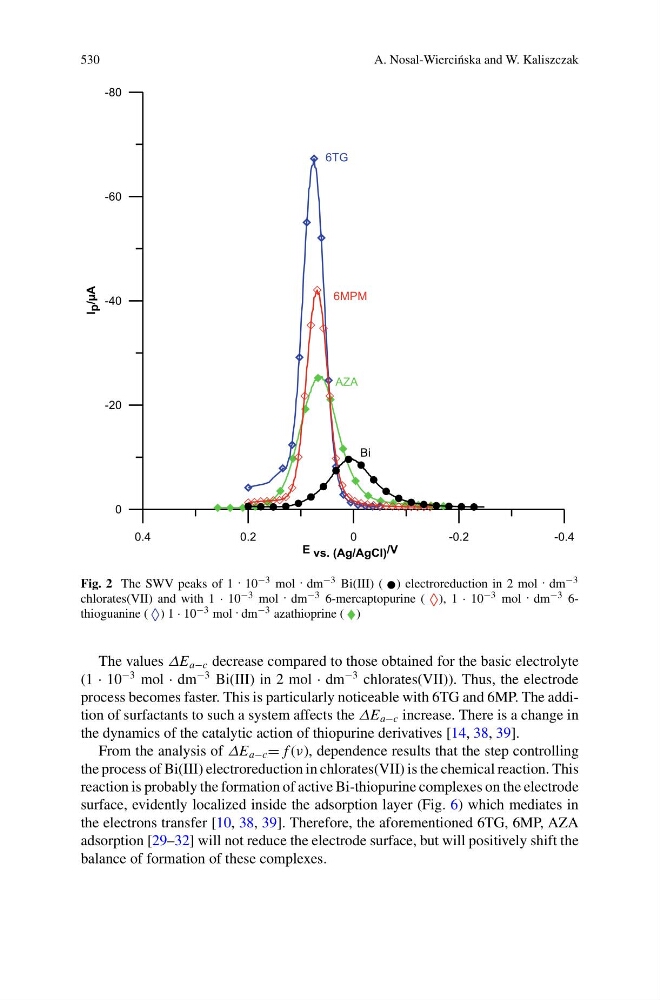
Fig. 2 The SWV peaks of 1 : 10 −3 mol : dm −3 Bi(III) ( ) electroreduction in 2 mol : dm −3
chlorates(VII) and with 1 · 10 −3 mol : dm −3 6-mercaptopurine ( ), 1 · 10 −3 mol : dm −3 6thioguanine ( ) 1 · 10 −3 mol : dm −3 azathioprine ( )
The values ΔE a−c decrease compared to those obtained for the basic electrolyte
(1 · 10
−3 mol · dm
−3 Bi(III) in 2 mol · dm
−3 chlorates(VII)). Thus, the electrode
process becomes faster. This is particularly noticeable with 6TG and 6MP. The addition of surfactants to such a system affects the ΔE a−c increase. There is a change in
the dynamics of the catalytic action of thiopurine derivatives [14, 38, 39].
From the analysis of ΔE a−c = f (ν), dependence results that the step controlling
the process of Bi(III) electroreduction in chlorates(VII) is the chemical reaction. This
reaction is probably the formation of active Bi-thiopurine complexes on the electrode
surface, evidently localized inside the adsorption layer (Fig. 6) which mediates in
the electrons transfer [10, 38, 39]. Therefore, the aforementioned 6TG, 6MP, AZA
adsorption [29–32] will not reduce the electrode surface, but will positively shift the
balance of formation of these complexes.
A. Nosal-Wierci´ nska and W. Kaliszczak
0.4
0.2
0
-0.2
-0.4
E vs. (Ag/AgCl) /V
0
-20
-40
-60
-80
I
p /µA
Bi
AZA
6MPM
6TG
Fig. 2 The SWV peaks of 1 : 10 −3 mol : dm −3 Bi(III) ( ) electroreduction in 2 mol : dm −3
chlorates(VII) and with 1 · 10 −3 mol : dm −3 6-mercaptopurine ( ), 1 · 10 −3 mol : dm −3 6thioguanine ( ) 1 · 10 −3 mol : dm −3 azathioprine ( )
The values ΔE a−c decrease compared to those obtained for the basic electrolyte
(1 · 10
−3 mol · dm
−3 Bi(III) in 2 mol · dm
−3 chlorates(VII)). Thus, the electrode
process becomes faster. This is particularly noticeable with 6TG and 6MP. The addition of surfactants to such a system affects the ΔE a−c increase. There is a change in
the dynamics of the catalytic action of thiopurine derivatives [14, 38, 39].
From the analysis of ΔE a−c = f (ν), dependence results that the step controlling
the process of Bi(III) electroreduction in chlorates(VII) is the chemical reaction. This
reaction is probably the formation of active Bi-thiopurine complexes on the electrode
surface, evidently localized inside the adsorption layer (Fig. 6) which mediates in
the electrons transfer [10, 38, 39]. Therefore, the aforementioned 6TG, 6MP, AZA
adsorption [29–32] will not reduce the electrode surface, but will positively shift the
balance of formation of these complexes.