

Structure and Properties of the POSS-Containing Nanocomposites …
499
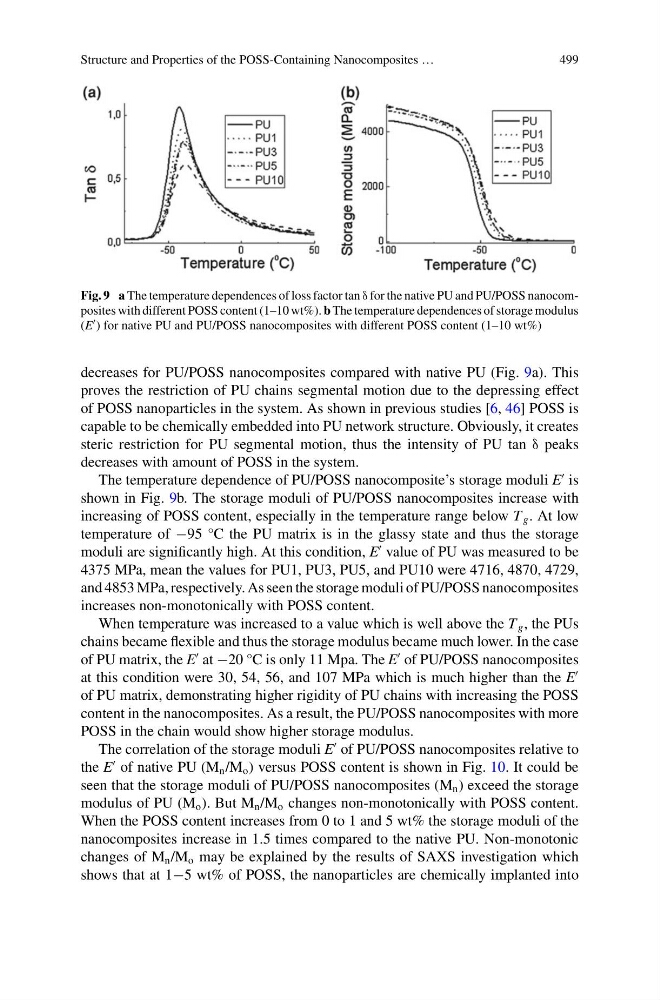
Fig. 9 a The temperature dependences of loss factor tan δ for the native PU and PU/POSS nanocomposites with different POSS content (1–10 wt%). b The temperature dependences of storage modulus
(E ) for native PU and PU/POSS nanocomposites with different POSS content (1–10 wt%)
decreases for PU/POSS nanocomposites compared with native PU (Fig. 9a). This
proves the restriction of PU chains segmental motion due to the depressing effect
of POSS nanoparticles in the system. As shown in previous studies [6, 46] POSS is
capable to be chemically embedded into PU network structure. Obviously, it creates
steric restriction for PU segmental motion, thus the intensity of PU tan δ peaks
decreases with amount of POSS in the system.
The temperature dependence of PU/POSS nanocomposite’s storage moduli E
is
shown in Fig. 9b. The storage moduli of PU/POSS nanocomposites increase with
increasing of POSS content, especially in the temperature range below T g . At low
temperature of −95 °C the PU matrix is in the glassy state and thus the storage
moduli are significantly high. At this condition, E
value of PU was measured to be
4375 MPa, mean the values for PU1, PU3, PU5, and PU10 were 4716, 4870, 4729,
and 4853 MPa, respectively. As seen the storage moduli of PU/POSS nanocomposites
increases non-monotonically with POSS content.
When temperature was increased to a value which is well above the T g , the PUs
chains became flexible and thus the storage modulus became much lower. In the case
of PU matrix, the E
at −20 °C is only 11 Mpa. The E
of PU/POSS nanocomposites
at this condition were 30, 54, 56, and 107 MPa which is much higher than the E
of PU matrix, demonstrating higher rigidity of PU chains with increasing the POSS
content in the nanocomposites. As a result, the PU/POSS nanocomposites with more
POSS in the chain would show higher storage modulus.
The correlation of the storage moduli E
of PU/POSS nanocomposites relative to
the E
of native PU (M n /M o ) versus POSS content is shown in Fig. 10. It could be
seen that the storage moduli of PU/POSS nanocomposites (M n ) exceed the storage
modulus of PU (M o ). But M n /M o changes non-monotonically with POSS content.
When the POSS content increases from 0 to 1 and 5 wt% the storage moduli of the
nanocomposites increase in 1.5 times compared to the native PU. Non-monotonic
changes of M n /M o may be explained by the results of SAXS investigation which
shows that at 1−5 wt% of POSS, the nanoparticles are chemically implanted into
499
Fig. 9 a The temperature dependences of loss factor tan δ for the native PU and PU/POSS nanocomposites with different POSS content (1–10 wt%). b The temperature dependences of storage modulus
(E ) for native PU and PU/POSS nanocomposites with different POSS content (1–10 wt%)
decreases for PU/POSS nanocomposites compared with native PU (Fig. 9a). This
proves the restriction of PU chains segmental motion due to the depressing effect
of POSS nanoparticles in the system. As shown in previous studies [6, 46] POSS is
capable to be chemically embedded into PU network structure. Obviously, it creates
steric restriction for PU segmental motion, thus the intensity of PU tan δ peaks
decreases with amount of POSS in the system.
The temperature dependence of PU/POSS nanocomposite’s storage moduli E
is
shown in Fig. 9b. The storage moduli of PU/POSS nanocomposites increase with
increasing of POSS content, especially in the temperature range below T g . At low
temperature of −95 °C the PU matrix is in the glassy state and thus the storage
moduli are significantly high. At this condition, E
value of PU was measured to be
4375 MPa, mean the values for PU1, PU3, PU5, and PU10 were 4716, 4870, 4729,
and 4853 MPa, respectively. As seen the storage moduli of PU/POSS nanocomposites
increases non-monotonically with POSS content.
When temperature was increased to a value which is well above the T g , the PUs
chains became flexible and thus the storage modulus became much lower. In the case
of PU matrix, the E
at −20 °C is only 11 Mpa. The E
of PU/POSS nanocomposites
at this condition were 30, 54, 56, and 107 MPa which is much higher than the E
of PU matrix, demonstrating higher rigidity of PU chains with increasing the POSS
content in the nanocomposites. As a result, the PU/POSS nanocomposites with more
POSS in the chain would show higher storage modulus.
The correlation of the storage moduli E
of PU/POSS nanocomposites relative to
the E
of native PU (M n /M o ) versus POSS content is shown in Fig. 10. It could be
seen that the storage moduli of PU/POSS nanocomposites (M n ) exceed the storage
modulus of PU (M o ). But M n /M o changes non-monotonically with POSS content.
When the POSS content increases from 0 to 1 and 5 wt% the storage moduli of the
nanocomposites increase in 1.5 times compared to the native PU. Non-monotonic
changes of M n /M o may be explained by the results of SAXS investigation which
shows that at 1−5 wt% of POSS, the nanoparticles are chemically implanted into