

470
B. M. Gorelov et al.
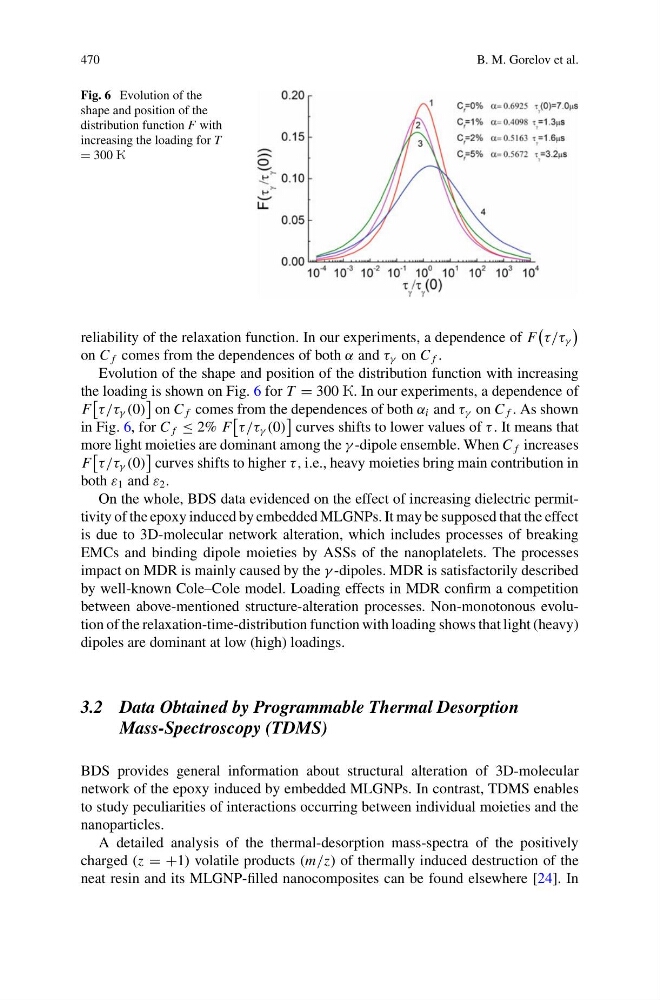
Fig. 6 Evolution of the
shape and position of the
distribution function F with
increasing the loading for T
= 300 K
reliability of the relaxation function. In our experiments, a dependence of F
τ/τ γ
on C f comes from the dependences of both α and τ γ on C f .
Evolution of the shape and position of the distribution function with increasing
the loading is shown on Fig. 6 for T = 300 K. In our experiments, a dependence of
F
τ/τ γ (0)
on C f comes from the dependences of both α i and τ γ on C f . As shown
in Fig. 6, for C f ≤ 2% F
τ/τ γ (0)
curves shifts to lower values of τ . It means that
more light moieties are dominant among the γ -dipole ensemble. When C f increases
F
τ/τ γ (0)
curves shifts to higher τ , i.e., heavy moieties bring main contribution in
both ε 1 and ε 2 .
On the whole, BDS data evidenced on the effect of increasing dielectric permittivity of the epoxy induced by embedded MLGNPs. It may be supposed that the effect
is due to 3D-molecular network alteration, which includes processes of breaking
EMCs and binding dipole moieties by ASSs of the nanoplatelets. The processes
impact on MDR is mainly caused by the γ -dipoles. MDR is satisfactorily described
by well-known Cole–Cole model. Loading effects in MDR confirm a competition
between above-mentioned structure-alteration processes. Non-monotonous evolution of the relaxation-time-distribution function with loading shows that light (heavy)
dipoles are dominant at low (high) loadings.
3.2 Data Obtained by Programmable Thermal Desorption
Mass-Spectroscopy (TDMS)
BDS provides general information about structural alteration of 3D-molecular
network of the epoxy induced by embedded MLGNPs. In contrast, TDMS enables
to study peculiarities of interactions occurring between individual moieties and the
nanoparticles.
A detailed analysis of the thermal-desorption mass-spectra of the positively
charged (z = +1) volatile products (m/z) of thermally induced destruction of the
neat resin and its MLGNP-filled nanocomposites can be found elsewhere [24]. In
B. M. Gorelov et al.
Fig. 6 Evolution of the
shape and position of the
distribution function F with
increasing the loading for T
= 300 K
reliability of the relaxation function. In our experiments, a dependence of F
τ/τ γ
on C f comes from the dependences of both α and τ γ on C f .
Evolution of the shape and position of the distribution function with increasing
the loading is shown on Fig. 6 for T = 300 K. In our experiments, a dependence of
F
τ/τ γ (0)
on C f comes from the dependences of both α i and τ γ on C f . As shown
in Fig. 6, for C f ≤ 2% F
τ/τ γ (0)
curves shifts to lower values of τ . It means that
more light moieties are dominant among the γ -dipole ensemble. When C f increases
F
τ/τ γ (0)
curves shifts to higher τ , i.e., heavy moieties bring main contribution in
both ε 1 and ε 2 .
On the whole, BDS data evidenced on the effect of increasing dielectric permittivity of the epoxy induced by embedded MLGNPs. It may be supposed that the effect
is due to 3D-molecular network alteration, which includes processes of breaking
EMCs and binding dipole moieties by ASSs of the nanoplatelets. The processes
impact on MDR is mainly caused by the γ -dipoles. MDR is satisfactorily described
by well-known Cole–Cole model. Loading effects in MDR confirm a competition
between above-mentioned structure-alteration processes. Non-monotonous evolution of the relaxation-time-distribution function with loading shows that light (heavy)
dipoles are dominant at low (high) loadings.
3.2 Data Obtained by Programmable Thermal Desorption
Mass-Spectroscopy (TDMS)
BDS provides general information about structural alteration of 3D-molecular
network of the epoxy induced by embedded MLGNPs. In contrast, TDMS enables
to study peculiarities of interactions occurring between individual moieties and the
nanoparticles.
A detailed analysis of the thermal-desorption mass-spectra of the positively
charged (z = +1) volatile products (m/z) of thermally induced destruction of the
neat resin and its MLGNP-filled nanocomposites can be found elsewhere [24]. In