

Modeling Multilayer Pyramidal-Like Adsorbate Structures …
439
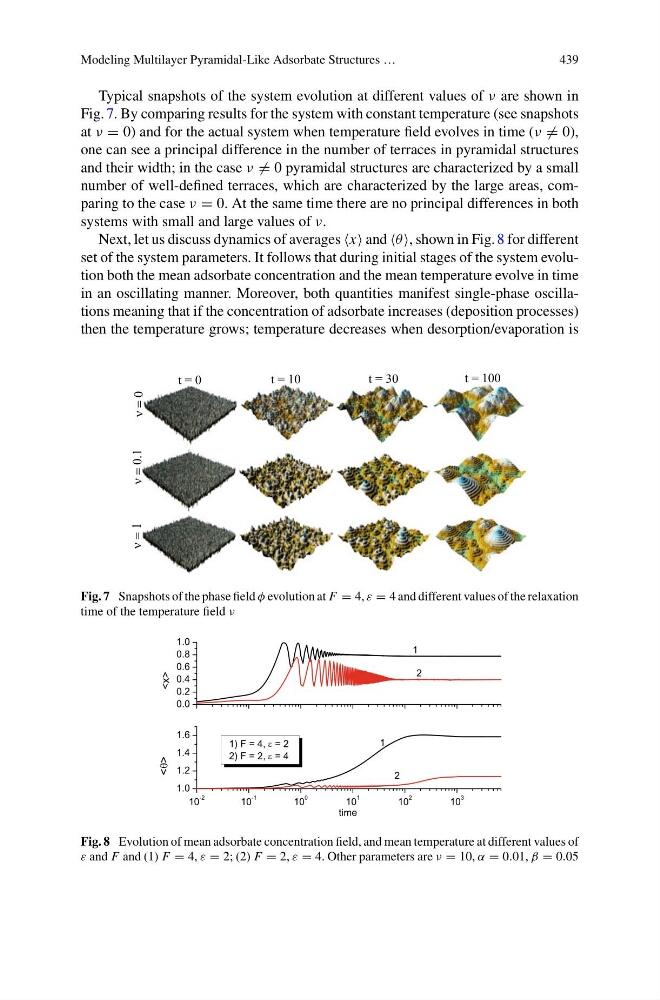
Typical snapshots of the system evolution at different values of ν are shown in
Fig. 7. By comparing results for the system with constant temperature (see snapshots
at ν = 0) and for the actual system when temperature field evolves in time (ν = 0),
one can see a principal difference in the number of terraces in pyramidal structures
and their width; in the case ν = 0 pyramidal structures are characterized by a small
number of well-defined terraces, which are characterized by the large areas, comparing to the case ν = 0. At the same time there are no principal differences in both
systems with small and large values of ν.
Next, let us discuss dynamics of averages and , shown in Fig. 8 for different
set of the system parameters. It follows that during initial stages of the system evolution both the mean adsorbate concentration and the mean temperature evolve in time
in an oscillating manner. Moreover, both quantities manifest single-phase oscillations meaning that if the concentration of adsorbate increases (deposition processes)
then the temperature grows; temperature decreases when desorption/evaporation is
Fig. 7 Snapshots of the phase field φ evolution at F = 4, ε = 4 and different values of the relaxation
time of the temperature field ν
10
-2
10
-1
10
0
10
1
10
2
10
3
1.0
1.2
1.4
1.6
0.0
0.2
0.4
0.6
0.8
1.0
< >
time
1
2
1) F = 4, = 2
2) F = 2, = 4
1
2
Fig. 8 Evolution of mean adsorbate concentration field, and mean temperature at different values of
ε and F and (1) F = 4, ε = 2; (2) F = 2, ε = 4. Other parameters are ν = 10, α = 0.01, β = 0.05
439
Typical snapshots of the system evolution at different values of ν are shown in
Fig. 7. By comparing results for the system with constant temperature (see snapshots
at ν = 0) and for the actual system when temperature field evolves in time (ν = 0),
one can see a principal difference in the number of terraces in pyramidal structures
and their width; in the case ν = 0 pyramidal structures are characterized by a small
number of well-defined terraces, which are characterized by the large areas, comparing to the case ν = 0. At the same time there are no principal differences in both
systems with small and large values of ν.
Next, let us discuss dynamics of averages and , shown in Fig. 8 for different
set of the system parameters. It follows that during initial stages of the system evolution both the mean adsorbate concentration and the mean temperature evolve in time
in an oscillating manner. Moreover, both quantities manifest single-phase oscillations meaning that if the concentration of adsorbate increases (deposition processes)
then the temperature grows; temperature decreases when desorption/evaporation is
Fig. 7 Snapshots of the phase field φ evolution at F = 4, ε = 4 and different values of the relaxation
time of the temperature field ν
10
-2
10
-1
10
0
10
1
10
2
10
3
1.0
1.2
1.4
1.6
0.0
0.2
0.4
0.6
0.8
1.0
< >
time
1
2
1) F = 4, = 2
2) F = 2, = 4
1
2
Fig. 8 Evolution of mean adsorbate concentration field, and mean temperature at different values of
ε and F and (1) F = 4, ε = 2; (2) F = 2, ε = 4. Other parameters are ν = 10, α = 0.01, β = 0.05