

432
A. V. Dvornichenko and O. M. Shchokotova
ε
ε
ε
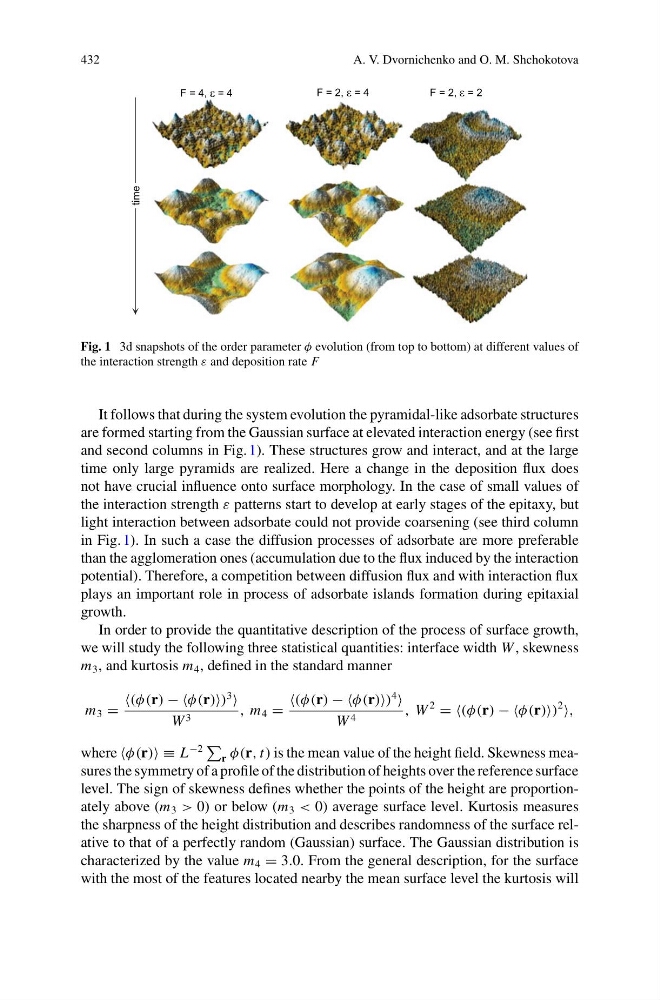
Fig. 1 3d snapshots of the order parameter φ evolution (from top to bottom) at different values of
the interaction strength ε and deposition rate F
It follows that during the system evolution the pyramidal-like adsorbate structures
are formed starting from the Gaussian surface at elevated interaction energy (see first
and second columns in Fig. 1). These structures grow and interact, and at the large
time only large pyramids are realized. Here a change in the deposition flux does
not have crucial influence onto surface morphology. In the case of small values of
the interaction strength ε patterns start to develop at early stages of the epitaxy, but
light interaction between adsorbate could not provide coarsening (see third column
in Fig. 1). In such a case the diffusion processes of adsorbate are more preferable
than the agglomeration ones (accumulation due to the flux induced by the interaction
potential). Therefore, a competition between diffusion flux and with interaction flux
plays an important role in process of adsorbate islands formation during epitaxial
growth.
In order to provide the quantitative description of the process of surface growth,
we will study the following three statistical quantities: interface width W , skewness
m 3 , and kurtosis m 4 , defined in the standard manner
m 3 =
(φ(r) − −φ(r)
3
W 3
, m 4 =
(φ(r) − −φ(r)
4
W 4
, W
2
= =(φ(r) − −φ(r)
2
where φ(r) ≡ L
−2
r φ(r, t) is the mean value of the height field. Skewness measures the symmetry of a profile of the distribution of heights over the reference surface
level. The sign of skewness defines whether the points of the height are proportionately above (m 3 > 0) or below (m 3 < 0) average surface level. Kurtosis measures
the sharpness of the height distribution and describes randomness of the surface relative to that of a perfectly random (Gaussian) surface. The Gaussian distribution is
characterized by the value m 4 = 3.0. From the general description, for the surface
with the most of the features located nearby the mean surface level the kurtosis will
A. V. Dvornichenko and O. M. Shchokotova
ε
ε
ε
Fig. 1 3d snapshots of the order parameter φ evolution (from top to bottom) at different values of
the interaction strength ε and deposition rate F
It follows that during the system evolution the pyramidal-like adsorbate structures
are formed starting from the Gaussian surface at elevated interaction energy (see first
and second columns in Fig. 1). These structures grow and interact, and at the large
time only large pyramids are realized. Here a change in the deposition flux does
not have crucial influence onto surface morphology. In the case of small values of
the interaction strength ε patterns start to develop at early stages of the epitaxy, but
light interaction between adsorbate could not provide coarsening (see third column
in Fig. 1). In such a case the diffusion processes of adsorbate are more preferable
than the agglomeration ones (accumulation due to the flux induced by the interaction
potential). Therefore, a competition between diffusion flux and with interaction flux
plays an important role in process of adsorbate islands formation during epitaxial
growth.
In order to provide the quantitative description of the process of surface growth,
we will study the following three statistical quantities: interface width W , skewness
m 3 , and kurtosis m 4 , defined in the standard manner
m 3 =
(φ(r) − −φ(r)
3
W 3
, m 4 =
(φ(r) − −φ(r)
4
W 4
, W
2
= =(φ(r) − −φ(r)
2
where φ(r) ≡ L
−2
r φ(r, t) is the mean value of the height field. Skewness measures the symmetry of a profile of the distribution of heights over the reference surface
level. The sign of skewness defines whether the points of the height are proportionately above (m 3 > 0) or below (m 3 < 0) average surface level. Kurtosis measures
the sharpness of the height distribution and describes randomness of the surface relative to that of a perfectly random (Gaussian) surface. The Gaussian distribution is
characterized by the value m 4 = 3.0. From the general description, for the surface
with the most of the features located nearby the mean surface level the kurtosis will