

Features of Phase Formation Processes in Amorphous Alloys …
415
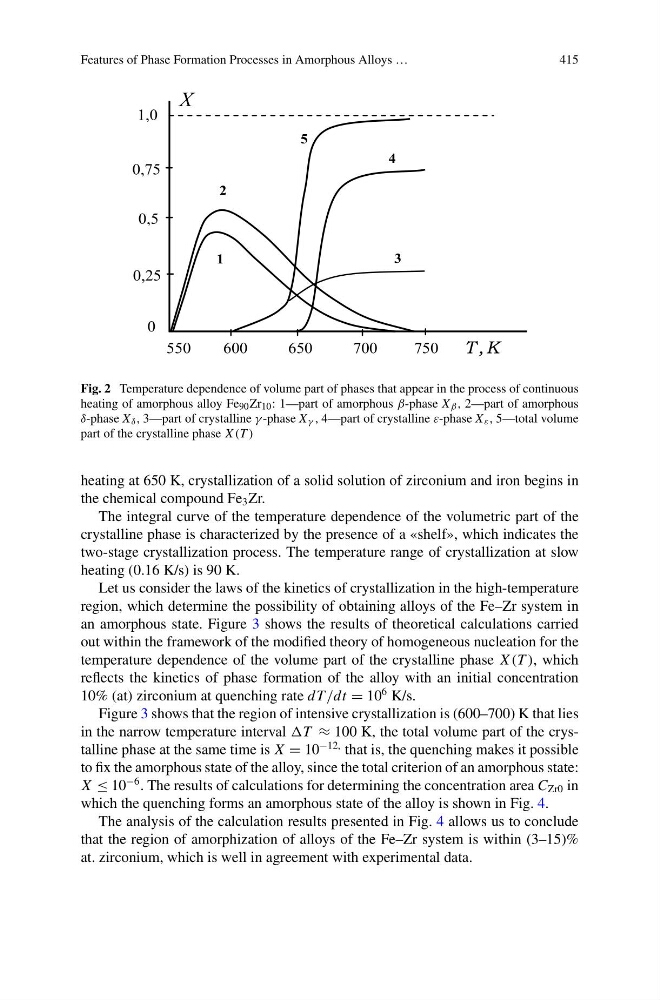
Fig. 2 Temperature dependence of volume part of phases that appear in the process of continuous
heating of amorphous alloy Fe 90 Zr 10 : 1—part of amorphous β-phase X β , 2—part of amorphous
δ-phase X δ , 3—part of crystalline γ -phase X γ , 4—part of crystalline ε-phase X ε , 5—total volume
part of the crystalline phase X (T )
heating at 650 K, crystallization of a solid solution of zirconium and iron begins in
the chemical compound Fe 3 Zr.
The integral curve of the temperature dependence of the volumetric part of the
crystalline phase is characterized by the presence of a «shelf», which indicates the
two-stage crystallization process. The temperature range of crystallization at slow
heating (0.16 K/s) is 90 K.
Let us consider the laws of the kinetics of crystallization in the high-temperature
region, which determine the possibility of obtaining alloys of the Fe–Zr system in
an amorphous state. Figure 3 shows the results of theoretical calculations carried
out within the framework of the modified theory of homogeneous nucleation for the
temperature dependence of the volume part of the crystalline phase X (T ), which
reflects the kinetics of phase formation of the alloy with an initial concentration
10% (at) zirconium at quenching rate dT /dt = 10
6 K/s.
Figure 3 shows that the region of intensive crystallization is (600–700) K that lies
in the narrow temperature interval ≈ 100 K, the total volume part of the crystalline phase at the same time is X = 10
−12, that is, the quenching makes it possible
to fix the amorphous state of the alloy, since the total criterion of an amorphous state:
X ≤ 10
−6 . The results of calculations for determining the concentration area C Zr0 in
which the quenching forms an amorphous state of the alloy is shown in Fig. 4.
The analysis of the calculation results presented in Fig. 4 allows us to conclude
that the region of amorphization of alloys of the Fe–Zr system is within (3–15)%
at. zirconium, which is well in agreement with experimental data.
415
Fig. 2 Temperature dependence of volume part of phases that appear in the process of continuous
heating of amorphous alloy Fe 90 Zr 10 : 1—part of amorphous β-phase X β , 2—part of amorphous
δ-phase X δ , 3—part of crystalline γ -phase X γ , 4—part of crystalline ε-phase X ε , 5—total volume
part of the crystalline phase X (T )
heating at 650 K, crystallization of a solid solution of zirconium and iron begins in
the chemical compound Fe 3 Zr.
The integral curve of the temperature dependence of the volumetric part of the
crystalline phase is characterized by the presence of a «shelf», which indicates the
two-stage crystallization process. The temperature range of crystallization at slow
heating (0.16 K/s) is 90 K.
Let us consider the laws of the kinetics of crystallization in the high-temperature
region, which determine the possibility of obtaining alloys of the Fe–Zr system in
an amorphous state. Figure 3 shows the results of theoretical calculations carried
out within the framework of the modified theory of homogeneous nucleation for the
temperature dependence of the volume part of the crystalline phase X (T ), which
reflects the kinetics of phase formation of the alloy with an initial concentration
10% (at) zirconium at quenching rate dT /dt = 10
6 K/s.
Figure 3 shows that the region of intensive crystallization is (600–700) K that lies
in the narrow temperature interval ≈ 100 K, the total volume part of the crystalline phase at the same time is X = 10
−12, that is, the quenching makes it possible
to fix the amorphous state of the alloy, since the total criterion of an amorphous state:
X ≤ 10
−6 . The results of calculations for determining the concentration area C Zr0 in
which the quenching forms an amorphous state of the alloy is shown in Fig. 4.
The analysis of the calculation results presented in Fig. 4 allows us to conclude
that the region of amorphization of alloys of the Fe–Zr system is within (3–15)%
at. zirconium, which is well in agreement with experimental data.