

412
T. L. Tsaregradskaya et al.
passes into a labile, that is, unstable with respect to the fluctuations in density and
composition of the state, with the relaxation of the system accompanied by an increase
in the fluctuation of the concentration of components. In binary systems there is an
area of unstable homogeneous states; disturbance of stability occurs in relation to
local deviations from equilibrium concentration. The thermodynamic prerequisite
for bundle binary systems is the S-shaped form of the concentration dependence of
the relative free Gibbs energy G(c, T ) [7].
In most amorphous alloys, the relative integral enthalpy H (c, T ) has a large
negative value and weakly varies depending on temperature, but the value of the
relative integral entropy S(c, T ) can also have a large negative value due to the
dependence S(c, T ) not only from concentration but also from volume change
V
V
(c, T ) at the formation of the alloy.
Consequently, the competing behavior of the quantities H (c, T ) and S(c, T )
leads to the fact that the concentration dependence G(c, T ) takes the S-shape form,
which reflects the tendency of the alloy to stratification process.
Experiments on low-temperature annealing of alloys of the Fe–Zr system showed
that when heating, there is a stratification within the amorphous state: initially, 2
amorphous phases are formed with a concentration of zirconium of 5% and 20%,
respectively (we denote their β and δ), then on the background of these phases are
formed 2 crystalline phases: Zr solution in α-Fe and chemical compound Fe 3 Zr
(denote them γ and ε) [8].
The main parameter that determines the kinetics of phase formation of binary
alloys is the concentration dependences of the free energies of the Gibbs of the
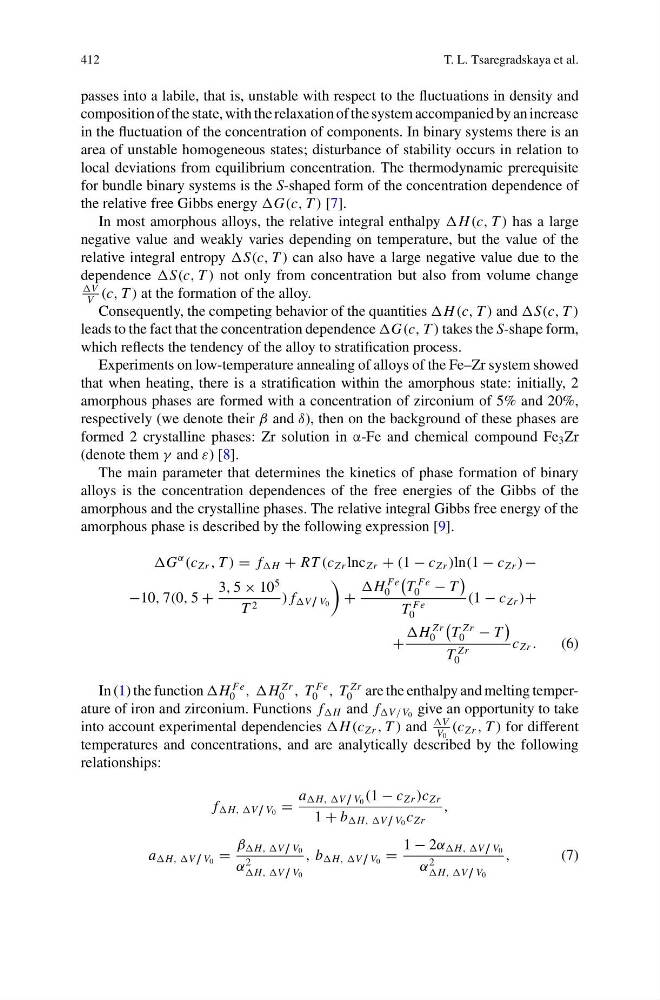
amorphous and the crystalline phases. The relative integral Gibbs free energy of the
amorphous phase is described by the following expression [9].
G
α
(c Zr , T ) = f H + RT (c Zr lnc Zr + (1 − c Zr )ln(1 − c Zr ) −
−10, 7(0, 5 +
3, 5 × 10
5
T 2
) f V / V 0
+
H
Fe
0
T
Fe
0 − T
T
Fe
0
(1 − c Zr )+
+
H
Zr
0
T
Zr
0 − T
T
Zr
0
c Zr .
(6)
In (1) the function H
Fe
0 , ,H
Zr
0 , T
Fe
0 , T
Zr
0 are the enthalpy and melting temperature of iron and zirconium. Functions f H and f V /V 0 give an opportunity to take
into account experimental dependencies H (c Zr , T ) and
V
V 0
(c Zr , T ) for different
temperatures and concentrations, and are analytically described by the following
relationships:
f H, ,V / V 0 =
a H, ,V / V 0 (1 − c Zr )c Zr
1 + b H, ,V / V 0 c Zr
,
a H, ,V / V 0 =
β H, ,V / V 0
α
2
H, ,V / V 0
, b H, ,V / V 0 =
1 − 2α H, ,V / V 0
α
2
H, ,V / V 0
,
(7)
T. L. Tsaregradskaya et al.
passes into a labile, that is, unstable with respect to the fluctuations in density and
composition of the state, with the relaxation of the system accompanied by an increase
in the fluctuation of the concentration of components. In binary systems there is an
area of unstable homogeneous states; disturbance of stability occurs in relation to
local deviations from equilibrium concentration. The thermodynamic prerequisite
for bundle binary systems is the S-shaped form of the concentration dependence of
the relative free Gibbs energy G(c, T ) [7].
In most amorphous alloys, the relative integral enthalpy H (c, T ) has a large
negative value and weakly varies depending on temperature, but the value of the
relative integral entropy S(c, T ) can also have a large negative value due to the
dependence S(c, T ) not only from concentration but also from volume change
V
V
(c, T ) at the formation of the alloy.
Consequently, the competing behavior of the quantities H (c, T ) and S(c, T )
leads to the fact that the concentration dependence G(c, T ) takes the S-shape form,
which reflects the tendency of the alloy to stratification process.
Experiments on low-temperature annealing of alloys of the Fe–Zr system showed
that when heating, there is a stratification within the amorphous state: initially, 2
amorphous phases are formed with a concentration of zirconium of 5% and 20%,
respectively (we denote their β and δ), then on the background of these phases are
formed 2 crystalline phases: Zr solution in α-Fe and chemical compound Fe 3 Zr
(denote them γ and ε) [8].
The main parameter that determines the kinetics of phase formation of binary
alloys is the concentration dependences of the free energies of the Gibbs of the
amorphous and the crystalline phases. The relative integral Gibbs free energy of the
amorphous phase is described by the following expression [9].
G
α
(c Zr , T ) = f H + RT (c Zr lnc Zr + (1 − c Zr )ln(1 − c Zr ) −
−10, 7(0, 5 +
3, 5 × 10
5
T 2
) f V / V 0
+
H
Fe
0
T
Fe
0 − T
T
Fe
0
(1 − c Zr )+
+
H
Zr
0
T
Zr
0 − T
T
Zr
0
c Zr .
(6)
In (1) the function H
Fe
0 , ,H
Zr
0 , T
Fe
0 , T
Zr
0 are the enthalpy and melting temperature of iron and zirconium. Functions f H and f V /V 0 give an opportunity to take
into account experimental dependencies H (c Zr , T ) and
V
V 0
(c Zr , T ) for different
temperatures and concentrations, and are analytically described by the following
relationships:
f H, ,V / V 0 =
a H, ,V / V 0 (1 − c Zr )c Zr
1 + b H, ,V / V 0 c Zr
,
a H, ,V / V 0 =
β H, ,V / V 0
α
2
H, ,V / V 0
, b H, ,V / V 0 =
1 − 2α H, ,V / V 0
α
2
H, ,V / V 0
,
(7)